wayground logo

Free Printable Worksheets

Font size

S
M
L
XL
Worksheets

Physics Fall Semester Review

Total questions: 130

Worksheet time: 4hrs 20mins

Name
Class
Date
1.
What is the formula to calculate speed?
a)
S = t/d
b)
S = d/t
c)
S = d x t
d)
S = t x d
2.
What is speed?
a)
how far you go
b)
how much distance is covered over a period of time
c)
how fast you accelerate
d)
the change in the location of a object
3.
A runner races in the 100 meter dash.  It takes her 10 seconds to finish.  What is her average speed?
a)
10 m/s
b)
1000 m/s
c)
100 seconds
d)
10 seconds
4.
Total distance divided by total time is
a)
average speed
b)
constant speed
c)
instantaneous speed
d)
acceleration
5.
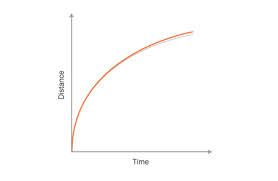
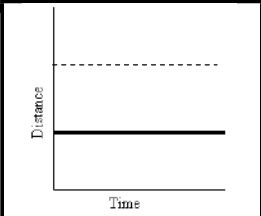
What does this graph represent?
a)
Constant Speed
b)
Acceleration
c)
Not moving
6.
What is the speed of an object that travels 60 meters in 4 seconds?
a)
240 m/s
b)
15 m/s
c)
0.067 m/s
d)
15 mph
7.
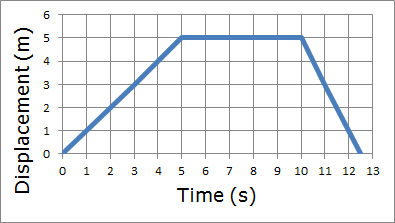
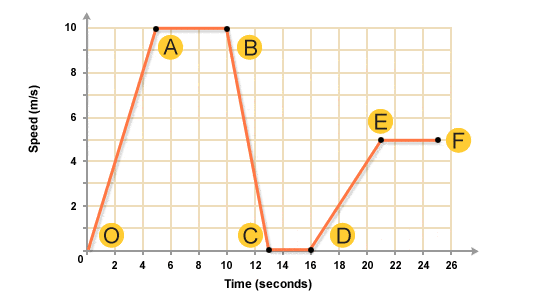
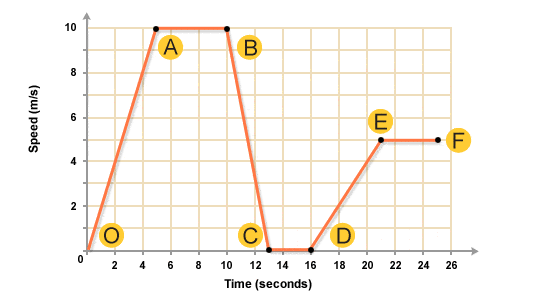
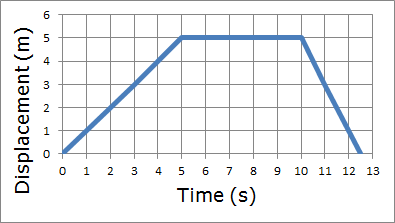
According to the graph how far does the person travel in the first 5 seconds?
a)
2 m
b)
10 m
c)
0 m
d)
5 m
8.
Which runner won the race?
a)
A
b)
B
c)
C
d)
It was a tie
9.
What is the person doing from 5 seconds to 10 seconds?
a)
Walking 
b)
Running
c)
Standing Still 
d)
Walking Fast
10.
A person walks 50 meters directly north, stops, and then travels 32 meters directly south.  What is their displacement?
a)
82 meters
b)
18 meters
c)
28 meters
d)
1.6 meters
11.
Which of the following represents a velocity?
a)
40 m
b)
40 m north
c)
40 m/s
d)
40 m/s north
12.
Find the velocity of a plane that traveled 3000 miles west in 5 hours.
a)
65 mph west
b)
6 mph west
c)
600 mph west
d)
6000 mph west 
13.
You walk 10 meters to math class in 20 seconds. Your average speed is
a)
2 m/s
b)
0.5 m/s
c)
200 m/s
d)
5 m/s
14.
Velocity is both ____ and _____. 
a)
speed , direction 
b)
direction, mass
c)
volume, density 
d)
direction, magnitude 
15.
What is the speed of a cheetah that travels 112.0 m in 4.0 s?
a)
0.0357 m/s
b)
28 m/s
c)
0.036 m/s
d)
28.0 m/s
16.
When you look at the speedometer of your car, it tells you your....
a)
Average speed
b)
Instantaneous speed
17.
David walks 3 km north, and then turns east and walks 4 km. What is the distance?
a)
7 km
b)
3 km
c)
4 km
d)
1 km
18.
Centripetal acceleration always points
a)
in the direction of the object's motion
b)
in the opposite direction of the object's motion
c)
towards the center of the circle
d)
towards the outside of the circle
19.
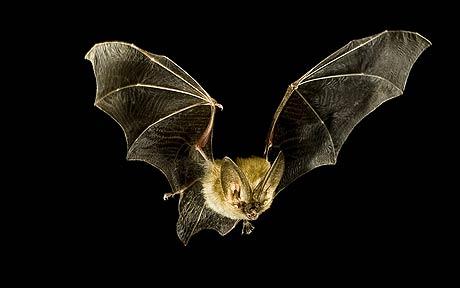
Bruno the bat flies at a speed of 0.5 m/s in circle of radius 1 m. What is his acceleration?
a)
0.25 ms-2
b)
0.5 ms-2
c)
1 ms-2
d)
2 ms-2
20.
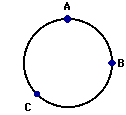
What is the direction of the velocity at point B, if the ball is revolving clockwise?
a)
up
b)
right
c)
down
d)
left
21.
The velocity is always _____ to the line of a circle. 
a)
outwards
b)
towards the center
c)
tangent
d)
faster
22.
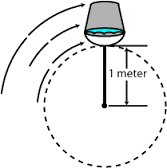
You swing a bucket of water attached to a string in a circle above your head. What keeps the water in the bucket?
a)
Friction
b)
Centripetal Force
c)
Gravity
d)
Inertia
23.
If the radius of the string is .3 meters long and the stopper makes 5 revolutions per second, what is the speed of the stopper? (Hint: C=2πr)
a)
9.4 m/s
b)
6.8 m/s
c)
11.7 m/s
d)
3.5 m/s
24.
Centrifugal force is a ______
a)
force that pushes you to the outside of a circle during uniform circular motion.
b)
fictitious force that is really just the linear momentum of an object in uniform circular motion.  
c)
The force that keeps the planets in orbit
25.

What's the centripetal acceleration of an object traveling 2.3 m/s around a circle of diameter 0.6 m?

a)

5 m/s2

b)

17.63 m/s2

c)

10 m/s2

d)

8.81 m/s2

26.
Calculate the velocity of an object moved around a circle with a radius of 1.65 m and an acceleration of 3.5 m/s2.
a)
2.4 m/s
b)
3.6 m/s
c)
3.9 m/s
d)
4.2 m/s
27.

A bicycle has a period of 0.3s . What is the

speed of its tires if their radius is 30 cm?

a)

6 m/s

b)

3 m/s

c)

60 m/s

d)

30 m/s

28.

The drum of a washing machine rotates 1800 times in 3 minutes. What is the period?

a)

0.1 s

b)

0.2 s

c)

0.3 s

d)

0.5 s

29.

A toy car is following a circular path with a constant speed of v=3 m/s . If the radius of the circular path is 1 m, find The centripetal acceleration of the car

a)

30 m/s2

b)

3 m/s2

c)

9 m/s2

d)

6 m/s2

30.

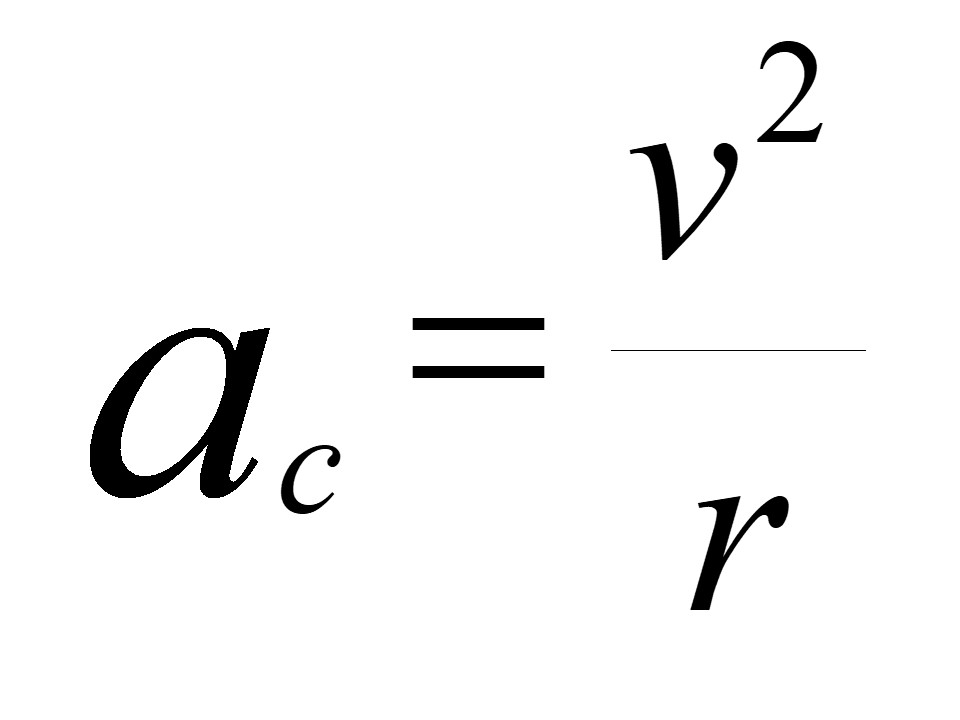
what is the centripetal acceleration formula?

a)
b)
c)
d)
31.

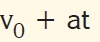
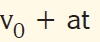
What is the velocity formula for uniform circular motion?

a)
b)
c)
d)
32.
Which of the following is the unit for centripetal force?
a)
J
b)
m/s2
c)
kg⋅m/s
d)
N
33.

A 10kg car travels at a constant speed of 20.0 m/s around a horizontal circular track. Which diagram correctly represent the direction of the car's velocity (v) and the direction of the centripetal force (Fc) acting on the car at a particular moment?

a)
b)
c)
d)
34.
Centripetal acceleration is ...
a)
Acceleration toward the center of a curved or circular path
b)
Acceleration toward the outside of a circle
c)
Vertical motion instead of horizontal motion
35.
Calculate the velocity of an object moved around a circle with a radius of 1.65 m and an acceleration of 3.5 m/s2.
a)
2.4 m/s
b)
3.6 m/s
c)
3.9 m/s
d)
4.2 m/s
36.
A test car moves at a constant speed around a circular track.  If the car is 48.2 m from the track's center and has a centripetal acceleration of 8.05 m/s2, what is the car's tangential speed?
a)
19.7 m/s
b)
5.99 m/s
c)
0.17 m/s
d)
388.01 m/s
37.
The time taken for one complete circuit is called the... 
a)
Period
b)
Frequency 
c)
Angular velocity
38.
The time taken for one complete circuit is called the... 
a)
Period
b)
Frequency 
c)
Angular velocity
39.

A rope attaches a tire to an overhanging tree limb. A girl swinging on the tire has a centripetal acceleration of 3.0 m/s2. If the length of the rope is 2.1 m, what is the girl’s tangential speed?

a)

3.5 m/s

b)

2.5 m/s

c)

8.5 m/s

d)

12.5 m/s

40.
What is this graph showing?
a)
Constant Speed
b)
Acceleration (speeding up)
c)
Deceleration (slowing down)
d)
No motion
41.
What does this graph represent?
a)
Constant speed
b)
Acceleration
c)
Not moving
42.
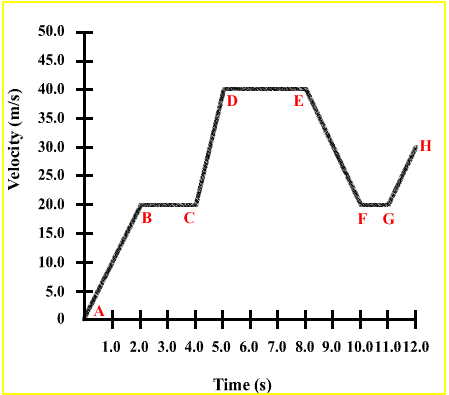
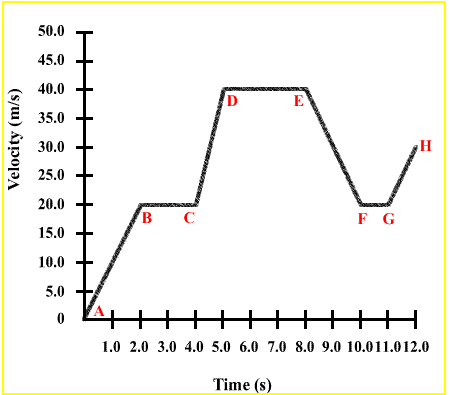
Which section of the graph shows acceleration?
a)
AB
b)
BC
c)
EF
d)
FG
43.
Which section of the graph shows constant velocity?
a)
AB
b)
BC
c)
EF
d)
GH
44.
What is happening in this graph from point A to B?
a)
The object is accelerating.
b)
The object is not moving.
c)
The object is decelerating.
d)
The object is moving at a constant speed.
45.
What is happening in this graph from point B to C?
a)
The object is going down a hill.
b)
The object is returning to its starting location.
c)
The object is slowing down.
d)
The object is staying still.
46.
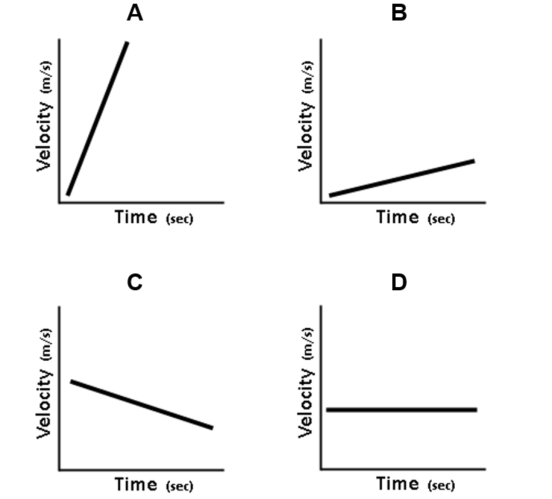
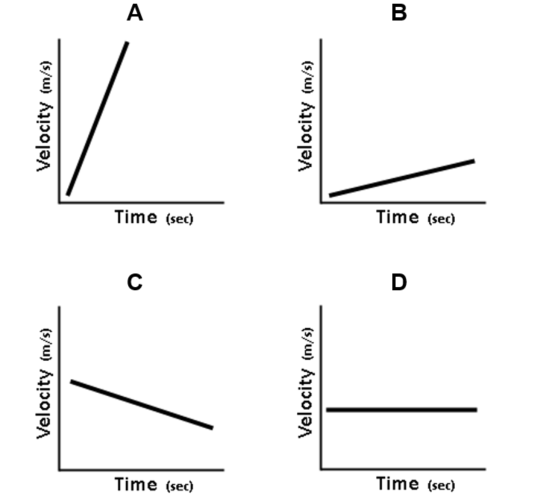
Which graph represents the greatest acceleration?
a)
A
b)
B
c)
C
d)
D
47.
Which graph represents zero acceleration (constant velocity)?
a)
A
b)
B
c)
C
d)
D
48.
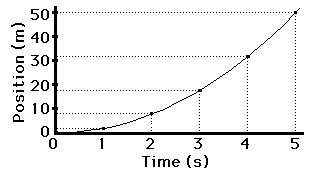
The picture of the position vs. time graph shows an object that is...
a)
accelerating/speeding up
b)
moving at a constant speed 
c)
not moving 
d)
accelerating/slowing down. 
49.
When are you undergoing an acceleration in a car? 
a)
speed up
b)
slow down
c)
make turns
d)
All of the above 
50.
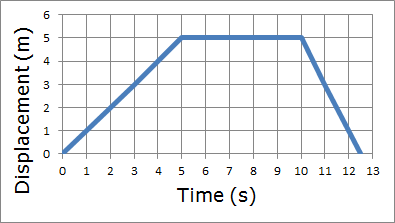
What is the person doing from 5 seconds to 10 seconds?
a)
Walking 
b)
Running
c)
Standing Still 
d)
Walking Fast
51.
If you double the mass of an object with the same force apply on it, the acceleration will
a)
double
b)
cut in half
c)
the same
d)
zero
52.
What kind(s) of objects have inertia?
a)
all objects with mass
b)
only objects at rest
c)
only objects in motion
d)
only objects whose motion is being changed
53.
Which one needs a greater net force to move, a kilogram of feathers or a kilogram of iron? 
a)
feathers 
b)
iron
c)
same
d)
depends on their friction
54.
After a cannonball is fired into frictionless space, the amount of force needed to keep it going equals
a)
twice the force with which it was fired
b)
the same amount of force with which it was fired
c)
1/2 the force with which it was fired
d)
zero, since no force is required to keep it moving. 
55.
The acceleration produced by a net force on an object is
a)
inversely proportional to the mass of the object.
b)
directly proportional to the magnitude of the net force.
c)
in the same direction as the net force.
d)
 all of the above
56.
Which of the following shows the direction of the friction force?
a)
A
b)
B
c)
C
d)
D
57.
What is happening at D?
a)
Stationary
b)
Accelerating
c)
Fast steady speed; moving away from the starting position
d)
Slower steady speed; moving away from the starting position
58.
What is happening at C?
a)
Stationary
b)
Accelerating
c)
Fast steady speed; moving away from the starting position
d)
Slower steady speed; moving away from the starting position
59.
What is the net force?
a)
5000 N right
b)
4000 N right
c)
40 N left
d)
4000 N left
60.
What is the difference between mass and weight?
a)
mass is how much matter is in an object, and weight is the gravitational pull on that object
b)
mass and weight are the same
c)
weight affects how much mass is in an object
d)
weight is determined by how many atoms make up an object
61.
The tendency of an object to stay in motion or at rest is called 
a)
velocity
b)
acceleration
c)
speed
d)
inertia
62.
Which one of Newton’s Laws of Motion best explains why the dishes do not move when the table cloth is removed?
a)
Newton's 1st Law
b)
Newton's 2nd Law 
c)
Newton's 3rd Law 
d)
Newton's Law of Biology
63.
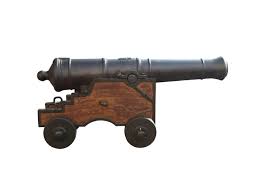
When a cannon fires a cannonball we observe Newton's third law. Which force is the reaction force?
a)
The cannon moving forward
b)
The cannonball moving forward
c)
The cannon moving backward
d)
The cannonball moving backward
64.
A 20 kg bike accelerates at 10 m/s2.  what was the net force
a)
25 Newtons
b)
20 Newtons
c)
200 Newtons
d)
10 Newtons
65.
A book weighs 4 N. When held at rest in your hands, the net force on the book is
 
a)
0 N.
b)
 0.4 N.
c)
 4 N.
d)
 39 N.
66.
During which interval is the object not moving?
a)
B to C
b)
C to D
c)
D to E
d)
only at point A
67.
During which interval is the object traveling at a constant velocity?
a)
B to C
b)
D to E
c)
F to G
d)
it traveling at a constant velocity during all of the intervals shown.
68.
Friction is a force that acts in an ___________ direction of movement.
a)
similar
b)
opposite
c)
parallel
d)
west
69.
The amount of friction depends on the weight of the objects pressing together.
a)
True
b)
False
70.
What type of friction is not moving?
a)
static
b)
sliding
c)
fluid
d)
rolling
71.
How can friction be reduced?
a)
reduce the force acting between the 2 surfaces
b)
reduce the roughness of the 2 surfaces coming in contact
c)
use wax, grease or oil
d)
all of the above are ways of reducing friction
72.
A type of friction that occurs when air pushes against a moving object causing it to decelerate.
a)
surface area
b)
air resistance
c)
velocity
d)
gravity 
73.
Which of the following is an example of friction that is helpful?
a)
Brakes used on a bike
b)
Tires from a car on the road
c)
Tread on the bottom of your shoes
d)
All are examples that are helpful
74.
Which of the following is an example of friction that is harmful?
a)
Pencil marking on paper
b)
Engine parts wearing out
c)
sand placed on ice in the winter
d)
Using an eraser to erase marks
75.
How would the absence of friction affect a marble traveling on a long, straight path?
a)
The marble’s speed would decrease.
b)
The marble’s speed would increase.
c)
The marble would stop immediately. 
d)
The marble would remain at constant speed.
76.
When two surfaces rub, the irregularities of one surface get caught on those of the other surface?
a)
True
b)
False
77.
Rougher surfaces have ...
a)
greater friction
b)
less friction
c)
the same level of friction
78.
Determine the momentum of 1000-kg car moving northward at 20 m/s......... 
a)
20000 N
b)
20000 Joules
c)
20000 Kg * m/s
d)
20000 kg * m/s north
79.
A 0.250 kg cart moving at 0.400 m/s has how much momentum?
a)
0.1 kg-m/s
b)
1 kg-m/s
c)
10 kg-m/s
d)
100 kg-m/s
80.
What is the unit for mass?
a)
m/sec
b)
kg/sec
c)
kg
d)
kg m/sec
81.
What is the unit for velocity?
a)
m/sec
b)
kg/sec
c)
kg/m
d)
kg m/sec
82.
What is the unit for momentum?
a)
m/sec
b)
kg/sec
c)
kg/m
d)
kg m/sec
83.
Which of the following has the least amount of momentum?
a)
An ant walking along the ground
b)
An ant at rest
c)
An elephant walking
d)
An elephant running
84.
Which object listed below has the greatest momentum?
a)
A 0.05 kg object rolling at 0.2 m/s.
b)
A 0.15 kg object rolling at 2 m/s.
c)
A 0.15 kg object rolling at 1 m/s
d)
A 0.4 kg object rolling at 2 m/s.
85.
When the speed of an object is doubled, its momentum
a)
remains unchanged in accord with the conservation of momentum.
b)
doubles
c)
quadruples
d)
decreases
86.
Which of the following has the greatest momentum? 
a)
a scurrying cockroach
b)
a parked semi-truck
c)
more information is needed
87.
When two objects collide, the Pbefore is ____________ the Pafter.
a)
more than 
b)
less than 
c)
equal to
d)
unrelated to
88.
In any collision (crash) the ______ is ALWAYS constant
a)
Total Momentum
b)
total speed
c)
total Velocity
d)
Energy
89.
The impulse is ______ the change in momentum
a)
Greater than
b)
Equal to
c)
less than
d)
always double
90.
A boy kicks a football with a force of 20 N, the time the force acts for is 0.3 s.
Calculate the impulse on the ball.
a)
1 N*s
b)
6 N*s
c)
33.3 N*s 
d)
None of these
91.
Momentum is a ____________________ quantity
a)
science
b)
scalar
c)
vector
d)
energy
92.
A 9300 kg railroad car traveling at a velocity of 5 m/s strikes a second boxcar that weighs 5000 kg at rest. At what speed will the second boxcar move?
a)
18.6 m/s
b)
9.3 m/s
c)
7.5 m/s
d)
1.86 m/s
93.
The equation to calculate momentum is
a)
p=mv
b)
p=1/2mv2
c)
p=mgh
d)
p=mg
94.
Which has more momentum: a car stopped at a red light or a bike moving at 15 mph?
a)
car
b)
bike
c)
they are equal
d)
cannot determine using the info provided
95.
Determine the momentum of 1000-kg car moving southward at 20 m/s......... 
a)
20000 N
b)
20000 Joules
c)
20000 Kg * m/s south
d)
10000 kg * m/s south
96.
The more mass an object has, the faster it will fall.
a)
True
b)
False
97.
If you throw a baseball straight up, what is its velocity at the highest point?
a)
9.8 m/s2
b)
9.8 m/s
c)
0 m/s2
d)
0 m/s
98.
If you throw a baseball straight up, what is its acceleration at the highest point?
a)
9.8 m/s2
b)
9.8 m/s
c)
0 m/s2
d)
0 m/s
99.
What is the horizontal acceleration of a projectile?
a)
0 m/s2
b)
9.8 m/s2
100.
What is the vertical acceleration of a projectile?
a)
0 m/s2
b)
9.8 m/s2
101.
An object is projected horizontally from a cliff.  The time it takes to hit the ground is
a)
more than if it was just dropped
b)
less than if it was just dropped
c)
the same amount of time than if it was just dropped
d)
impossible to determine
102.
If I throw a crayon straight up at 12m/s, how fast is its speed when i catch it at the same height?
a)
6 m/s
b)
12 m/s
c)
18 m/s
d)
24 m/s
103.
As an object travels through the air, its vertical velocity 
a)
changes continuously
b)
remains the same
104.
An object is shot from the ground (at 25 m/s) at 25 degrees and 65 degrees.  Which one has the greater range?   (assume no air resistance)
a)
25 degrees
b)
65 degrees
c)
same for both
105.
An object is shot from the ground (at 25 m/s) at 25 degrees and 65 degrees.  Which is in the air for longer? (assume no air resistance)
a)
25 degrees
b)
65 degrees
c)
same for both
106.
If a bullet is horizontally shot at the same moment another bullet is dropped from the same height, which will hit the ground first?
a)
Shot Bullet
b)
Dropped Bullet
c)
Hit at Same Time
107.
Consider drops of water leaking from a water faucet. As the drops fall they 
a)
remain at a relatively fixed distance from each other
b)
get farther apart
c)
get closer together
108.
Two balls of the same mass begin at a height of 2m. One is released from rest while the other begins with a horizontal velocity of 5m/s. Which object its the ground first?
a)
Ball A
b)
Ball B
c)
Both balls his the ground at the same time
d)
unable to determine with information given
109.
Two objects - one with mass m and the other with mass 2m - are released from rest at the same height. Which object hits the ground first?
a)
mass m
b)
mass 2m
c)
both objects hit the ground at the same time
d)
unable to determine with information given
110.
Two objects of the same mass are launched from the ground. Object A has a launch angle of 45, while Object B has a launch angle of 65. Which object has the greatest maximum height height?
a)
A
b)
B
c)
Both objects reach the maximum height
d)
unable to determine with the given information
111.
Two objects of the same mass are launched from the ground. Object A has a launch angle of 45, while Object B has a launch angle of 65. Which object will hit the ground first?
a)
A
b)
B
c)
Both objects hit the ground at the same time
d)
unable to determine with the given information
112.
According to Newton's First Law, an object at rest will tend to do which of the following?
a)
stay at rest
b)
stay in motion
c)
speed up
d)
change in direction
113.
According to Newton's First Law, an object in motion will tend to:
a)
stay at rest
b)
stay in motion
c)
change in direction
d)
slow down
114.
Which of the following could cause an acceleration?
a)
A balance between two forces
b)
A balance between three forces
c)
An imbalance between two forces
d)
Zero forces
115.
Multiplying the mass and acceleration of an object would give you:
a)
the force of gravity
b)
the force of friction
c)
the velocity
d)
the net force
116.
Which of the following is always true?
a)
Fnet = ma
b)
Fnet = m + a
c)
Fnet = m - a
d)
Fnet = m/a
117.
We often say that g = -9.8 m/s2. The lowercase g represents:
a)
the speed of gravity
b)
the velocity of gravity
c)
the acceleration of gravity
d)
the force of gravity
118.
Multiplying the mass and acceleration of an object would give you:
a)
the force of gravity
b)
the force of friction
c)
the velocity
d)
the net force
119.
A book rests on a table. The normal force points:
a)
Up
b)
Down
c)
Left
d)
Right
120.
There is a small amount of friction as the sled shown is pulled to the left. The friction points:
a)
up
b)
down
c)
left
d)
right
121.
Gravity pulls an object down with 49 N of force and a rope pulls the object up with 50 N of force. What is the net force?
a)
1 N upward
b)
1 N downward
c)
0.98 N upward
d)
0.98 N downward
122.
A child pulls on a toy with a force of 25 N to the right. Another child pulls the toy with 15 N to the left. The net force is:
a)
1.7 N to the right
b)
1.7 N to the left
c)
10 N to the right
d)
10 N to the left
123.
A rabbit pushes down on a turtle. What is the reaction force?
a)
The turtle pushes down on the ground.
b)
The ground pushes up on the turtle.
c)
The air pushes down on the rabbit.
d)
The turtle pushes up on the rabbit.
124.
The same force acts on a heavy mass and a light mass. Which has a greater acceleration?
a)
The light mass
b)
The heavy mass
c)
They have the same acceleration.
d)
Neither will move.
125.
An object weighs 100 N on Earth. To find the object's mass, one should:
a)
multiply by 9.8
b)
divide by 9.8
c)
multiply by 1.6
d)
divide by 1.6
126.
A person stands on a scale in an elevator. If the elevator accelerates upward, what happens to their "weight"?
a)
Their "weight" increases.
b)
Their "weight" stays the same.
c)
Their "weight" decreases.
d)
Their "weight" changes to a negative value.
127.
A wrench is used to tighten a nut. A 15N perpendicular force is applied 50cm away from the axis of rotation, and moves a distance of 10 cm as it turns. What is the torque applied to the wrench?
a)
7.5 Nm
b)
1.5 Nm
c)
750 Nm
d)
150 Nm
128.
The easiest way to open a heavy door  is by applying the force
a)
Near the hinges
b)
In the middle of the door
c)
At the edge of the door far from the hinges
d)
At the top of the door
129.
A 800N man is playing on a seesaw with son who has a weight of 200N. If the child is sitting 3 meters away, how far will the man have to sit to balance the seesaw?
a)
0.75m
b)
3m
c)
1.5m
d)
1m
130.

What is Sir Issac Newton most famous for

a)

Laws of gravity to explain planet movements

b)

Laws of projectile motions

c)

Laws of inertia

d)

Laws of apples