
Font size
 Worksheets
KS3 Light
Total questions: 60
Worksheet time: 42mins

Which statement is true for refraction of light? Choose 2 answers.
When it enters a denser medium (e.g. from air to glass), it changes direction towards the normal.
When it enters a denser medium (e.g. from air to glass), it changes direction away from the normal.
When it enters a less dense medium (e.g. from glass to air), it changes direction towards the normal.
When it enters a less dense medium (e.g. from glass to air), it changes direction away from the normal.

The angle of incidence is _________ the angle of reflection


Image
Reflection
Shadow
Colour
Which of the following does not have light of its own?
a torch
a lamp
the moon
the sun
Opaque is?
Material that allows light to pass through
Light made by nature
Material that allows no light to pass through

Why does the cat form a shadow?
It reflects light
It blocks light
How does the light enter the pinhole camera?
through a lens
through a mirror
through a small hole
through a prism
When the light hit an opaque object, what happens to it?
it is scattered in all directions
some of it is absorbed, some of it is transmitted
All of it is absorbed
All of it is reflected
When an angle of incidence is increased, what happens to the angle of reflection?
it increases
it decreases
it stays the same
it becomes more diffuse
When white light strikes a blue object, which color(s) is/are absorbed?
None of the colors are absorbed but blue
Some of the red
Mostly the green
all colors are absorbed but blue


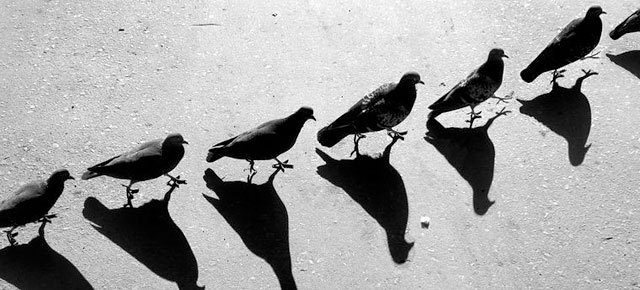


Light travels... (select 2 answers)
Around corners
In straight lines
Faster in glass than in air
Faster than sound
The speed of light is.....
300,000,000m/s
340m/s
1500m/s
5000m/s
The speed of sound in air is.....
1500m/s
340m/s
5000m/s
300,000,000m/s

In the diagram, which letter represents the angle of incidence?
A
B
C
D
Nothing can travel faster than light in the whole universe
False
True


What is happening to the light ray at the surface of the water to mean the fish appears higher up than it is?
The light ray is reflecting
The light ray is refracting
The light ray is scattering
The light ray is absorbed
If I shine white light at a red filter, what will I see the other side of the filter?
White light
No light
Red light
Yellow light
Which figure represents the path light takes through a converging lens?
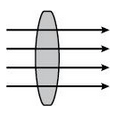
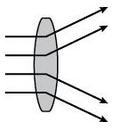
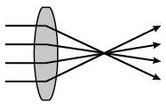
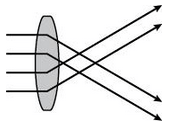

What does "refraction" mean?
The change of direction of a light ray
The increase of mass in an object
The increase of temprature
The way a luminous object reflects light
What is are the 2 different types of reflection?
Reflected Ray / Rough Surface
Specular Scattering
Specular Reflection / Diffuse Scattering
Rough Transprent / Diffuse Surface
What are the 2 different types of lenses?
Convex / Converge
Coverage / Conrage
Croex / Contage
PLANE MIRROR
SPECULAR
DIFFUSE
WAVY SEA
SPECULAR
DIFFUSE
SNOW
SPECULAR
DIFFUSE
GLARE ON PAIR OF EYEGLASSES
SPECULAR
DIFFUSE
The ray of light leaving the mirror
The ray of light approaching the mirror/the ray given off from a light source

The picture shows which type of reflection?
Specular Reflection
Optical Reflection
Diffuse Reflection
Scatter Reflection

The angle between the incident ray and the normal. (X on the diagram) is called the:
Angle of Optic Sight
Angle of Reflection
Angle of Incidence
Angle of Normal

The angle between the reflected ray and the normal (labelled Y on the diagram) is called the:
Angle of Incidence
Angle of Reflection
Angle of Normal
Angle of Optic Sight

An imaginary line that is drawn at a right angle (90 degrees) to a mirror (Green line) is called the:
Reflected Ray
Normal
Incident Ray
Perpendicular Ray

When light reflects off of a completely smooth surface it is called:
Diffuse Reflection
Optical Reflection
Smooth Reflection
Specular Reflection

If the angle of incidence in the diagram is 80°, the angle of reflection will be:
10°
100°
90°
80°
Opaque
Materials light cannot pass through
Lens
Piece of glass that focuses light
Specular
Reflection from a smooth surface
Luminous
Something that gives out light
Normal
Imaginary lines at right angles to a surface
what are primary colors
red
purple
yellow
blue


This polar bear is happy because someone gave him a pumpkin to play with. But, this polar bear is sad because it looks like his head is no longer attached to his body. :( What property of light creates this optical illusion?
Refraction
Reflection
Transparency
Opaqueness

Reorder the sentences to show the process of how the eye enables us to see objects.
Light enters the eye through the pupil
The size of the pupil is altered by the iris
The cornea and lens, focus light onto the retina
The retina contains two light sensitive cells called rods and cones. When light hits these cells, chemical reactions produce electrical impulses that travel via the optic nerve to the brain
Label the different part of the eye

