
 Worksheets
CHAPTER 7 GASEOUS EXCHANGE (Week 11)
Total questions: 10
Worksheet time: 5mins
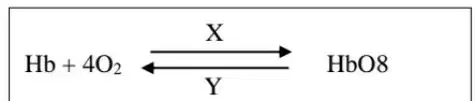
2. The following reaction shows the affinity of haemoglobin towards oxygen in animal tissues under condition X and Y.
A. X = High partial pressure of O2 Y = Low partial pressure of CO2
B. X = High partial pressure of O2 Y = High partial pressure of CO2
C. X = Low partial pressure of O2 Y = High partial pressure of CO2
D. X = High temperature Y = Low hydrogen ion concentration
3. One molecule of haemoglobin consists of
A. One polypeptide subunit, one haem group, one Fe2+ ion
B. One polypeptide subunit, one haem group, four Fe2+ ion
C. Four polypeptide subunits, four haem group, four Fe2+ ion
D. Four polypeptide subunits, four haem groups, one Fe2+ ion
4. Where does gas exchange take place in the lungs?
A. Alveolus
B. Bronchus
C. Bronchiole
D. Trachea
5. What is the most important chemical stimulus in regulating the rate of respiration?
A. O2 concentration
B. CO concentration
C. CO2 concentration
D. N2 concentration
6. What is a chemoreceptor?
A. A sensory receptor that responds to a chemical stimulus.
B. A sensory receptor that control the respiration in human.
C. A sensory receptor that responds to the pressure of CO2 in human blood.
D. A sensory receptor that connect to breathing control centre.
7. The two types of chemoreceptors are
A. Phrenic nerve and thoracic nerve.
B. Intercostal muscle and diaphragm.
C. Aortic bodies and carotid bodies.
D. Central chemoreceptor and peripheral chemoreceptor.
8. Breathing centre communicate with the following effectors via which nerves?
A. Diaphragm : phrenic nerve
External intercostal muscle : vagus nerve
B. Diaphragm : vagus nerve
External intercostal muscle : intercostal nerve
C. Diaphragm : phrenic nerve
External intercostal muscle : thoracic nerve
B. Diaphragm : intercostal nerve
External intercostal muscle : Phrenic nerve
9. All the following statements are the function of central chemoreceptor EXCEPT
A. To ensure O2 delivery to nervous system
B. Responds to changes in CO2 concentration in cerebrospinal fluid.
C. Monitors pH in cerebrospinal fluid.
D. Controls the concentration of CO2 in cerebrospinal fluid.
10. The opening of stomata is regulated by ....
A. the accumulation of K+ ions in guard cell.
B. the accumulation of K+ ions in epidermis cell.
C. the absence of light
D. the uneven thickness of guard cell's walls.

