
 Worksheets
Animal and Plant Classification
Total questions: 43
Worksheet time: 22mins
Animals that usually have the same body temperature, regardless of their surroundings are called:
terrestrial
aquatic
warm-blooded
cold-blooded

Mammal
Bird
Fish
Reptile
Amphibian
How would you classify pelicans, robins, and seagulls?
invertebrate
fish
bird
mammal
Why are nonvascular plants so small?
because they don't have tubes to easily transport nutrients
because they don't need to get sunlight for photosynthesis
because they are spending their energy producing cones instead of growing tall
because they don't have room to grow taller
How is a jellyfish and shark different.
A shark is the animal kingdom
A shark has a backbone.
A shark is cold-blooded
Shark lives in water.

Study the drawings of parts of a pumpkin plant.
Which plant would scientists group with pumpkin plants?
fern
moss
pine tree
apple tree
Which statement about vascular plants is NOT true?
They can grow to be quite large.
They have tissue that carries food.
They are much smaller than nonvascular plants.
They absorb water through roots.

Algae
Moss
Fern
Flowers
Breathe with gills
Have fins and scales
Live in water
Are cold-blooded
Usually lay gelatinous eggs
Mammal
Bird
Fish
Reptile
Amphibian
Apple trees and roses are examples of plants that make seeds by using flowers.
True
False
Which is NOT true of a horse, cat, and pig.
They are warm-blooded.
They breathe through lungs.
They have scales.
They have live babies.
Pine trees are classified as ____________________ producers without using flowers
Seed
Non-seed

Use the chart to answer the question.
Which animal in the chart is a bird?
Animal 1
Animal 2
Animal 3
Animal 4


What group would this plant be classified under?
Vascular Flowering
Vascular Nonflowering
Vascular Seedless
Non-Vascular
Which of the following statements is true about mammals and birds, but not true about reptiles.
Birds and mammals are warm-blooded
Birds and mammals give live birth
birds and mammals have feathers
birds and mammals have backbones

Which of these is an example of an nonvascular plant?
A-pine tree
B-flower
C-moss
D-fern
Have scaly skin
Live on land
Are cold-blooded
Usually lay leathery eggs
Mammal
Bird
Fish
Reptile
Amphibian

Mammal
Bird
Fish
Reptile
Amphibian
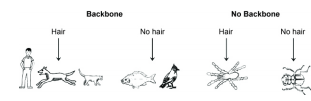
According to the classification key above, which pair of animals could be classified as mammals?
humans and dogs
birds and fish
birds and fish
cats and birds
One important way that scientists classify plants is by how they receive water. Which statement below is NOT true about how vascular plants receive water?
Vascular plants receive water by absorbing it from their surroundings.
Vascular plants receive water through tubes.
Vascular plants can receive water through their roots, stems, and leaves.
Vascular plants receive water and nutrients through tubes in the roots.

Mammal
Bird
Fish
Reptile
Amphibian

What group would the green substance belong to?
Vascular Flowering
NonVascular NonFlowering
Vascular Seedless
NonVascular
Which group has the largest number of animal species?
Invertebrates
Mammals
Protists
Vertebrates
I am cold blooded and live both on land water. I have moist skin, a backbone and lay jelly coated eggs in the water. What am I?
A reptile
An amphibian
A mammal
A fish
Live in water when they are young (breath with gills)
Live on land when they are adults (breath with lungs)
Are cold-blooded
Have smooth, moist skin
Lay jellylike eggs without shells
Mammal
Bird
Fish
Reptile
Amphibian
Tommy was watching an animal outside his classroom window. He took these notes:
- The animal has a backbone
- It lives on land.
- It bears live young.
- It has hair.
What is the classification of this animal?
reprile
bird
mammal
amphbian
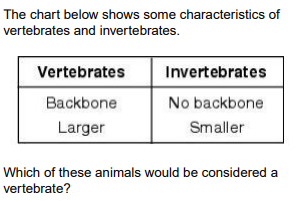
fish
clam
sponge
octopus
Have two legs, feathers, and wings
Breath with lungs
Eat with a bill or beak
Are warm-blooded
Have hollow bones and most can fly
Lay hard-shelled eggs
Mammal
Bird
Fish
Reptile
Amphibian
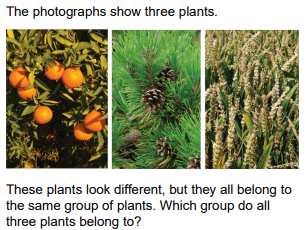
plants that produce seeds
plants that produce flowers
plants that produce spores
plants that produce needles

Mammal
Bird
Invertebrate
Reptile
Amphibian
Which statement about the earthworm and snake is true?
Both are invertebrates because neither has eggs.
The worm is an invertebrate because it has shiny skin.
Both are vertebrates because both have a head and a tail.
The snake is a vertebrate because it has a flexible backbone.
Scientists sort animals into two groups, vertebrate and invertebrate. They discovered a new organism. Its babies are born alive, drink milk from the mother's body, and have fur on their bodies. They are warm-blooded and breathe with lungs. How would these animals be classified?
as a vertebrate and a reptile
as a vertebrate and a fish
as a vertebrate and a mammal
as an invertebrate and a mammal
Which of the following is a characteristic of mammals?
they do not have backbones
they give birth to live young
Their body temperature changes depending on their surroundings
they are single celled organisms
Which of the following questions could we ask to distinguish a mammal, such as a monkey, from a reptile, such as a crocodile.
Does the animal have four limbs?
Does the animal lay eggs to reproduce?
Does the animal consume food for energy?
Does the animal have a backbone?
If a plant has no true roots, stems, or leaves what term would best describe the plant?
Nonvascular
Wilted
Flowering
Vascular
Non-vascular plants must have
a host that is shady and moist to live, such as a shady damp rock.
have a dry area in order to survive.
a strong root system.

Which of these organisms is an arthropod?
A-butterfly
B-worm
C-fish
D-clam
Which correctly compares a fish and a bird?
Birds are warm-blooded and fish are warm-blooded.
Birds breathe through lungs and fish breathe through gills.
Birds have live births and fish lay eggs
Which group best describes this animal? The animal lays eggs and has scaly skin. The animal does not breath through gills, does not fly, is not warm blooded, and does not have fur on its body.
Mammal
Amphibian
Fish
Reptile

Which of the following contains the largest group of organisms?
Vertebrates
Invertebrates
An animal without a backbone is called a
vertabrate
invertebrate
non-vascular
vascular
If you are creating a model to classify organisms, which three factors should you include in your model to classify vertebrates?
What they eat, how they breath, and where they can be found
How they breath, how they move, and how their body temperature is controlled
Where they can be found, how they move, and what they eat
how they breath, what their body is covered with and how their body temperature is controlled.

