wayground logo

Free Printable Worksheets

Font size

S
M
L
XL
Worksheets

B2A2 8.1 - 8.2 Quiz Review

Total questions: 136

Worksheet time: 7hrs 21mins
Name
Class
Date
1.
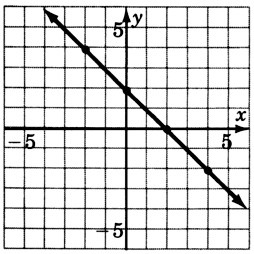
Which equation is being represented by this line?
a)
y = -1x + 2
b)
y = 1/2x + 2
c)
y = 3x -4
d)
y = -3x +2
2.
Find the x and y intercepts
4x - 5y = 40
a)
x intercept is 10 
y intercept is 8
b)
x intercept is 10
y intercept is 20
c)
x intercept is 8
y intercept is 10
d)
x intercept is 10
y intercept is -8
3.
Which equation best represents the line on the graph?
a)
y= 1/2x
b)
y= -1/2x
c)
y = 2x
d)
y = -2x
4.

Find the slope of the line.

a)

3/2

b)

-43/2

c)

2

d)

-2

5.
Find the value of y when x = 2.
a)
2
b)
6
c)
7
d)
8
6.
Find the slope of the line.
a)
Undefined
b)
0
c)
1/1
d)
-1/1
7.
Which equation represents the graph?
a)
x = 2
b)
y = 2
c)
y = 2x
d)
y = undefined
8.
Which equation is written in STANDARD form?
a)
y = 1/2x + 2
b)
y - 3 = -5(x + 2)
c)
-7x + 2y = 9
d)
3x + 2 = y
9.

Graph

a)
b)
c)
d)
10.
a)

y=1/2x+5

b)

y=-1/2x+5

c)

y=-1/2x-5

d)

y=1/2x-5

11.
a)

y=-4x-12

b)

y=4x+12

c)

y=-4x+12

d)

y=-4x+3

12.
The graph of a linear function is always straight?
a)
true
b)
false
13.
What does "m" represent in y=mx+b?
a)
y-intercept
b)
slope
c)
macaroni
d)
nothing
14.

What is 'b' in this linear equation? y= 5x - 6

a)

6

b)

5

c)

y

d)

-6

15.
Which graph represents x=2?
a)
A
b)
B
c)
C
d)
D
16.
Which of these represents slope-intercept form?
a)
y - y1 = m(x-x1)
b)
Ax + By = C
c)
y = mx + b
17.

What is the slope of the graph?

a)

-2

b)

2

c)

1/2

d)

-1/2

18.

The starting point in a situation is represented by the _______________

a)

slope

b)

y-intercept

c)

m

d)

x value

19.

If m=3 and b=6, what is the correct slope intercept equation?

a)

y=3-6

b)

y=3x-6

c)

y=3x+6

d)

y=6x+3

20.

How would you write the equation with a slope of -3 and a y-intercept of 1

a)

y= -3x + 1

b)

y= -x - 3

c)

y= -3x - 1

d)

y= x + 3

21.

How would you write the equation with a slope of 4/5 and a y-intercept of -1

a)

y= -x + 4/5

b)

y= x + 4/5

c)

y= 4/5x - 1

d)

y= 2/5x + 4/5

22.
Write in slope intercept form
5x - 3y = -9
a)
y = (5/3)x - 3
b)
y = (5/3)x + 9
c)
y = (5/3)x + 3
d)
y = (3/5)x + 3
23.

This line has a __________ slope.

a)

Negative

b)

Positive

c)

Undefined

d)

No Slope

24.
Write the equation in point-slope form of the line that passes through the given point and has the given slope.
(4, -7); m = -1/4
a)
y + 7 = -1/4(x - 4)
b)
y - 4 = -1/4(x + 7)
c)
y + 7 = 4(x - 4)
d)
y - 7 = -1/4(x - 4)
25.
Write the equation of the line in Point-Slope form that goes through the point (10,5) and has a slope of -3
a)
y - 5 = -3(x - 10)
b)
y= -3x + 35
c)
y + 5= -3(x + 10)
d)
y= -3x - 35
26.
Write an equation  
m = 5 through (-1, -3)
a)
y = 5x + 2
b)
y = -5x - 5
c)
y = -5x + 2
d)
y = 2x - 5
27.
For the equation
y + 1 = -3 (x - 5),
the line contains the point (5, -1) and has a slope of?
a)
-1
b)
1
c)
-3
d)
5
28.

What is the equation of the line y + 5 = -3(x - 6) in slope intercept form?

a)

y = -3x - 23

b)

y = -3x -13

c)

y = -3x - 11

d)

y = -3x+13

29.
Which of these represents point-slope form of a linear equation?
a)
y - y1 = m(x - x1)
b)
Ax + By = C
c)
y = mx + b
d)
y=kx
30.
For the equation
y - 3 = 2(x + 4),
the line has a slope of 2 and contains what point?
a)
(-4, 3)
b)
(3, -4)
c)
(-3, -4)
d)
(-4, -3)
31.
Write the equation in point-slope form for the line that contains the points
(-2, -3), (4, 3)
a)
y - 3 = 1(x - 2)
b)
y + 3 = 1(x + 2)
c)
y -3 = -1(x + 2)
d)
y + 3 = -1(x - 2)
32.
For the equation 
y - 4 = -1/3(x - 7), 
what are the coordinates for the point?
a)
(4, 7)
b)
(-7, - 4)
c)
(7, 4)
d)
(-4, -7)
33.
Write the equation in slope-intercept form for the line that contains the points
(3, -5) and (5, - 1)
a)
y = 2x + 11
b)
y = 2x + 1
c)
y = 2x - 1
d)
y = 2x - 11
34.
Write the equation in point-slope form of the line that passes through the given point and has the given slope:
 (-2, -1); m= -3
a)
y + 1 = -3(x - 2)
b)
y + 1 = -3(x + 2)
c)
y - 1 = 3(x - 1)
d)
y + 2 = -3(x + 1)
35.

What is the point slope form equation through the point (4, -8) with a slope of -2?

a)

y4 = 2(x8)y-4\ =\ -2\left(x-8\right)

b)

y+4 = 2(x+8)y+4\ =\ -2\left(x+8\right)

c)

y+8=2(x4)y+8=-2\left(x-4\right)

d)

y8=2(x+4)y-8=-2\left(x+4\right)

36.

What is the slope of the following equation?


y4=(x+2)y-4=-\left(x+2\right)  

a)

1

b)

-1

c)

2

d)

-4

37.

y+8=3(x5)y+8=3\left(x-5\right)  

If the slope is 3 in the following equation, what is the point?

a)

(5, -8)

b)

(5, 8)

c)

(-5, 8)

d)

(-5, -8)

38.

y+3=4(x9)y+3=-4\left(x-9\right)  

If the slope is -4 for the following equation, what is the point?

a)

(-9, 3)

b)

(-9, -3)

c)

(9, 3)

d)

(9, -3)

39.

Write the linear equation in y = mx + b form using the given points.

a)

y = -2x + 1

b)

y = -3x + 1

c)

y = 2x + 1

d)

y = 3x - 1

40.

Write the linear equation in y = mx + b form using the given points.

a)

y = -2x + 1

b)

y = 1/2x - 2

c)

y = 2x - 1

d)

y = -1/2x + 2

41.
Write an equation in slope-intercept form from the points (0, 3) and (-4, -1)
a)
y = x + 3
b)
y =  x - 3
c)
y = x + 1
d)
y = 3x + 1
42.

What is the equation of the line that goes through the points (2, 9) and (3, 1) ?

a)

y= 8x - 5

b)

y= -8x + 25

c)

y= (1/8)x - 2

d)

y= (-1/8)x + 1

43.

Which of the following is the equation of the line that has a slope of 3 and passes through the point (-1, 9)?

a)

y = -3x + 12

b)

y = 3x + 3

c)

y = 3x + 12

d)

y = 3x - 3

44.

Which equation has a line that would pass through both (8, 5) and (9, −1) ?

a)

y = 6x + 53

b)

y = −6x - 53

c)

y = (−4/5)x + 53

d)

y = −6x + 53

45.

Which of the equations below would have a line that passes through both (1, 7) and (0, −9)?

a)

y = 1/2x − 9

b)

y = 16x − 9

c)

y = -1/2x − 9

d)

y = =16x − 9

46.
Write the equation of the line that passes through the points
(3, 3) and (4, -1).
a)
y = -4x - 15
b)
y = 1/4x + 15
c)
y = -4x + 15
d)
y = -1/4x - 15
47.
Write equation of the line containing (6,3) and (4,1)
a)
y = -1x + 5
b)
y = 1x - 3
c)
y = 1x + 5
d)
y = -1x + 3
48.
Find the equation of the line that passes through the points:
(0, -2) and (-5, 3)
a)
y = -x - 2
b)
y = x - 2
c)
y = x + 3
d)
y = -x - 3
49.
f(x) is the same thing as ______.
a)
y
b)
x
c)
input
d)
an equation
50.
What is x if
f(x) = -2?
a)
4
b)
0
c)
3
d)
8
51.
Given h(x) = 5 - 9x, find h(8). 
a)
h(8) = -360
b)
h(8) = -67
52.
What is f(1)?
a)
1
b)
5
c)
0
d)
4
53.
For the function f(x) = -3(x-1) find f(0).
a)
0
b)
-3
c)
3
d)
-1
54.
Evaluate f(-2) if f(x) = x + 3
a)
-1
b)
1
c)
5
d)
-5
55.
Evaluate f(-2) if f(x) = x2+ 3
a)
-1
b)
1
c)
7
d)
-7
56.
What is x if
f(x) = -2?
a)
4
b)
0
c)
3
d)
8
57.
Let w(x) = 3x - 7. If w(x) = 14, find x.
a)
7
b)
35
c)
2.33333
d)
-49
58.
If f(x) = x - 5, what is the value of x when f(x) = 15?
a)
20
b)
10
c)
5
d)
0
59.
Are the equations parallel, perpendicular, or neither?
a)
Parallel
b)
Perpendicular
c)
Neither
60.
Are the equations parallel, perpendicular, or neither?
a)
Parallel
b)
Perpendicular
c)
Neither
61.
Are the equations parallel, perpendicular, or neither?
a)
Parallel
b)
Perpendicular
c)
Neither
62.

Slopes of parallel lines are...

a)

opposite reciprocals.

b)

opposites.

c)

identical.

d)

always 7.

63.
Slopes of perpendicular lines are...
a)
opposite reciprocals.
b)
opposites.
c)
identical.
d)
always 7.
64.
y = 3x +2
y = 3x - 3
These lines are...
a)
Parallel
b)
Perpendicular
c)
Neither
d)
The same line
65.
y = -2/3x + 2
y = 3/2x + 9
These lines are...
a)
Parallel
b)
Perpendicular
c)
Neither
66.
What slope is parallel to:  
m = 4
a)
4
b)
-1/4
c)
-4
d)
1/4
67.
What slope is perpendicular to:  
m = 5/8
a)
-5/8
b)
5/8
c)
-8/5
d)
8/5
68.
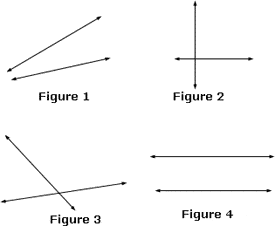
Which figure shows a set of perpendicular lines?
a)
Figure 1
b)
Figure 2
c)
Figure 3
d)
Figure 4
69.
Which figure shows a set of parallel lines?
a)
Figure 1
b)
Figure 2
c)
Figure 3
d)
Figure 4
70.

Are the lines shown parallel. perpendicular, or neither?

a)

Parallel

b)

Perpendicular

c)

Neither

71.

Are the lines shown parallel. perpendicular, or neither?

a)

Parallel

b)

Perpendicular

c)

Neither

72.

Are the lines below parallel, perpendicular, or neither?

a)

Parallel

b)

Perpendicular

c)

Neither

73.

Are the lines below parallel, perpendicular, or neither?

a)

Parallel

b)

Perpendicular

c)

Neither

74.

f(x)f\left(x\right)  


is the same thing as ______.

a)

y

b)

x

c)

input

d)

an equation

75.

How would you write

y=2x3y=2x-3  in function notation?

a)

y=2x3y=2x-3  

b)

f=2x3f=2x-3  

c)

f(x)=2x3f\left(x\right)=2x-3  

76.

How do you read 

f(x)f\left(x\right)  ?

a)

f x

b)

f of x

c)

f parenthesis x

d)

f with an x inside parenthesis

77.

Translate the function notation into a coordinate point.

f(1)=5f\left(-1\right)=5  

a)

(1,5)\left(-1,5\right)  

b)

(1,5)\left(1,5\right)  

c)

(5,1)\left(5,1\right)  

d)

(5,1)\left(5,-1\right)  

78.

Translate the coordinate pair into function notation.

(0,8)\left(0,8\right)  

a)

f(0)=8f\left(0\right)=8  

b)

f(0)=8f\left(0\right)=-8  

c)

f(8)=0f\left(8\right)=0  

d)

f(8)=0f\left(-8\right)=0  

79.

Given the function
f(x)=x+3f\left(x\right)=x+3  

Evaluate: 


f(2)f\left(-2\right)  

a)

f(2)=1f\left(-2\right)=-1  

b)

f(2)=1f\left(-2\right)=1  

c)

f(2)=5f\left(-2\right)=5  

d)

f(2)=5f\left(-2\right)=-5  

80.

Given 
  g(x)=4x2g\left(x\right)=4x-2  


Evaluate: 

g(7)g\left(-7\right)  

a)

g(7)=30g\left(-7\right)=-30  

b)

g(7)=26g\left(-7\right)=-26  

c)

g(7)=36g\left(-7\right)=-36  

d)

g(7)=26g\left(-7\right)=26  

81.

Given:
w(x)=10x5w\left(x\right)=-10x-5  

Evaluate: 
w(1)w\left(1\right)  

a)

w(1)=15w\left(1\right)=-15  

b)

w(1)=5w\left(1\right)=-5  

c)

w(1)=5w\left(1\right)=5  

d)

w(1)=15w\left(1\right)=15  

82.

Given:
f(x)=6xf\left(x\right)=6x  


Find x when  f(x)=24f\left(x\right)=-24  

a)

x=4x=-4  

b)

x=4x=4  

c)

x=144x=-144  

d)

x=6x=-6  

83.

Given:
g(x)=3x5g\left(x\right)=3x-5  


Find x when  g(x)=4g\left(x\right)=4  

a)

x=3x=3  

b)

x=3x=-3  

c)

x=7x=7  

d)

x=3x=-3  

84.

Given: 
h(x)=148xh\left(x\right)=14-8x  


Find x when  h(x)=2h\left(x\right)=-2  

a)

x=2x=2  

b)

x=2x=-2  

c)

x=30x=30  

d)

x=30x=-30  

85.

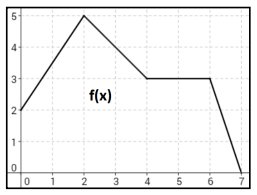
Given the graph, 

find:

f(2)f\left(2\right)  

a)

f(2)=5f\left(2\right)=5  

b)

f(2)=4f\left(2\right)=4  

c)

f(2)=3f\left(2\right)=3  

d)

f(2)=0f\left(2\right)=0  

86.

Given the graph, 

find:

f(4)f\left(4\right)  

a)

f(4)=3f\left(4\right)=3  

b)

f(4)=1f\left(4\right)=1  

c)

f(4)=2f\left(4\right)=2  

d)

f(4)=0f\left(4\right)=0  

87.

Given the graph, 

find:

f(6)f\left(6\right)  

a)

f(6)=3f\left(6\right)=3  

b)

f(6)=1f\left(6\right)=1  

c)

f(6)=2f\left(6\right)=2  

d)

f(6)=0f\left(6\right)=0  

88.

Given the graph, 

find:

f(7)f\left(7\right)  

a)

f(7)=3f\left(7\right)=3  

b)

f(7)=1f\left(7\right)=1  

c)

f(7)=2f\left(7\right)=2  

d)

f(7)=0f\left(7\right)=0  

89.

Given the graph, 

find:

f(0)f\left(0\right)  

a)

f(0)=7f\left(0\right)=7  

b)

f(0)=1f\left(0\right)=1  

c)

f(0)=2f\left(0\right)=2  

d)

f(0)=0f\left(0\right)=0  

90.

Given the graph, 

find the value of x when: 

f(x)=0f\left(x\right)=0  

a)

x=1x=1  

b)

x=0x=0  

c)

x=7x=7  

d)

x=2x=2  

91.

Given the graph, 

find the value of x when: 

f(x)=5f\left(x\right)=5  

a)

x=5x=5  

b)

x=0x=0  

c)

x=3x=3  

d)

x=2x=2  

92.

Given the graph, 

find the value of x when 

f(x)=5f\left(x\right)=5  

a)

x=7x=7  

b)

x=6x=6  

c)

x=5x=5  

d)

x=3x=3  

93.

Given the graph, 

find the value of x when 

f(x)=2f\left(x\right)=2  

a)

x=7x=7  

b)

x=1x=1  

c)

x=5x=5  

d)

x=4x=4  

94.
Simplify the following radical: √24
a)
2√6
b)
4√6
c)
2√12
d)
3√8
95.
Simplify the following radical: √300
a)
3√10
b)
2√150
c)
100√3
d)
10√3
96.
Simplify the following radical: √150
a)
5√15
b)
5√2
c)
5√6
d)
15√5
97.
Simplify 4√75
a)
4√5
b)
12√5
c)
20√3
d)
7√3
98.
Simplify the following radical: 2√24
a)
4√6
b)
2√6
c)
24√2
d)
4√4
99.

5√80

a)

20√5

b)

-4√5

c)

5√20

d)

4√5

100.

Simplify the radical - 10√20

a)

5√20

b)

-20√5

c)

4√5

d)

40√5

101.

Simplify:

√72

a)

√72

b)

2√2

c)

6√2

d)

4√18

102.
In simplest radical form, -5√75 is equivalent to:
a)
5√3
b)
-15√5
c)
√3
d)
-25√3
103.
What is the simplified form of √140
a)
4√35
b)
10√14
c)
2√70
d)
2√35
104.

What is  1\sqrt[]{-1} ?

a)

1

b)

-i

c)

-1

d)

i

105.

Simplify  4\sqrt[]{-4}

a)

2i

b)

-2i

c)

2

d)

4i

106.
What does i=  ?
a)
1
b)
-1
c)
√-1
d)
√1
107.

Simplify  28\sqrt[]{-28}

a)

-√28

b)

-2i√7

c)

2i√7

d)

28i

108.

Simplify  81\sqrt[]{-81}

a)

-√81

b)

-9i

c)

9i

d)

81i

109.

Simplify  23\sqrt[]{-23}

a)

-√23

b)

23i

c)

23

d)

i√23

110.

Simplify  45\sqrt[]{-45}

a)

3i√5

b)

-3i√5

c)

-i√45

d)

45i

111.

Simplify  100\sqrt[]{-100}

a)

-√100

b)

-10i

c)

10i

d)

100i

112.

Simplify 75\sqrt[]{75}

a)

75i75i

b)

3 53\ \sqrt[]{5}

c)

5i 55i\ \sqrt[]{5}

d)

5 35\ \sqrt[]{3}

113.

Simplify x3\sqrt[]{x^3}

a)

x xx\ \sqrt[]{x}

b)

xx

c)

3x3x

d)

2 x2\ \sqrt[]{x}

114.

Simplify 8\sqrt[]{-8}

a)

8i8i

b)

2 2 2\ \sqrt[\ ]{2}

c)

4i4i

d)

2i 22i\ \sqrt[]{2}

115.

Simplify completely 92\frac{9}{\sqrt[]{2}}

a)

9 29\ \sqrt[]{2}

b)

9 2 2\frac{9\ \sqrt[\ ]{2}}{2}

c)

3 22\frac{3\ \sqrt[]{2}}{2}

d)

92\frac{9}{2}

116.
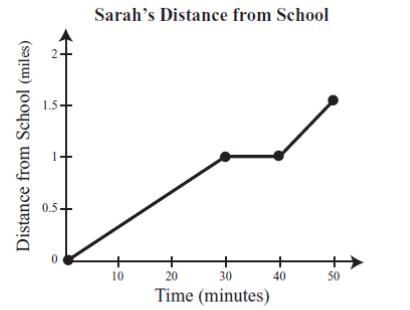
What is happening in the graph between 30 and 40 minutes?
a)
Sarah is accelerating
b)
Sarah is not moving
c)
Sarah is slowing down
d)
Sarah is travelling at a constant speed
117.
What is happening in this graph from point A to B? HINT: Look at the axis labels. 
a)
The object is accelerating.
b)
The object is not moving.
c)
The object is decelerating.
d)
The object is moving at a constant speed.
118.
What is happening at D?
a)
Stationary
b)
Accelerating
c)
Fast steady speed; moving away from the starting position
d)
Slower steady speed; moving away from the starting position
119.
What is happening at A?
a)
Stationary
b)
Accelerating
c)
Slower steady speed; moving away from the starting position
d)
Steady speed; returning to start position
120.
Where is the object not moving
a)
A-B
b)
O-A
c)
C-D
d)
B-C
121.
Describe the bus’s motion from A-B
a)
A)The bus is speeding up
b)
 B)The bus's speed is remaining constant
c)
 C)The Bus is stopped
d)
 D)The bus is beginning to slow down
122.
Describe the bus’s motion from C-D
a)
A)The bus is speeding up
b)
 B)The bus's speed is remaining constant
c)
 C)The Bus is stopped
d)
 D)The bus is beginning to slow down
123.
What was the speed of the bus from point A-B
a)
A)12 m/s
b)
 B)20 m/s 
c)
 C)10 m/s 
d)
 D)The bus is stopped, so its speed must be zero
124.
Describe the bus’s motion from B-C
a)
A)The bus is speeding up
b)
 B)The bus's speed is remaining constant
c)
 C)The Bus is stopped
d)
 D)The bus is beginning to slow down
125.
Where is the object not moving
a)
A-B
b)
O-A
c)
C-D
d)
B-C
126.
What is happening in this graph from point A to B? HINT: Look at the axis labels. 
a)
The object is accelerating.
b)
The object is not moving.
c)
The object is decelerating.
d)
The object is moving at a constant speed.
127.
What happened during E to F point?
a)
not moving
b)
increasing speed at a constant rate
c)
moving at a 5 m/s
d)
moving at 5 m/sacceleration
128.
In the coordinate points (2,7) the 2 represents
a)
y
b)
origin
c)
x
d)
point
129.
How do you write an ordered pair?
a)
(X,X)
b)
(Y,X)
c)
(X,Y)
d)
(Y,Y)
130.
In an ordered pair the first number represents which axis?
a)
x
b)
y
131.
In the ordered pair (4,9), which number is the y-coordinate?
a)
4
b)
9
c)
neither
d)
both
132.
What is coordinate L?
a)
(6,6)
b)
(2,5)
c)
(2,3)
d)
(5,2)
133.
Ordered pair (0,0) is also known as the ___.
a)
y-axis
b)
x-axis
c)
origin
134.
What letter is located at (8, 5)?
a)
A
b)
B
c)
C
d)
D
135.
The __ - axis is vertical in the coordinate plane.
a)
X
b)
Y
c)
Z
d)
None of the above
136.
Which axis runs horizontally?
a)
x
b)
y