
 Worksheets
1E - Prove Mastery (Blood)
Total questions: 25
Worksheet time: 13mins
Name
Class
Date
1.
Blood cell formation occurs in the:
a)
kidney
b)
red bone marrow
c)
heart
d)
lymphatic system
2.
Of the formed elements in blood, which is the most numerous?
a)
Erythrocytes
b)
Eosinophils
c)
Basophils
d)
Platelets
e)
Lymphocytes
3.
Who is the universal recipient?
a)
O+
b)
B-
c)
O-
d)
AB+
4.
"B" antigens on the surface of the RBC's indicates what blood type?
a)
AB blood type
b)
A blood type
c)
B blood type
d)
O blood type
5.
A man with blood type B- can have children with blood types A+ depending on the man's genotype and woman's genotype.
a)
True
b)
False
6.
Antigens A and B are present on the red cells.
a)
there are no antibodies to A or B antigens in the plasma
b)
the blood is Rh positive
c)
all of the choices are correct
7.
Thrombocytes only initiate the clotting process (many other factors are involved).
a)
True
b)
False
8.
Erythrocytes are commonly called what?
a)
red blood cells
b)
platelets
c)
white blood cells
d)
thrombocytes
9.
A person with O- blood can receive a blood transfusion from which of the following candidates?
a)
O+
b)
AB+
c)
A+
d)
O-
10.
Blood cells that transport oxygen are called:
a)
leucocytes
b)
thrombocytes
c)
erythrocytes
d)
macrophages
11.
The universal donor ABO blood type is __.
a)
Type A
b)
Type B
c)
Type AB
d)
Type O
12.
Universal donors can receive blood groups A, B, AB, and O.
a)
True
b)
False
13.
Platelets are fragments of:
a)
Erythrocytes
b)
Eosinophils
c)
Basophils
d)
Megakaryocytes
e)
Macrophages
14.
The + after the blood type A+ stands for what?
a)
the lack of B antigens
b)
the presence of Rh antigens
c)
the presence of A antigens
d)
the lack of Rh antibodies
15.
Blood is classified as:
a)
epithelial tissue
b)
muscular tissue
c)
connective tissue
d)
nervous tissue
16.
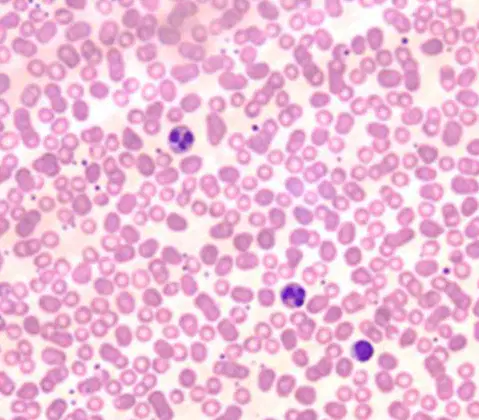
What is the general function of the numerous red/pink-colored cells in this blood smear?
a)
carries oxygen from the lungs to the body tissues
b)
destroys pathogens and protects you from illness and disease
c)
helps to stop bleeding
17.
Hemoglobin is found within red and white blood cells.
a)
True
b)
False
18.
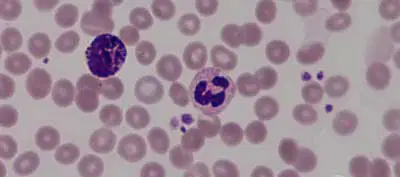
The 2 leukocytes in this picture are:
a)
basophil and lymphocyte
b)
erythrocyte and thrombocyte
c)
lymphocyte and neutrophil
d)
monocyte and neutrophil
19.
The main protein in erythrocytes is:
a)
Albumin
b)
Fibrin
c)
Fibrinogen
d)
Hemoglobin
20.
Which of the following cells has the shape of a biconcave disk?
a)
Thrombocytes
b)
Megakaryocytes
c)
Leukocytes
d)
Erythrocytes
21.
A person with O+ blood can receive blood from which of the following donors?
a)
AB+
b)
A-
c)
B+
d)
O-
22.
The liquid portion of the blood is called:
a)
Albumin
b)
Fibrin
c)
Antibody
d)
Agglutinogen
e)
Plasma
23.
The pH of the blood is between 7.35 and 7.45.
a)
True
b)
False
24.
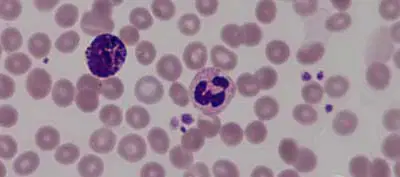
Seven small, dark blue-purple spots are observed in this field of view. What are the smallest spots in this picture?
a)
platelets
b)
blood
c)
erythrocytes
d)
red blood cells
e)
leucocytes
25.
Which of the following is required for the formation of hemoglobin?
a)
calcium
b)
zinc
c)
potassium
d)
iron
e)
sodium
100 %

