Wayground logo

Free Printable Worksheets

Font size

S
M
L
XL
Worksheets

7th Grade Plant Structure and Reproduction

Total questions: 53

Worksheet time: 2hrs 37mins

Name
Class
Date
1.
What organ transports sugar throughout the plant
a)
Phloem
b)
Stomata
c)
Guard cells
d)
Cambium
2.
Which organ transports water throughout the plant
a)
Phloem
b)
Xylem
c)
Stomata
d)
Cambium
3.
Which organ contains small openings that allow for air exchange
a)
Xylem
b)
Phloem
c)
Cambium
d)
Stomata
4.

What part of the plant is responsible for making food?

a)

roots

b)

flower

c)

stem

d)

leaves

5.
Which of these plant structures supports a plant so it does not fall over?
a)
Seed
b)
Root
c)
Leave
d)
Flower
6.
What is the function of the roots of a plant?
a)
Absorb water and minerals
b)
Capture sunlight for energy
c)
Support the plant above ground
d)
Create food for the plant
7.
Process by which green plants prepare their own food
a)
Germination
b)
Pollination
c)
Transpiration
d)
Photosynthesis
8.

What is the function of the flower part of a plant?

a)

help the plant reproduce

b)

transport water to the leaves

c)

make food for the plant

d)

provide support for the plant

9.
This part of the plant supports it and carries water.
a)
root
b)
stem
c)
leaf
d)
seed
10.

What makes a plant a plant?

a)

it has to have roots, a stem, leaves, and flowers

b)

it is green

c)

the cells!

11.

Stomata are made of specialized cells called ______ which surround a tiny pore/opening

a)

stoma

b)

guard cells

c)

dermal cells

d)

diffusion channels

12.

The main function of stomata is to

a)

capture sunlight

b)

protect leaves from insects

c)

allow gases to move rapidly in/out of leaves

d)

release sugars into the atmosphere

13.
Needle-shaped leaves help plants ____________ more water than wide leaves.
a)
lose
b)
create
c)
absorb
d)
conserve
14.
Why might some plants that grow on the shady rain forest floor have large leaves?
a)
to stay safe from predators
b)
to attract different animals
c)
to survive harsh winters with heavy snowfall
d)
to take in as much sunlight as possible
15.
What is the name of the organelle in the leaves of plants that absorbs the Sun's energy?
a)
roots
b)
chlorophyll
c)
chloroplast
d)
stomata
16.
Roots perform all of the following functions EXCEPT
a)
Carrying out the light reactions of photosynthesis
b)
Anchoring the plant in the soil
c)
Absorbing water and nutrients from the soil
d)
Storing water and minerals
17.
The plant tissue that carries food materials DOWNWARD from the leaves to the rest of the pant is the ______.
a)
Phloem
b)
Stomata
c)
Chlorophyll
d)
Xylem
18.
Vascular tissue that transports water and minerals UPWARDS from a plant's roots is know as ______.
a)
Chlorophyll
b)
Phloem
c)
Stomata
d)
Xylem
19.
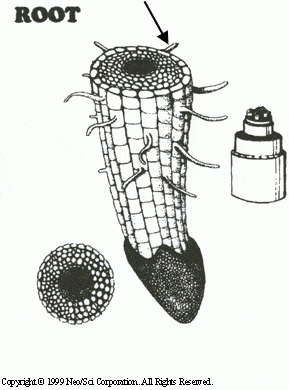
What is the name of the part of the root that allows water and minerals enter?
a)
root hairs
b)
epidermis
c)
phloem
d)
phyla
20.
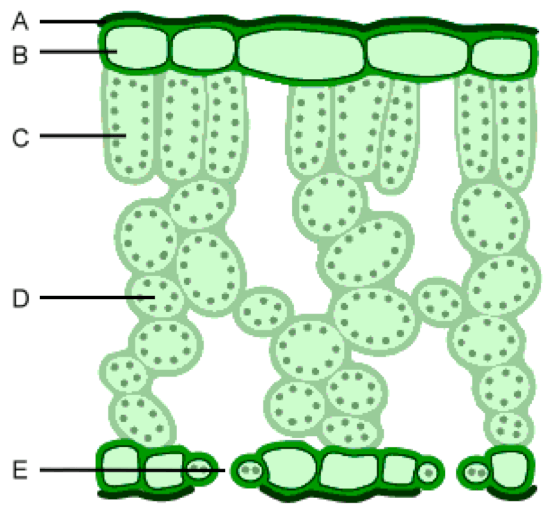
What is E pointing to?
a)
waxy cuticle
b)
stomata
c)
upper epidermis
d)
cuticle
21.
What is a sac-like structure used to store water and nutrients? These are much larger in plant cells?
a)
Lysosomes
b)
Mitochondria
c)
Vacuoles
d)
Golgi Body
22.
Which is NOT a characteristic of plants?
a)
Autotroph
b)
Eukaryotic Cell
c)
Unicellular
d)
Cell walls
23.
What TWO things help a plant to stand vertically?
a)
cell wall & vascular tissue
b)
cell wall & chloroplasts
c)
vascular tissue & vacuole
d)
cytoplasm & ribosomes
24.
What two things do plants need to do the PROCESS of photosynthesis?
a)
Carbon dioxide & water
b)
Oxygen & water
c)
Sugar & water
d)
Carbon dioxide & Sugar
25.
Why do plants do photosynthesis?
a)
to make oxygen for people
b)
to make food for itself
c)
to make a flower
d)
to make carbon dioxide
26.
Why do leaves look green?
a)
it reflects all colors but green
b)
it reflects yellow and blue
c)
it reflects green light
d)
it absorbs green light
27.

Which of the following is NOT a part of a plant?

a)

Stem

b)

Leaf

c)

Root

d)

Flower

e)

Tubed Feet

28.

What type of root system would the roots under A be considered?

a)

Fibrous

b)

Taproot

29.

What type of root system would the root under B be considered?

a)

Taproot

b)

Fibrous

30.

Which part of the plant contains the seeds?

a)

Stem

b)

Flower

c)

Roots

d)

Stem

31.

True or False: All plants produce flowers.

a)

True

b)

False

32.
All of the following is a root function, except
a)
water absorption
b)
food storage
c)
plant anchoring
d)
food production
33.

Flowers develop into _____________ after fertilization.

a)

trees

b)

fruits

34.

What is fertilization?

a)

the process by which the pollen fuses with an ovule

b)

When the pollen is moved from the anther to stigma

c)

the process by which the seed is formed

35.

Flower has 4 main parts: Sepals, ________, Stamen and ________

a)

petals, pistil

b)

petals, root

c)

roots , leaves

36.

The fruit contains

a)

the flower

b)

the seeds

c)

animal fur

37.

The ___________ produces or makes pollen.

a)

pistil

b)

petals

c)

stem

d)

stamen

38.

Pollen is collected in the ______________

a)

stamen

b)

leaves

c)

pistil

d)

petals

39.

Some of the most common pollinators are

(choose 4)

a)

animals

such as birds

and bats

b)

insects

like bees, butterflies and moths

c)

wind

d)

water

e)

machines

40.

When bees or other pollinators transfer pollen from plant to plant, this is called_____

a)

photosynthesis

b)

reproduction

c)

pollination

d)

respiration

41.

What is the main function, or job of the flower?

a)

to make seeds for new plants (reproduction)

b)

to help in the process of photosynthesis

c)

to make chlorophyll

42.

What are the 2 main types of plants

a)

flower and flowerless

b)

seed and seedless

c)

vascular and non-vascular

d)

phloem and xylem

43.

What are the 2 main types of seedless plants

a)

flower and flowerless

b)

seed and seedless

c)

vascular and non-vascular

d)

phloem and xylem

44.

Root like structure that anchor seedless plants

a)

rhizoids

b)

fronds

c)

phloem

d)

xylem

45.

What are the 2 main types of plants

a)

flower and flowerless

b)

seed and seedless

c)

vascular and non-vascular

d)

phloem and xylem

46.

What are the 2 main types of seedless plants

a)

flower and flowerless

b)

seed and seedless

c)

vascular and non-vascular

d)

phloem and xylem

47.

Root like structure that anchor seedless plants

a)

rhizoids

b)

fronds

c)

phloem

d)

xylem

48.

Which are non-vascular seedless plants

a)

liverwort

b)

club moss

c)

moss

d)

ferns

e)

hornwort

49.

Which are vascular seedless plants

a)

horsetails

b)

club moss

c)

moss

d)

ferns

e)

hornwort

50.

The 2 types of seed plants

a)

angiosperms

b)

vascular

c)

gymnosperms

d)

non-vascular

51.

Angiosperms

a)

seeds are produced in cones

b)

leaves are flat and broad

c)

leaves are needle like

d)

seeds are in the form of fruits

e)

have flowers

52.

gymnosperms

a)

seeds are produced in cones

b)

leaves are flat and broad

c)

leaves are needle like

d)

seeds are in the form of fruits

e)

have flowers

53.

Gymnosperms

a)
b)
c)
d)