
 Worksheets
Algebra 2 3rd Quarter Review
Total questions: 101
Worksheet time: 51mins
i2=
i
−1
−i
1
−1=
i
−1
−i
1
−64
8i
−8
8
±8i
Solve: x2+36=0
±6
−6
6i
±6i
(3−i)−(2+4i)=
10+10i
1−5i
6−4i2
10
(3−i)(2+4i)=
10+10i
1−5i
6−4i2
10
−12
2i3
4i3
−23
−4i3
−18
3i2
9i2
−32
−9i2
x2 - 4x + 4 = 20,
what goes in the blank?
(x - __ )2 = 20
x2 + 6x + ____
x2 + 6x = 5
x2 + 12x + ____
x2 + 10x + ____
x2 + 14x + ____
Solve by completing the square.
x2−8x−20=0
x={−2, 10}
x={−10, 2}
x={−20, −8}
x={8, 20}
Solve by completing the square.
x2−12x+20=0
x={2, 10}
x={−10, −2}
x={−12, 20}
x={12, 20}
Solve by completing the square.
x2−6x−27=0
x={−9, −3}
x={−3, 9}
x={−9, 3}
x={3, 9}
x2 + 5x - 24
Factor:
x2 + 11x + 24
(x + 6)(x + 4)
(x + 12)(x + 2)
(x - 8)(x - 3)
(x + 8)(x + 3)
Factor 4x2 - 81
(4x - 9)(x + 9)
(2x - 9)(2x + 9)
(2x - 9)(2x - 9)
(4x - 1)(x + 81)
Factor
k2+7k+10 .(k+2)(k−5)
(k+2)(k+5)
(k+10)(k+4)
(k−2)(k−5)
Factor k2−2k−24
(k−4)(k+6)
(k+4)(k+6)
(k+6)(k−1)
(k+4)(k−6)

Does the quadratic have a maximum or minimum vertex, and does the parabola open up or down?
max/ opens down
min/ opens up
max/ opens up
min/ opens down
f(x)=4(x-2)2 + 3
f(x)=4(x-2)2 + 3
y=a(x-h)2+k
Explain the translation:
y = (x + 9)2 + 5
translated left 9, up 5
translated left 9, down 5
translated right 9, up 5
translated right 9, down 5
Explain the translation:
y = (x - 5)2 - 1
translated right 5, up 1
translated left 5, down 1
translated right 5, down 1
translated left 5, up 1

f(x) = x2
then the red must be...
f(x)=4(x-2)2 + 3
y = x2 +5x +7, match each leading coefficient with its correct letter
x2 + 6x - 13 = 3
2x2 + 7x - 15 = 0
y = 3x3 + 8x - 1
4x2 - 5x + 7 = 10


Use the quadratic formula to determine the solutions.
2x2 + 2x - 12?
-2, 3
2, 3
2, -3
-2, -3
Use the quadratic formula to determine the solutions.
2x2 - 9x - 35 = 0
x = 7/2, x = -6
x = -5/2, x =5
x = -3/7, x =6
x = -5/2, x = 7
The formula to determine how many solutions a quadratic equation is called the discriminant which is...
aX2 + bX + c
b - 4ac
b2 - 4ac
b2 + 4ac
If the discriminant is negative, you will have....
two real solutions
two irrational solutions
no solution
one solution
For the function below, is the discriminant positive, negative, or zero?
___________
y = x² + 4x + 4
Positive
Negative
Zero
Not Sure
Use the discriminant to determine the number of solutions the following quadratic equation has.
6x2 − 2x − 3 = 0
76 Two Solutions
29 Two Solutions
68 Two Solutions
none of these
What is the degree of the polynomial?
3y2 + y4 + 4
2
3
4
5
What is the degree of the polynomial:
3x2 + 9x5 − 4 + 10x8 + 2x9
8
9
5
-4

Describe the degree and leading coefficient for the polynomial shown.
Lead Coefficient: Positive
Degree: Even
Lead Coefficient: Positive
Degree: Odd
Lead Coefficient: Negative
Degree: Even
Lead Coefficient: Negative
Degree: Odd

Describe the degree and leading coefficient for the polynomial shown.
Lead Coefficient: Positive
Degree: Even
Lead Coefficient: Positive
Degree: Odd
Lead Coefficient: Negative
Degree: Even
Lead Coefficient: Negative
Degree: Odd

Describe the degree and leading coefficient for the polynomial shown.
Lead Coefficient: Positive
Degree: Even
Lead Coefficient: Positive
Degree: Odd
Lead Coefficient: Negative
Degree: Even
Lead Coefficient: Negative
Degree: Odd

Describe the degree and leading coefficient for the polynomial shown.
Lead Coefficient: Positive
Degree: Even
Lead Coefficient: Positive
Degree: Odd
Lead Coefficient: Negative
Degree: Even
Lead Coefficient: Negative
Degree: Odd

Describe the degree and leading coefficient for the polynomial shown.
Lead Coefficient: Positive
Degree: Even
Lead Coefficient: Positive
Degree: Odd
Lead Coefficient: Negative
Degree: Even
Lead Coefficient: Negative
Degree: Odd

As x --> -∞, f(x) --> ____
As x --> +∞, f(x) --> ____
-∞
-∞
+∞
+∞
Which shows the polynomial 8x2+16x+8 completely factored?
(4x+4)2
(4x+4)(2x+2)
8(x+1)2
8(x+1)(x−1)
Add the polynomial (-3x + 4) + (8x - 5)
5x - 9
5x - 1
11x - 1
11x - 9
None of these
(3x²-3x+2)-(x²-2x+1)
(2x³+6x²+4x-2)-(x³+4x²-x)
(4x3-5x2+3x)+(-2x3-x2+6x)
2x3-6x2-9x
2x3+6x2+9x
-2x3-6x2+9x
2x3-6x2+9x
None of these
Add the following polynomials
(x³-6x²+3)+(3x³+4x-1)
4x³-2x²+2
4x³-6x²+4x+2
-2x³+2x+2
4x³-2x²-2
None of these
What is another way to say "where a function crosses the x-axis"?
x-intercept
zero
root
all of these.
x2 -16x + 48


In the above graph, which root has a multiplicity of 2?
Remember to look at your roots, multiplicity, and end behavior!!
Use your notes!
-1
-3
-120
4
√45
3√16
a = 9 b = 40


Considering the lengths of the sides of the triangle, what measure will < A have to be?
30
45
60
90


What is the correct ratio you would use to solve for "w"?
sin 40 = w/28
cos 40 = w/28
tan 40 = w/28
sin 40 = 28/w

Which is the correct ratio you would use to solve for "x"?
sin 28 = x/14
cos 28 = x/14
tan 28 = x/14
tan 28 = 14/x
What is the acronym to help you remember the ratios to use in trigonometry?
RIGHTANG
SOHCAHTOA
SHOCHATOA
SAHCOHTOA

Choose the correct ratio you could use to solve for "x".
sin(37)=x/14
cos(37)=x/14
tan(37)=x/14
sin(37)=14/x

Find x rounded to the nearest tenth.
46.1
4.9
16.4
26.9

Which trig function would you use to solve this problem for "x"?
Sine
Cosine
Tangent
Pythagorean Theorem

Find the measure of the missing angle to the nearest degree.
49o
90o
41o
33o
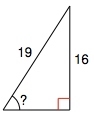
Use inverse trig ratios (SOH CAH TOA) to solve for the missing angle to the nearest degree.
49°
57°
45°
54°

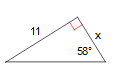
Find the value of "x" rounded to the nearest hundredth.
6.09
18.77
5.52
7.68




y = 98.91
y = 105.26
y = 12.31
y = 47.31

