
 Worksheets
Muscle System Review
Total questions: 54
Worksheet time: 36mins

Area #1 is known as a -
perimysium
epimysium
muscle fiber
fascicle

Area #3 is called the
perimysium
epimysium
muscle fiber
fascicle

Area #2 is called the -
endomysium
perimysium
epimysium
olomysium

Area #4 is called the -
epimysium
perimysium
endomysium
muscle fiber

Area #5 is called the -
muscle fiber
epimysium
perimysium
fascicle


#1 Represents one whole...
Actin Filament
Z Disc
Sarcomere
Myosin Filament

What muscle is the arrow pointing toward?
biceps
traps
pecs
triceps

What muscle is the arrow pointing to?
Pectoralis (Pecs)
Biceps
Triceps
Lats


All of the following are functions of skeletal muscle EXCEPT:
Heart Contractions
Maintaining body posture
Producing body heat
Body movement

The thin myofilament found within a muscle fiber is labeled 3. It is
motor neuron
sarcomere
actin
myosin

All are true about the sliding filament model EXCEPT
The Z lines are pulled closer together
actin and myosin filaments “slide” past each other and the myosin “hooks” onto the actin contracting the muscle
sarcomeres become smaller and contract
It requires no energy for the sliding filament theory
The connective tissue that attaches muscle to bone is:
sarcomere
ligament
tendon
myofilament
Which type of muscle tissue is voluntary?
Skeletal muscle
Cardiac muscle
Smooth muscle
Which type of muscle tissue lines the blood vessels/ stomach and is not striated.
cardiac
smooth
skeletal
The muscle system works with the nervous system. Muscles must have a signal from the brain to contract. The point of contact between a motor neuron and a muscle is called the
neuromuscular junction
axon junction
intercalated discs
dendritic junction
When grandma stays in bed and doesn't want to move, she risks muscle ____________ that can be hazardous to your health.
hypertrophy
atrophy
fatigue
tetanus
An injury to a tendon is a
strain
sprain
fracture
The thick myofilament of a sarcomer is called_______?
Actin
Myosin
Myofibril
Myofilament
The sarcoplasmic reticulm releases this ion, ______, which binds to troponin causing it to move so that myosin binding sites can be exposed.
Creatine
Iron
ATP
Calcium
Which are the correct four functions of the muscle system?
send signals, produc heat, maintain posture and break down nutrients
Produce heat, transport oxygen, stabilize joints and make heat
Connect tissues, send signals, break down nutrients and maintain posture
Movement, heat production, maintain posture and stabilize joints
This neurotransmitter must be released by an axon to innervate your muscle cells.
Synaptic Cleft
Axon terminals
Synaptic Vesicles
Acetylcholine

This image shows a ________?
Sarcomere
Fascicle
Neuromuscular Juntion
Prime mover
Acetylcholine must cross this space in order for the action potential to innervate the muscle Fiber.
Synaptic Cleft
Actin
Myosin
sarcomere
Which type of muscle tissue has visible striations and single, centrally located nuclei?
cardiac
skeletal
smooth
fibrous
Muscle has the ability to shorten when adequately stimulated, a characteristic known as __.
elasticity
irritability
contractibility
extensibility


During which phase does a large amount of sodium ions flood into the cell while a smaller amount of potassium ions leave, resulting in the interior of the cell become positively charged?
Repolarization
Action potential phase
Resting potential phase

The I band is labeled here as _______.
AD
AC
BC
AB

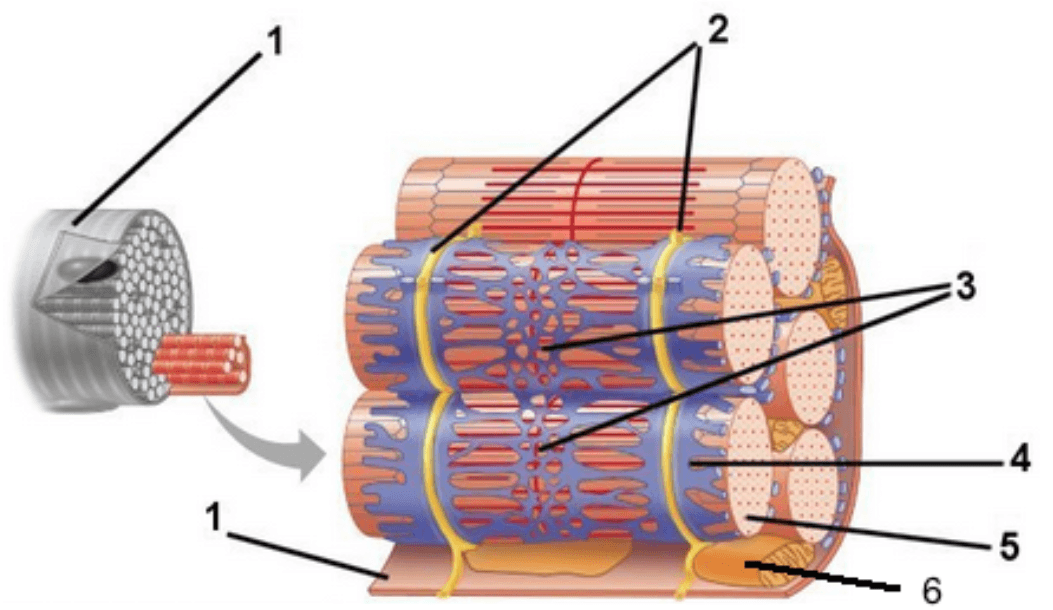
What is labeled "4" (the blue/purple part) in the diagram?
sarcolemma
sarcoplasmic reticulum
transverse tubules
myofibril
What does calcium do to the actin?
Covers myosin binding sites
Uncovers myosin binding sites on actin
Covers actin binding sites
Uncovers actin binding sites on myosin
What happens when the action potential reaches the axon terminal of a motor neuron?
Voltage-gated channels open, releasing sodium
Voltage-gated channels open, releasing acetylcholinesterase
Voltage-gated channels open, releasing acetylcholine
Voltage-gated channels open, releasing calcium
What ions are transported by the activated ion channel in muscle cells?
Sodium ions rush out of the cell, while potassium ions rush into the cell
Calcium ions rush out of the cell, while potassium ions rush into the cell
Sodium ions rush into the cell, while potassium ions rush out of the cell
Calcium ions rush into the cell, while potassium ions rush out of the cell
Which ways do muscles get their energy from?
Creatine Phosphate
Anaerobic Respiration
Kreb Cycle
Aerobic Respiration

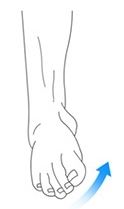


Which shoulder motion is illustrated in the picture?
rotation
adduction
flexion
extension


