
Font size
 Worksheets
Chemistry_Q3 DAY 3 Reviewer
Total questions: 15
Worksheet time: 11mins
Which statement best explains the reactivity of noble gases?
Noble gases have a lot electrons, so they are unlikely to gain more by reacting.
Noble gases are typically unreactive since they have full outer electron shells.
Noble gases are very reactive because they have full outer electron shells.
Which statement is TRUE about noble gas compounds?
Only the smallest noble gases can form compounds.
Noble gases cannot form compounds because they are unreactive.
Only helium and neon have not formed compounds.
Which describes the state that the noble gases are found at room temperature?
unreactive monatomic gases
unreactive diatomic gases
highly reactive monatomic gases
Noble gases are almost completely _____________ because they have eight valence electrons.
inert
reactive
nonreactive
The reactivity of a given element is most closely related to its ___________.
electron configuration
density
solubility
With which noble gas was the first noble gas compound finally formed?
neon
xenon
krypton
The octet rule is based on the number of electrons in the noble gases, which are the least
reactive elements.
TRUE
FALSE
The atomic size is the distance from the nucleus to its outermost shell of electrons.
TRUE
FALSE
In Group 16, Sulfur (S) has the smallest atomic radius.
TRUE
FALSE
Arrange the following atoms in order of decreasing atomic radius:
Ga, As, Sn, Sb, Te
Sn, Sb, Te, Ga, As
Ga, As, Sn, Sb, Te
Which of the following is the correct order of increasing size of atomic radii?
Al < Ga < In
Ga < In < Al
Which of the following has the largest atomic radius?
BORON (B)
NITROGEN (N)
FLUORINE (F)
Among the following, which element of the third period has the largest atomic radius?
MAGNESIUM (Mg)
SODIUM (Na)
SILICON (Si)
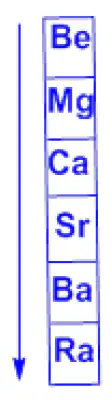
In the diagram of elements, which of the following describes the change of atomic radius along the
direction of the arrow?
Stays the same
Decreases
Increases
The atomic size of silicon is greater than ________.
Sodium
Phosphorus
C. Aluminium

