
 Worksheets
Revolutions Review
Total questions: 30
Worksheet time: 15mins
Which of the following was a common cause of the English Civil War, American Revolution, and the French Revolution?
All sought an increase in freedom of religion
All desired an immediate end of the Monarchy
All wanted to limit the size of the military
All were fought over an increase in taxes
Who controlled the French Government during the Reign of Terror?
Napoleon Bonaparte
King Louis XVI (16th)
Maximilien Robespierre
The Directoire
Who led the only successful slave revolt in history?
Maximillian Robespierre
Simon Bolivar
Prince Pedro of Portugal
Toussaint L'Ouverture
Which of the following Social classes made up majority of the population in France?
3rd Estate
2nd Estate
1st Estate
This tool was widely used for public executions during the French Revolution & was considered a "Humane" form of execution.
The Firing Squad
Public Hangings
The Electric Chair
The Guillotine
What happened to Haiti's plantation system after they gained their freedom from France?
Slaves continued to work on plantations
The Plantation system grew due to needed trade
The Plantation system collapsed due to banned slavery
Slaves started to travel to new countries
This man was a priest who's responsible for starting the Mexican Revolution & bringing their social classes together?
Marcus Garvey
Miguel Hidalgo
King Dom Pedro
Toussaint L'ouveture
This man took advantage of the Reign of Terror using his military power to become Consul of France.
Miguel Hidalgo
Toussaint L'ouveture
Napoleon Bonaparte I
Maximilien De Robespierre
Who was the most famous leader of the South American wars of independence from Spain?
Simon Bolivar
Maximillian De Robespierre
Toussaint L'ouveture
Napoleon Bonaparte
Why did many of the great thinkers of the Scientific Revolution come into conflict with the Catholic Church?
They refused to pay their taxes to church as they believed they were helping society
They worked to prove that the teachings of Jesus Christ were true
They challenged many of the ideas that were considered truths in Christian teaching
They were trying to convert people and spread the Islamic faith throughout Europe
Copernicus, Galileo, Kepler, and Newton all supported which idea from the Scientific Revolution?
Heliocentric Theory
Geocentric Theory
Law of Planetary motion
Law of Gravity
Which term describes the era when new ideas and advances in sciences roughly from 1500-1700
The Renaissance
The Age of Revolutions
The Middle Ages
The Scientific Revolution
What did the ideas of John Locke, Baron de Montesquieu, and Jean Jacques Rousseau have in common?
The philosophies inspired the American and French revolutions.
The theories encouraged the establishment of absolute monarchs
The theories promoted fairness in the criminal justice system.
The philosophies challenged the traditional role of women.
Please read the following:
The Preamble to the United States Constitution:
"We the People of the United States, in Order to form a more perfect Union, establish Justice, insure domestic Tranquility, provide for the common defense, promote the general Welfare, and secure the Blessings of Liberty to ourselves and our Posterity, do ordain and establish this Constitution for the United States of America."
What Enlightenment idea is reflected in the Preamble to the U.S. Constitution?
Power should be divided among three branches.
The government's power comes from the people.
A system of checks and balances is necessary.
All men and women are created equal.
Enlightenment thinkers of the 17th Century believed in applying reason to the natural world, while also supporting the ideas of democracy and
World Peace
Abolitionism
Religious Tolerance
Military Expansionism
The Enlightenment influenced revolutionary thought by
encouraging the poor to take up arms.
stressing the importance of the monarchy.
designing a common revolutionary strategy
Instilling a belief in the natural rights of man.
According to the concept of absolutism
people have absolute power in government.
there is no absolute authority in society.
government had absolute power and could not be disobeyed.
people have the right to overthrow absolute monarchies.
Peter the Great (Russia), Fredrick the Great (Prussia), and Louis XIV (France) were all considered to be
feudal lords.
constitutional monarchs.
absolute monarchs.
enlightened despots.
Absolutist monarchs in Europe sought to do which of these?
encourage the rebellion of peasants and serfs
centralize political power within their countries
to prove their greatness by emancipating slaves
increase political rights for commoners
Which nation's revolution resulted in a decreased power of the church, nobility and later influenced political revolutions such as Haiti?
France
Mexico
Great Britain
United States of America
Which of these was a reason the American colonies were fighting a war for independence in 1776?
failure to protect the colonists from attacks by the French
restrictions on slave ownership in the colonies
restrictions on colonial trade
failure to protect the colonists from attacks by the Spanish
Which concept was being challenged during the English Civil War?
Divine Right of Kings
power of the government over the church
A Freedom of Religion
the rule of succession
Napoleon Bonaparte's rise to power came as
an opponent of the Revolution.
a French military hero.
husband of Marie Antoinette.
after executing Louis XVI.
I. Nationalism in Spain and Germany
II. French power over the Catholic Church
III. More rights for women I
V. Unity and order in France.
Napoleon's expansion into Europe resulted in what events?
I and II only
II and IV only
I, II, and IV only
I, II, and III only
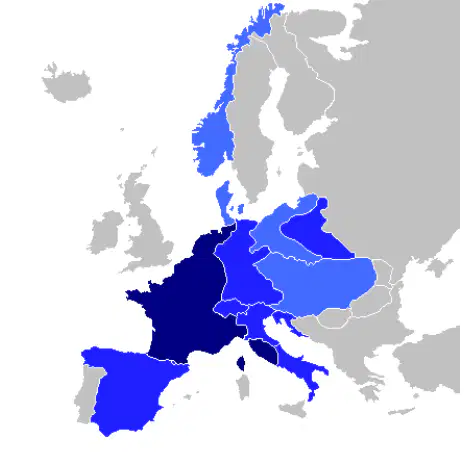
The map shown above represents the territory conquered or controlled by what famous 19th century leader?
King Louis XVI
Frederick the Great
Napoleon Bonaparte
Maximilien Robespierre
He was a politician, scientist, and philosopher, known not only for his belief in the "scientific method" but for his creation of "empiricism."
Francis Bacon
Galileo
Newton
Descartes
This French thinker is often called the "Father of Modern Philosophy," was a key figure in the Scientific Revolution, and whose belief in rationalism can be summed up with the phrase "I think, therefore I am."
Francis Bacon
Descartes
Galileo
Newton
Perhaps the most important figure of the Scientific Revolution, this Italian astronomer and mathematician was condemned by the Catholic Church in the 1600s for popularizing heliocentrism.
Francis Bacon
Descartes
Galileo
Newton
This English scientist is known for scientifically describing gravitational force, spelling out the "laws of motion," for writing "Philosophiæ Naturalis Principia Mathematica"- one of the most important books in world historyand much, much more.
Francis Bacon
Descartes
Galileo
Newton
This is the astronomical observation that the Earth revolves around the Sun, not the other way around; a model that was popularized by Copernicus and Galileo.
Heliocentrism
The Scientific Revolution
Geocentric
Gravity

