wayground logo

Free Printable Worksheets

NEW

Font size

S
M
L
XL
Worksheets

DMD Quiz 2 Review

Total questions: 32

Worksheet time: 50mins

Name
Class
Date
1.

Which part of the body is affected by DMD?

a)

Bones

b)

Brain

c)

Muscles

d)

Blood

2.

What do we call a single muscle cell?

a)

Fascicle

b)

Perimysium

c)

Myofibril

d)

Muscle fiber

3.

What is the name of the structure inside Muscle Cells that allows them to contract?

a)

Fascicle

b)

Myofibril

c)

Perismysium

d)

Z-line

4.

What is the name for the structure inside of Myofibrils that is made up of Actin and Myosine

a)

Fascicle

b)

Myofibril

c)

Dystrophin

d)

Sacromere

5.

What are the contracting proteins in Muscle Cells?

a)

Dystrophin + Actin

b)

Actin + Myosin

c)

Dystrophin, Actin + Myosin

d)

Dystrophin + Myosin

6.

What is the function of Dystrophin?

a)

Connect Sarcomeres to Muscle Cell Membrane

b)

Connect Actin to Myosin

c)

Connect the Myofibrils together

d)

Allow for contraction

7.

What happens when a DMD muscle cell moves/contracts?

a)

Nothing

b)

muscle cell membrane thinkens

c)

Heart stops

d)

Small tears/rips form in the muscle cell membrane

8.

Which is TRUE about healthy muscle cells?

a)

Calcium is inside the muscle cells.

b)

Proteases are activated.

c)

Creatine Kinase is inside the muscle cells.

d)

Energy cannot be accessed/used.

9.

What happens when DMD muscle cells tear?

a)

Proteases are activated.

b)

Calcium flows out of the cell.

c)

Creatine Kinase flows into the cell.

d)

Energy can finally be accessed/used.

10.

Why do DMD muscle cells tear?

a)

They have too much Dystrophin

b)

They are lacking Dystrophin/Dystrophin is too short.

c)

Dystrophin is too long.

d)

Dystrophin tangles within actin and myosin.

11.

Which of the following is TRUE in a DMD muscle cell

a)

Activated Proteases produce more protein.

b)

Energy is easily accessible for movement.

c)

Cells cannot repair their tears/damage.

d)

Cell membrane repairs itself immediately after tearing.

12.
Proteins are made of which molecule?
a)
Amino Acids
b)
Lipids
c)
Carbohydrates
13.

A string of nucleotides that contain the information to make a specific protein

a)

Ribose

b)

Amino Acids

c)

tRNA

d)

Gene

14.

mRNA is created during this process

a)

Translation

b)

Transcription

c)

Replication

d)

Delivery

15.
The process where DNA is transcribed to mRNA happens in what part of the cell?
a)
Nucleus
b)
Mitochondria
c)
Cytoplasm
d)
Endoplasmic Reticulum
16.
The process where mRNA is read and made into an amino acid chain.
a)
Transcription
b)
Translation
c)
Transportation
d)
Transient
17.
What is the three base sequence of mRNA that codes for a single amino acid?
a)
Anticodon
b)
Codon
c)
Protein
18.
What is the mRNA strand that would result from the DNA template strand CCTA?
a)
GGAT
b)
CCAT
c)
GGAU
d)
CCAU
19.
The process where mRNA is translated into amino acids happens in what part of the cell?
a)
Nucleus
b)
Mitochondria
c)
Cytoplasm
d)
Endoplasmic Reticulum
20.
Enzymes are considered to be 
a)
Lipids
b)
Carbohydrate
c)
Protein
d)
Nucleic Acid
21.
What is the purpose  of an enzyme?
a)
give permission for the reaction
b)
raise activation energy
c)
speed up reactions
d)
control how many reactions occur
22.
Where do substrates bind on an enzyme?
a)
voltage-gated channels
b)
surface receptor
c)
calcium channels
d)
active site
23.
Any substance that is acted upon by an enzyme is called a(n)?
a)
Coenzyme
b)
Substrate
c)
Vitamin
d)
Polypeptide
24.
can a change in pH alter the active site of an enzyme
a)
yes
b)
no
25.
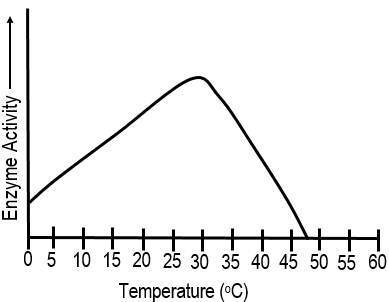
Based on the graph, what temperature does this enzyme work best? 
a)
15 C
b)
40 C
c)
30 C
d)
47 C
26.
Which of the following conclusions can be drawn from this graph?
a)
The optimum pH of the enzyme is 6.6.
b)
The optimum pH of the enzyme is 5.8
c)
The enzyme’s activity increases as pH increases 5.0 to 9.0
d)
The enzyme’s activity is greater around pH of 8.0 .
27.

What happens when enzymes are heated to a high temperature?

a)

The enzymes die.

b)

The shapes of the enzyme are altered.

c)

The enzymes' amino acid sequence changes.

d)

The enzymes remain the same

28.
What 3 letters do enzymes typically end in?
a)
-ose
b)
-ase
c)
-ese
d)
-tic
29.
What are the three types of mutation? 
a)
Insertion, Deletion, Subsitution
b)
Deletion, Newstion, Subsitution 
c)
Newstion, Deletion, Insertion 
d)
Insertion, Newstion, Substitution 
30.
What mutation has occurred here? 
T-G-A-C-C-A
T-G-A-G-C-A
a)
Substitution
b)
Deletion
c)
Insertion
d)
Frameshift 
31.
DNA molecule segment is : TTACGCAAG
The mutated DNA segment is TTCGCAAG. This is an example of ___ mutation.
a)
Substitution
b)
Deletion
c)
Insertion
d)
Inversion
32.
Original: ATC CAT
Mutation: ATC GCAT
What mutation occurred?

a)
deletion
b)
insertion
c)
silent
d)
transverse