
 Worksheets
Q4_TOPIC 4_MIRRORS and LENSES
Total questions: 50
Worksheet time: 38mins

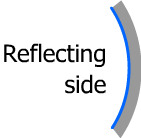

What type of mirror is used in a convenience store to provide a wide angle view?
Plane
Convex
Concave

What type of mirror is used by a dentist to get magnified view of a patient's teeth?
Plane
Convex
Concave

What type of mirror that can produce an inverted image?
Plane
Convex
Concave
Which of the following are the characteristics formed by plane mirror?
Virtual, Inverted, Laterally inverted, Same Size, Same Distance
Virtual, Upright, Laterally inverted, Same Size, Same Distance
Real, Inverted, Laterally inverted, Same Size, Same Distance
What does diverging mirrors or lenses mean?
Light rays converge producing a magnified image.
Light rays reflect producing a mirror like image
Light rays spread out producing a wider view field
Light rays absorb producing a darker image.
Which of the following is produces a diverging image, wider view field?
Convex mirror
Which of the following produces a converging image, magnified view of the object?
Concave lens
Convex Lens
Convex mirror

The ray of light that strikes a mirror
incident ray
reflected ray
angle of incidence
angle of reflection
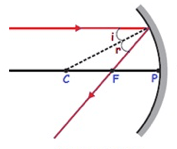
This ray diagram is for which mirror?
concave
convex
plane
window

According to the law of reflection the angle of incidence is ____________ the angle of reflection.
less than
greater than
equal to

This is an example of a _________ mirror
Concave
Convex
Magnifying
Plane
All of the following are examples of concave mirrors except one, what is it?
make up mirrors
dental mirrors
side mirrors
inward scoop of spoon
Why can we not use concave mirrors as side mirrors for automobiles?
Because concave mirrors produces varying images at different distances
Because concave mirrors collects too much dust because of its shape
Concave mirrors produces small images which cannot be seen by the driver
Concave mirrors are only used for flashlights


How does a concave lens differ from a convex lens?
A convex lens is another way to describe a plane mirror; a concave lens is curved
A concave lens is curved inward on both sides; a convex lens is on only one side
A convex lens has a thick center and thin edges, a concave lens has a thin center and thicker edges
A convex lens has a thin center and thick edges. a concave lens has a thick center and thinner edges
When light waves move from passing through air to passing through a glass lens when happens to them?
They slow down and change direction
They speed up and change direction
They maintain the same speed and change direction
They maintain their same speed and direction

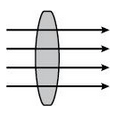
The above lens is a type of ___.
diverging lens
converging lens
divergent lens
convergent lens
Which figure represents the path light takes through a converging lens?
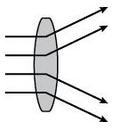
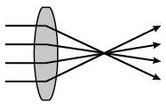
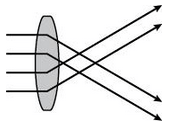
Where are lenses used? (multiple correct)
Telescopes
Contact lenses
Eye-glasses
Binoculars
What does the word "converging" mean?
How is a convex lens able to project an image onto a screen?
The lens bends light outward and creates a real image.
The lens bends light outward and creates a virtual image.
The lens bends light inward and creates a real image.
The lens bends light inward and creates a virtual image.
A telescope is a tool that helps people observe distant objects. In the simplest telescope design, incoming light hits a lens and is focused to a single point. This focused image is then magnified by a second lens so that it is roughly the same size as an observer's pupil. Which of the following wave behaviors plays the most important role in the functioning of this type of telescope?
refraction
interference
resonance
reflection

The time line below shows how the use of lenses to magnify objects has changed over the last 2,000 years. What does the time line suggest about scientific knowledge throughout the years?
It suggests that scientific knowledge began when the first convex lens was developed, since complex lenses opened the door to all scientific studies.
It suggests that scientific knowledge changes over time, as shown by the new discoveries made about lenses leading to changes in their uses.
It suggests that scientific knowledge does not change, as scientists work independently of each other and do not build on each other's ideas.
It suggests that scientific knowledge is replaced and not modified, as exemplified by the single lens replacing multiple lenses.

The pictures show three objects. Which of the following correctly matches the letters with the names of the objects?


Which statement best describes how light and lenses work together?
Lenses change the direction of light rays by bending them.
Lenses break up white light into the spectrum.
Lenses cause light rays to spread apart.
Lenses cause objects to appear larger.

A model of a concave lens is shown below.
Which of the following describes a possible application of this type of lens?
Concave lenses can be used in mirrors to make objects appear closer than they truly are.
Concave lenses can be used in laser pointers to converge the projected light to a single point.
Concave lenses can be used in microscopes to make small objects appear larger.
Concave lenses can be used in car headlights to spread the projected light outwards.
What kind of mirror is used in automobiles and trucks to give the driver a wider area and smaller image of traffic behind him?
plane mirror
converging mirror
concave mirror
diverging mirror
What type of mirror do dentists usually use to see clearly the images of our teeth?
plane mirror
convex mirror
diverging mirror
converging mirror
What type of lens is used to treat hyperopia?
Diverging lens
Concave lens
Converging lens
Converging meniscus lens
What type of lens is used to correct nearsightedness?
Concave lenses
Convex lenses
Diverging lenses
Converging lenses
The following statements describes a diverging lens except...
Spreads out light 🕯️
Minifies objects
Thinner in the middle and thicker at the edges
Bulging surfaces that is directed outward
The following mirrors are all concave except....
Head light if the car
Solar cooker
Side mirror
Burning mirror
Which of the following uses concave lens?
Which type of lens is commonly used in magnifying glasses?
Concave lens
Convex lens
Diverging lens
Converging lens
What happens to light when it passes through a diverging lens?
It converges to a focal point
It diverges and spreads out
It reflects off the surface
It absorbs the light completely
What type of mirror is commonly used in makeup vanity tables?
Plane mirror
Convex mirror
Concave mirror
How does a concave mirror differ from a convex mirror in terms of image formation?
Concave mirrors always produce virtual images.
Convex mirrors always produce real images.
Concave mirrors can produce both real and virtual images.
Convex mirrors can produce both real and virtual images.
How does a convex mirror affect the size of the image compared to the object?
It magnifies the image
It reduces the size of the image
It maintains the same size
Which type of lens is commonly used in cameras and projectors?
Concave lens
Convex lens
Diverging lens
Converging lens
Which type of lens is used in a magnifying glass to make objects appear larger?
Concave lens
Convex lens
Diverging lens
Converging lens
What is the primary function of a convex mirror?
To produce real images
To converge light rays
To reduce the size of the image
To provide a wider field of view
Which of the following optical instruments uses a diverging lens and converging lens, respectively?
Binocular, telescope
Binocular, DSLR camera
DSLR camera, telescope
Microscope, telescope

