
 Worksheets
Plant Structure Quiz
Total questions: 30
Worksheet time: 22mins
The leaf's waxy cuticle
stores water
reduces evaporation and dehydration
transports water into the leaf
absorbs water for the leaf
Where do gases involved in photosynthesis pass in and out of the leaf?
stomata
phloem
xylem
cuticle
What part of a plant transports water and soil minerals through the roots, stems, and leaves?
root hairs
phloem
xylem
cuticle

Which of the following is the function of the guard cells on the lower surface of the leaf?
synthesizing proteins
transporting water and minerals
control how much water is lost from the leaf
allowing light to enter the leaf
What is a plant trophism?
A stimulus that affects plants.
The way a plant responds to a stimulus.
The way a plant grows.
The way a plant dies.

The diffusion of water vapor out of a leaf
transportation
transformation
transpiration
translocation
Needle-shaped leaves help plants ____________ more water than broad leaves.
lose
create
absorb
conserve
Xylem transports ___________________and phloem transports __________ inside of the plant.
water up; food down
water down; food up
food up; food down
food down, food up
What is the region of rapid cell division and growth in plants?
Guard
Stomata
Xylem
Meristem

What plant structure are these?
tap roots
fibrous roots
storage roots
Where leaves are attached on the stem
Casparian strip
node
vascular bundle
primary growth
Where photosynthesis occurs in the leaf
Secondary growth
mesophyll
stomata
transpiration

What structure is label A showing?
A vein containing xylem and phloem
Palisade mesophyll
spongy mesophyll
stomata and guard cells

If plants don't store up water, how does water leave the plant?
The roots get rid of excess water.
Most plants DO store water.
It is released from the leaves by TRANSPIRATION.
The leaf is known as the ___________.
photogenic organ
Photosynthetic organ
Photographic organ

Name part 1 in the structure of the leaf, which is know as "skin".
Upper epidermis
Palisade mesophyll
Spongy mesophyll
Lower epidermis

Which type of the root is shown in the picture?
Fibrous
Taproot
Vascular
Nonvascular

Why are these root hairs so important to this germination seed?
they connect the xylem and phloem
they increase the surface area for absorption of water and minerals
they are needed to store food
they are needed for photosynthesis

Which label shows the palisade layer?
A
B
C
D
E
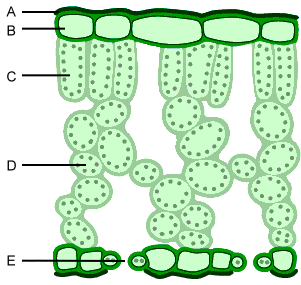
What is letter "D" pointing to?
upper epidermis
palisade mesophyll
spongy mesophyll
bundle sheath
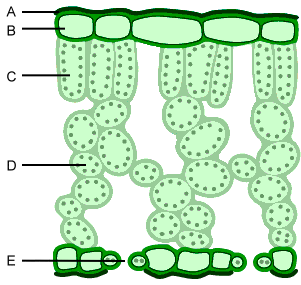
Which of the following is pointing to the "stomata"?
B
C
D
E

Plants curling around a pole or mailbox is an example of:
Phototropism
Germination
Turgor pressure
Thigmotropism
The tip of the root that protects is as it grows is called the __.
root force
root guard
root shield
root cap

If the phloem found beneath the bark of a tree is removed, what will happen to the tree?
It will go dormant
It will generate new phloem
food would not be able to reach the roots and it will die
No change will be seen

The movement or growth of a plant in response to the light coming from this window is called __.
Thigmotropism
Geotropism
Phototropism
Hydrotropism

Which type of tropism is represented in the GIF?
Hydrotropism
Thigmotropism
Phototropism
Gravitropism

Which type of tropism is represented in the GIF?
Hydrotropism
Thigmotropism
Phototropism
Geotropism

Which type of tropism is represented in the GIF of a Venus Fly Trap?
Hydrotropism
Thigmotropism
Phototropism
Gravitropism
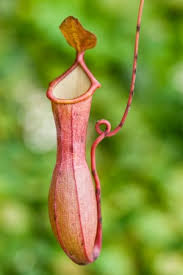
Identify the picture
sundew
Venus flytrap
pitcher plant

What is one possible reason for seeds to have hooks or barbs?
to stay warm during the winter
to protect themselves from sunlight
to get attached to passing animals and get carried away
to stick to animals and steal nutrients from them

