
 Worksheets
Geosphere Unit Test
Total questions: 24
Worksheet time: 12mins
Name
Class
Date
1.
The inner most layer of the earth is
a)
solid
b)
liquid
c)
gas
d)
plasma
2.
Which of the following is NOT a characteristic that all minerals must have?
a)
naturally occurring
b)
organic
c)
solid under normal conditions
d)
fixed chemical composition
3.
Which characteristic of a mineral is the most easily observed but the least reliable?
a)
color
b)
luster
c)
streak
d)
hardness
4.
Which mineral property is determined by rubbing it on a rough surface?
a)
color
b)
luster
c)
streak
d)
hardness
5.
The Moh’s scale shows the range of which mineral property?
a)
color
b)
luster
c)
streak
d)
hardness
6.
Which of the following is NOT true of mining?
a)
It will likely become more costly to mine in the future.
b)
We can reduce our need to mine by recycling mineral-containing materials.
c)
Minerals are used to produce household items such as electronics and cosmetics.
d)
The environmental impact of mining will likely remain the same in the future.
7.
Plates move away from each other, allowing magma to rise and cool in the gap, creating new land.
a)
Convergent
b)
Divergent
c)
Transformative
d)
Conservative
8.
Heat from the core of the earth causes the mantle to move with what
a)
hydroelectric power
b)
plate instability
c)
convection currents
d)
deep sea currents
9.
When two plates are moving towards each other, this boundary is called what?
a)
divergent boundary
b)
convergent boundary
c)
transform boundary
d)
fault
10.
The point on the surface of earth where we feel an earthquake directly above the release of energy is called what?
a)
Focus
b)
Epicenter
c)
Waves
d)
Fault
11.
Earthquakes are...
a)
plate tectonics
b)
a release of energy in the crust
c)
convection currents
d)
weather patterns
12.
Most volcanoes on earth are found where?
a)
continental mountain ranges
b)
the ocean floor
c)
the ring of fire
d)
transform boundaries
13.
Most mountains form where?
a)
convergent boundaries
b)
volcanoes
c)
earthquakes
d)
divergent boundaries
14.
What is the primary difference between the inner and outer core?
a)
Convection occurs in the inner core but not outer core
b)
The inner core is much cooler than the outer core
c)
The inner core is solid and the outer core is liquid
d)
The inner core is mostly iron and the outer core mostly nickel
15.
What type of boundary occurs when a shearing force is occurring between two plates
a)
Divergent
b)
Convergent
c)
Transform
d)
None of these are correct
16.
Which of the following are the three largest sources of energy for the United States?
a)
petroleum, natural gas, and coal
b)
solar, natural gas, and coal
c)
petroleum, hydroelectric, and natural gas
d)
solar, wind, and hydroelectric
e)
nuclear, hydroelectric, and coal
17.
Which of the following is NOT true of solar energy?
a)
Solar energy is most efficiently collected in highly populated areas.
b)
Solar energy is difficult to store.
c)
There is plenty of solar radiation to fuel the whole world with the correct technology.
d)
One of the drawbacks to solar energy is the cost of producing photovoltaic cells.
18.
Which of the following energy sources is incorrectly matched?
a)
oil- nonrenewable
b)
solar- renewable
c)
wind- renewable
d)
natural gas- nonrenewable
e)
geothermal- nonrenewable
19.
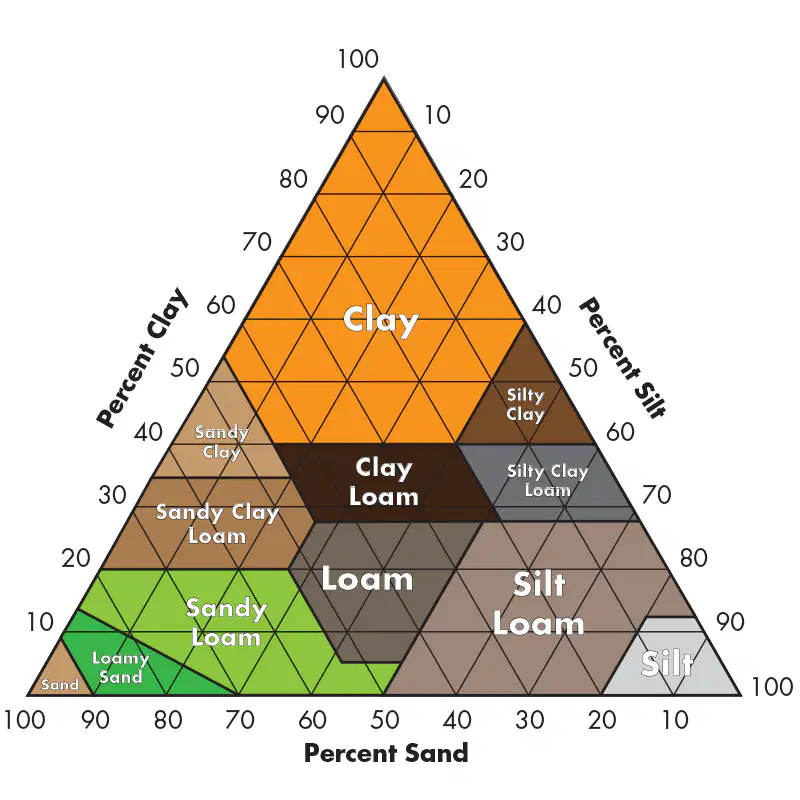
What type of soil is composed of 75% sand, 15% silt, and 10% clay?
a)
Sandy Loam
b)
Clay
c)
Sandy Clay Loam
d)
Loam
20.

Name the type of soil that is made of 40% sand, 40% silt, and 20% clay
a)
Silty Clay
b)
Clay loam
c)
Loam
d)
Loamy sand
21.

20% sand, 60% silt, 20% clay makes what kind of soil?
a)
Loam
b)
Silt loam
c)
Silt
d)
Sand
22.

Which ocean is located at 20 S, 0?
a)
Pacific
b)
Arctic
c)
Indian
d)
Atlantic
23.

Which set of coordinates locate a country in North America?
a)
0,0
b)
40 N, 100 W
c)
20 S, 140 E
d)
80 S, 0
24.

What country is located at 40 N, 120 W?
a)
Sacremento
b)
Mexico City
c)
Nairobi
d)
Beijing
100 %

