wayground logo

Free Printable Worksheets

NEW

Font size

S
M
L
XL
Worksheets

Waves PRACTICE TEST

Total questions: 65

Worksheet time: 2hrs 45mins
Name
Class
Date
1.

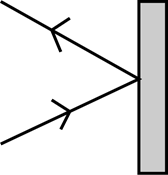
The illustration shows a light ray striking an object.

In the illustration, the light ray striking the object is-

a)

diffraction

b)

Deflection

c)

reflection

d)

all of these

2.
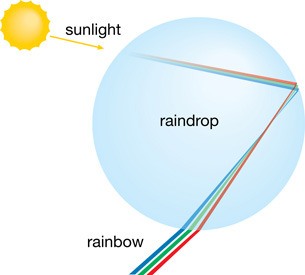
Light bending as it passes through a rain drop is an example of...
a)
Refraction
b)
Reflection
3.
a)

Reflection

b)

Refraction

c)

Diffraction

4.

The wave goes around something that gets in the way.

a)

Reflection

b)

Refraction

c)

Diffraction

5.

The wave bends because the speed of the wave changes.

a)

Reflection

b)

Refraction

c)

Diffraction

6.

What would you call this?

a)

Refraction

b)

Diffraction

c)

Bends

d)

Reflection

7.
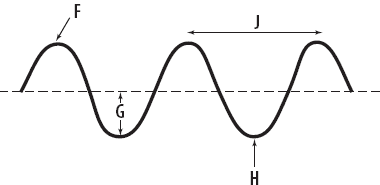
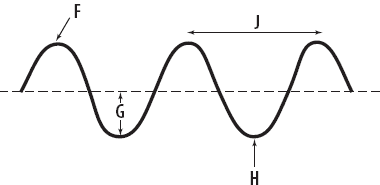
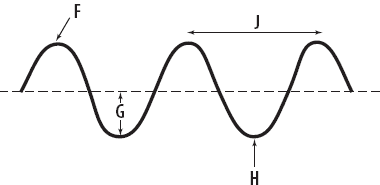
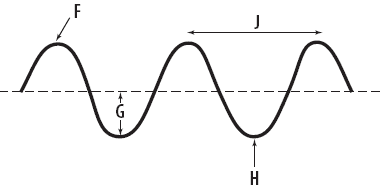
Which letter is a crest?
a)
F
b)
G
c)
H
d)
J
8.
Which letter is a trough?
a)
F
b)
G
c)
H
d)
J
9.
Which letter shows amplitude?
a)
F
b)
G
c)
H
d)
J
10.
Which letter identifies the wavelength?
a)
F
b)
G
c)
H
d)
J
11.
In a sound wave, the area where molecules have been pressed together is a...
a)
Compression
b)
Rarefaction
c)
Wavelength
12.
In a sound wave, the area where there are fewer molecules and they are spread out is a...
a)
Compression
b)
Rarefaction
13.

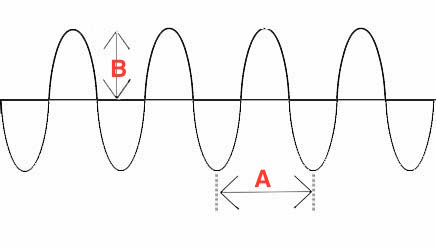
What is the term for the section of this wave labeled B?

a)

B is called rarefaction

b)

B is called compression

c)

B is called the crest

14.

What is the term for the section of this wave labeled A?

a)

A is compression

b)

A is the trough

c)

A is the rarefraction

15.

In a solid, sound waves travel _____ in a liquid.

a)

faster than

b)

slower than

c)

the same as

d)

all of these

16.

Frequency is measured in _____

a)

hertz

b)

meters

c)

decibels

d)

meters/second

17.

Refraction happens because the wave ____

a)

changes speed as it changes mediums

b)

changes speed as it changes directions

c)

changes color as it changes mediums

d)

the type of wave changes

18.

Waves that need a medium are called

a)

electromagnetic

b)

light

c)

mechanical

d)

microwaves

19.

When the car moves AWAY from you, its horn seems_____.

a)

Low frequency

b)

High frequency

c)

greater amplitude

d)

the same as when it is coming towards you

20.

When an ambulance move TOWARD you it has a ________.

a)

high frequency

b)

low frequency

c)

medium frequency

d)

the same as when it moves away

21.
What does a wave carry?
a)
boats
b)
matter
c)
energy
d)
water
22.

In space,you cannot hear because _____

a)

there are no air molecules to carry sound.

b)

the sounds o space are too loud

c)

the sun destroys the sound waves

d)

there is no magnetic field

23.

Sound travels through all of these EXCEPT _____

a)

water

b)

helium

c)

metal

d)

vacuum

24.
Which wave has a greater frequency?
a)
wave B
b)
wave C
25.
Which wave is pictured?
a)
Transverse
b)
Longitudinal
c)
Both
d)
Neither
26.
This picture (B) shows light moving as a...
a)
Transverse Wave
b)
Ocean Wave
c)
Compression Wave
d)
Slinky Wave
27.

When a wave encounters an obstacle, and it either passes through it or around it. The wave bends or spreads out. This is...

a)

diffraction

b)

reflection

c)

refraction

d)

amplitude

28.
What kind of wave is pictured below?
a)
compressional wave
b)
transverse wave
c)
sound wave
d)
mechanical wave
29.
Waves are a transfer of what?
a)
Heat
b)
Light
c)
Energy
d)
Food
30.

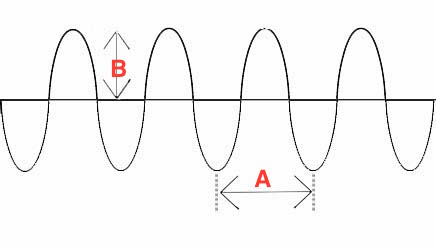
What property of this wave is represented by the letter "A"

a)

amplitude

b)

crest

c)

trough

d)

wavelength

31.
What property of the wave is represented by the letter "B"?
a)
amplitude
b)
crest
c)
trough
d)
wavelength
32.
The number of wavelengths that pass a point each per second is:
a)
frequency
b)
period
c)
longitudinal 
d)
transverse wave 
33.
The type of waves that require medium to pass:
a)
Mechanical Waves
b)
Electromagnetic Waves
34.
When the frequency of a wave increases, what happens to the wavelength?
a)
The wavelength is not directly affected by the frequency of a wave.
b)
The wavelength increases.
c)
The wavelength decreases.
d)
More specific information is needed to form a conclusion about the wavelength.
35.
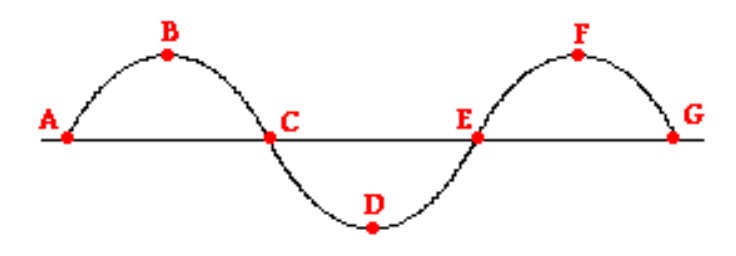
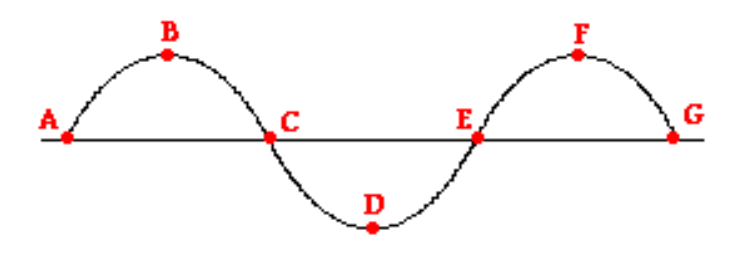
Which vocabulary term is used to identify the distance between points C & G?
a)
Amplitude
b)
Crest
c)
Frequency
d)
Wavelength
36.
Which letter(s) represent the trough of the wave?
a)
A
b)
B & D
c)
D
d)
C & G
37.
Which letter(s) represent the crest of the wave?
a)
A
b)
B & D
c)
B & F
d)
F
38.
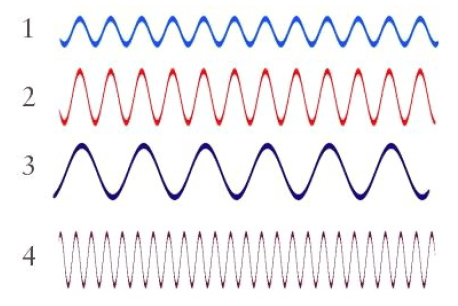
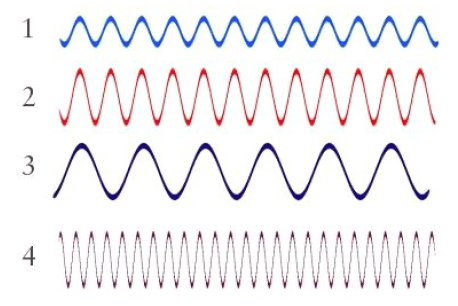
Which wave in the diagram has the greatest frequency?
a)
1
b)
2
c)
3
d)
4
39.
Which wave in the diagram has the greatest wavelength?
a)
1
b)
2
c)
3
d)
4
40.
What are the spaced out sections of this wave called?
a)
Reflections
b)
Rarefactions
c)
Compressions
d)
Wavelengths
41.
This is a __________wave
a)
transverse
b)
longitudinal
c)
surface
d)
all of the above
42.
This is a __________wave
a)
transverse
b)
longitudinal
c)
surface
d)
all of the above
43.
A wave carries...?
a)
energy only
b)
matter only
c)
energy and matter
d)
neither
44.
Which term best represents what happens when two wave pulses meet as they approach each other on a string?
a)
constructive interference
b)
destructive interference
c)
absorbed interference
d)
static interference
45.
When sound or light waves approach a corner, what is it most likely to do?
a)
go in a straight line
b)
bend around the corner
c)
turn around around and go back
d)
none of the above
46.

The material in which a mechanical wave travels is...

a)

medium

b)

vacuum

c)

black holes

d)

chocolate

47.
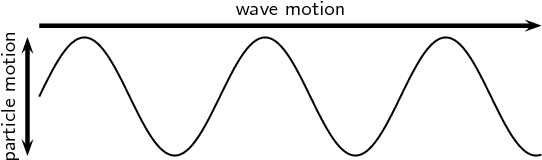
makes the particles in a medium move parallel to the direction of the wave
a)
longitudinal wave 
b)
transverse wave 
c)
electromagnetic wave 
48.
Wave that moves perpendicular to the motion of the wave
a)
transverse
b)
compressional
c)
physical 
d)
chemical
49.
The interaction between 2 waves that meet is 
a)
interference
b)
resonance
c)
frequency
d)
nodes
50.
Which letter shows reflection? 
a)
Pathway A
b)
Pathway B
c)
Pathway C
d)
Pathway D
51.

The wavelength of a sound wave is 20m. The frequency is 5 Hz. What is the wave speed?

a)

4 m/s

b)

100 m/s

c)

25 m/s

d)

15 m/s

52.
When the sound source moves, the frequency changes
ex. police car siren sounding lower pitch after the car passes
a)
pitch
b)
frequency
c)
Doppler Effect
d)
medium
53.

The pitch of a sound wave relates to the wave's _________________.

a)

Amplitude

b)

Frequency

c)

Wavelength

d)

Period

54.

You are driving in a car and honk the horn at a person standing in the street. As you approach the person, what happens to the pitch of the horn according to you in the car?

a)

It increases

b)

It decreases

c)

It stays the same because you are in the car moving with the sound.
55.

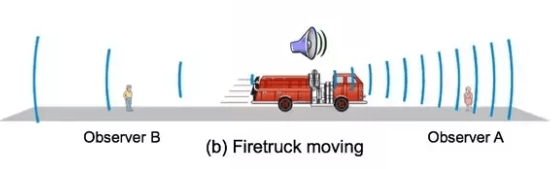
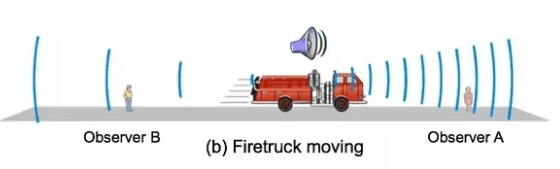
Look at the picture. Who is experiencing a higher pitched sound?

a)

Observer A

b)

Observer B

c)

There's no difference

56.

Look at the picture. Who is experiencing a lower pitched sound?

a)

Observer A

b)

Observer B

c)

There is no difference

57.
What can you tell about this object's motion?
a)
Moving to the North (up).
b)
Moving to the South (down). 
c)
Moving to the West (left). 
d)
Moving to the East (right). 
58.
What can you tell about the motion of this object?
a)
Moving left.
b)
Moving right quickly.
c)
Standing still. 
d)
Moving up slowly. 
59.
One end of the rope is vibrated to produce a wave with a wavelength of .25 m.  The Frequency of the wave is 3.0 Hz.  What is the speed of the wave?
a)
3.00 m/s
b)
2.50 m/s
c)
.75 m/s
d)
1.25 m/s
60.
 A wave has frequency of 50 Hz and a wavelength of 10 m. What is the speed of the wave?
a)
500 m/s
b)
50 m/s
c)
5 m/s
d)
0.5 m/s
61.
 A wave has frequency of 5 Hz and a speed of 25 m/s. What is the wavelength of the wave?
a)
25 m
b)
125 m
c)
5 m
d)
25 m/s
62.
A wave has wavelength of 10 m and a speed of 340 m/s. What is the frequency of the wave?
a)
34 m/s
b)
3400 Hz
c)
3400 m/s
d)
34 Hz
63.
What is the speed of a 20 Hz with a 4m wavelength?
a)
0.2 m/s
b)
5 m/s
c)
80 m/s
d)
320 m/s
64.
What is the frequency of a wave traveling at 300 m/s with a 4 m wavelength?
a)
0.013 Hz
b)
75 Hz
c)
300 Hz
d)
1200 Hz
65.
A wave has wavelength of 10 m and a speed of 340 m/s. What is the frequency of the wave?
a)
34 m/s
b)
3400 Hz
c)
3400 m/s
d)
34 Hz