
NEW
Font size
 Worksheets
Science Benchmark 2 Review #2
Total questions: 50
Worksheet time: 4hrs 10mins
A ____ is the time it takes the EARTH to REVOLVE around the SUN.
1 day/24 hours
1 year/365 days
1 month
1 week
The path one space object takes around another.
Revolution
Gravity
Revolve
Orbit
What are the OUTER planets?
Jupiter, Saturn, Earth, Neptune
Saturn, Neptune, Mars, Uranus
Jupiter, Saturn, Uranus, Neptune
Mercury, Venus, Earth, Mars

The diagram shows the SUN interactions with the OCEAN.
Which statement shows the correct interaction?
No evaporation but condenses into clouds.
Evaporation of saltwater becoming water vapor
The wind moving constantly.
Run-off through the land back in the ocean.
Which of the following are NON-RENEWABLE energy?
Plants
Coal
Petroleum (oil)
Wind energy
Solar energy
Wood
Natural gas
Coal
Petroleum (oil)
Plants
coal
Animals

Which answer choice best classifies the NATURAL RESOURCES in the chart?
Renewable: coal, air, tree Nonrenewable: petroleum, wheat, natural gas, sheep, lake, fish
Renewable: coal, petroleum, natural gas, lake Nonrenewable: air, tree, wheat, sheep, fish
Renewable: tree, wheat, sheep, fish Nonrenewable: coal, air, petroleum, natural gas, lake
Renewable: air, tree, wheat, sheep, lake, fish
Nonrenewable: coal, petroleum, natural gas

A wagon is pushed and begins to move. As the wagon moves, it slows and comes to a stop. The wagon and the direction it is pushed are shown.
What FORCE causes the wagon to stop?
(Hint: what force works AGAINST motion?)
The force of gravity which is acting in the same direction as the arrow
The force of friction which is acting in the same direction as the arrow
The force of gravity which is acting in the opposite direction of the arrow
The force of friction which is acting in the opposite direction of the arrow

A student wants to make a change to the circuit shown below so that when Switch 1 is open and Switch 2 is closed, only 1 light will be on in the circuit.
Which diagram shows how the student should change the circuit?
(Hint: use your finger to create a complete path from the positive to the negative end of the battery.
Switch: Open = broken, Closed = flows)


A science class is observing a pet turtle in a small plastic pool. The students turn on a portable camping lamp that is clamped on to a counter next to the pool.
Which kind of ENERGY is used by the portable lamp to produce light?
(Hint: MELTS)
Mechanical energy, because the lamp is clamped on to the counter
Thermal energy, because the lamp increases the temperature of the water
Electrical energy, because the lamp is battery-operated
Sound energy, because the lamp vibrates when clicked on

A student constructs the circuit shown for a science demonstration.
With the switches in these positions, which lights are ON?
All the lights
Lights 1 and 2 only
Lights 3 and 4 only
None of the lights

A student uses a flashlight to shine a beam of light on three different objects.
Which table describes what happens to the light beam as it interacts with each object?


Students investigate FORCE. The masses they use begin at rest on the ramp. The setup the students use is shown
Which change will REDUCE the amount of force needed to move the masses?
Decrease the height of the ramp
Increase the height of the ramp
Add an additional mass
Pull the spring scale with two hands

Students list resources that are used to heat buildings.
Which of these tables correctly classifies the resources?


A student’s model of a closed ecosystem is shown. The student plans to add land snails to the model in order to show how the snails interact with different parts of the ecosystem.
What should the student add to the model so that the snails will survive?
Fish to provide food
Sticks to provide a place to hide
Deep water to provide carbon dioxide
Living plants to provide oxygen

The raccoon can be found in most areas of Texas. The coati has a smaller territory and is found from Big Bend to Brownsville. These two species are related. The chart shows the characteristics of these two species.
Which statement does NOT describe how the body structures of these animals help them escape predators?
Paws with long claws on flexible toes help them climb trees.
Sharp teeth allow them to catch prey on land or in water.
Long tails allow them to balance on branches in trees.
Good eyesight helps them to see at night.

5.5A - A student reads the label on the bottle of salad dressing shown below.
Why would the student shake the salad dressing well before using it?
Vinegar and oil have different densities.
Vinegar and oil easily form a solution
Vinegar and oil both contain water
Vinegar and oil are both liquids
A student puts four objects in a bucket filled with water. The objects are listed below. - Plastic ball Glass marble Metal paper clip Wood block - Which two objects are most likely LESS DENSE than the water?
Wood block and metal paper clip
Plastic ball and glass marble
Metal paper clip and glass marble
Wood block and plastic ball
What is the difference between a CONDUCTOR and an INSULATOR?
An insulator allows electricity to flow through it easily and a conductor does not
A conductor allows electricity to flow through it easily and an insulator does not.
An insulator is magnetic and a conductor is not
A conductor is magnetic and an insulator is not
Which of these is an example of PRECIPITATION?
snow
air
clouds
vapor
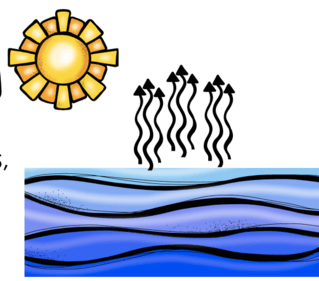
What part of the water cycle does this picture show?
condensation
precipitation
evaporation
What is the energy source for the water cycle?
the sun
the earth
water
the moon
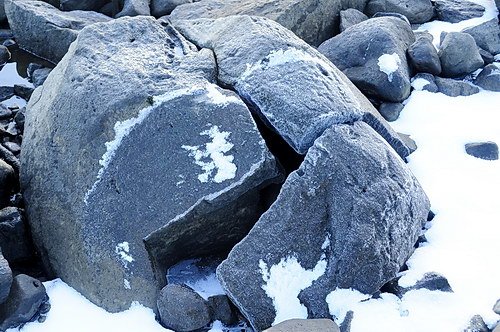
How does freezing water cause the WEATHERING of rocks? The freezing water ______.
keeps the rocks in place.
makes the rocks last longer.
expands cracks and breaks rocks.
causes rocks to fall in landslides.
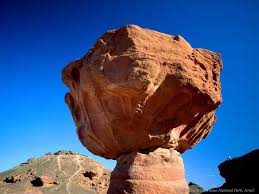
The process that breaks down rocks and other materials on Earth's surface is called _______.
Weathering
Erosion
Deposition
Decomposition

The pictures shows what a student observed when he looked through a hand lens at a penny.
What happens to light passing through a hand lens that makes the image of the penny appear larger? The light is _______.
absorbed
reflected
refracted
stopped
What form of energy is being used when a person pushes heavy boxes across the floor?
Electrical energy
Mechanical energy
Heat energy
Sound energy
A combination of 2 or more substances that CANNOT be easily separated is called a ____________.
a mixture
a solution
a solute
a solvent

If you spilled nails in a sandbox, what separation tool/method could you use to clean out the sandbox so it would be safe for children to play in?
Filter
Screen
Magnet
Evaporation
All of the following are sources of light EXCEPT ______________.
the sun
a light bulb
fire
the moon

What type of lens is this?
Convex
Concave
Compact

What type of lens is this?
Convex
Concave
Compact
What happens when a light strikes a transparent surface, such as window glass or plastic wrap?
Light can pass through or be transmitted
Light will reflect and scatter
Light will be absorbed and heated
The light will be refracted
Charlee wants to watch the sunset. Which direction in the sky should she look?
North
West
South
East

What is the volume of water in the graduated cylinder?
34 mL
30 mL
40 mL
32 mL
In a grassland ecosystem, lions prey on wildebeest. The population of lions has declined steadily because of illegal hunting.
What will most likely happen to the population of wildebeest?
The wildebeest population will decrease.
The wildebeest population will increase.
The wildebeest population will remain the same.
What would happen if the snakes were taken out of this food chain?
Clover → Grasshopper → Frog → Snake → Owl
clover would increase
frogs would increase
grasshoppers would increase
owls would increase
A fly (prey) is eaten by a frog (predator). Both are an important part of the ecosystem.
Why is it important to have both the predator and prey in an ecosystem?
Forgs are predators.
There should not be any predators.
Most people don't like flies so it is a good thing they are eaten by frogs.
It keeps a balance in the eosystem.
What forces cause tsunamis?
the movement of the earth and moon
underwater earthquakes and volcanoes
high winds on the surface of warm water
cold deepwater currents and warm surface currents colliding

Trail mix represents an example of which of the following?
solution of solids
mixture of solids
solution of solids and gases
mixture of solids and gases
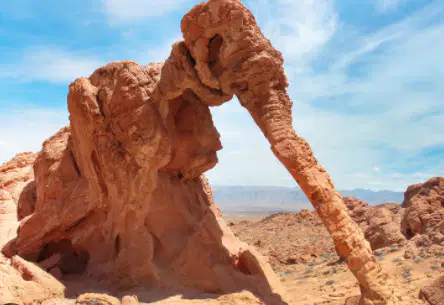
The strange shape of the rock formation shown is most likely the result of which of the following?
a landslide
gradual weathering
a volcanic eruption
an earthquake
What force slows down objects that are in motion?
Friction
Fiction
Fact
Sludge
2 wires carrying electricity can create a spark if they come too close together. This spark can start a fire. Wires carrying electricity are usuallly covered with plastic to keep them from starting a fire.
Why does the plastic keep electricity from starting a fire?
Plastic is a good insulator.
Plastic can melt when heated.
Plastic is softer than wire.
Plastic conducts electricity.
A student made a list of activities that involve energy.
1. Sharks chasing a school of fish
2. A toaster heating bread
3. A cell phone charging
4. A tree limb falling to the ground
5. Tomato plants absorbing sunlight
6. A canoe floating down a river -
Which activities on the list are examples of the use of mechanical energy?
Activities 1, 4, and 6
Activities 2, 4, and 5
Activities 1 and 2
Activities 3, 5, and 6
Sugar is added to water and stirred unit it completely dissolves.
Which of the following correctly describes something that has happened to the sugar?
The mass of the sugar decreased.
The sugar disappeared an no longer exists.
The sugar is evenly distributed in the water.
The crystal of sugar have entered the atmosphere.
A student was asked to help pass out cups of hot chocolate to two other students. A teacher poured the steaming liquid into cups. Once cup was made of stainless steel and the other was made of thick plastic. As the student walked across the room, he suddenly put one of the cups on a desk and exclaimed "Ouch".
Which cup did he put down and why?
He put down the plastic cup because the contents were spilling everywhere.
He put down the steel cup because it was conducting thermal energy from the liquid to his hand.
He put down the steel cup because it was insulating thermal energy from the liquid to his hand.
He put down the plastic cup because it was insulating thermal energy from the liquid to his hand.
A metal spoon was left in a pot of boiling soup. The cook burned a finger by touching the spoon.
Why did the finger get burned?
The metal spoon chemically reacted with the cook's hand
the metal spoon conducted electricity to the cook's hand
the metal spoon conducted heat to the cook's hand
Which list includes only objects that are CONDUCTORS?
Paper clip, rubber, glass, copper penny
Rubber, glass, wood, plastic
Rubber, glass, copper penny, wood
Paper clip, iron nail, copper penny, aluminum foil
A student observes ice forming on the edge of a school building.
At what temperature did the water outside the school building most likely begin to change to ice?
100°C
32°C
25°C
0°C
Some students paint the inside of several boxes. They paint each box a different color. They observe that the inside of the box painted white looks brighter than the others.
What is the most likely reason this box looks brighter?
More light is reflected off white paint
More is refracted by white paint
More light passes through white paint
More light is absorbed by white paint
A teacher wears protective gloves to lift a metal pan filled with boiling water from a hot plate.
Why are the protective gloves necessary?
The metal pan creates thermal energy
The metal pan insulates thermal energy
The metal pan conducts thermal energy
The metal pan reduces thermal energy

Which form of matter lacks a fixed shape but has a definite volume?
Gas
Solid
Liquid
Plasma

