
NEW
Font size
 Worksheets
The "New" Imperialism
Total questions: 65
Worksheet time: 33mins
In the 19th century, the idea of Social Darwinism was used by Europeans to justify their policy of
multiculturalism
imperialism
national self-determination
secular humanism
One major reason European countries engaged in imperialism in the late 19th century was to
gain a better understanding of unknown territories
ease tensions with their rivals
develop treatments for diseases
obtain markets for their manufactured goods
What was a major reason European nations competed for control of Africa during the second half of the 1800s?
Africa had a wealth of natural resources
Slave labor was needed in the Americas
African nations offered religious and political freedom
Europeans needed land for their excess population
- Treaty of Nanjing gives control of Hong Kong to Great Britain.
- French government sets up a protectorate in Cambodia.
- Italian forces occupy Ethiopia.
Which policy is most closely associated with these statements?
détente
appeasement
nonalignment
imperialism
The primary reason France and Japan were interested in controlling parts of Indochina in the 20th century was to
dominate the Indian Ocean
obtain valuable natural resources
stop the spread of communism
prevent Spanish colonization
The British government took control of the Suez Canal and Singapore during the 19th century in order to
self petroleum to these territories
gain more converts to Christianity
ensure safe passage on strategic waterways
transport laborers directly to the Americas
Which statement best expresses the Western perspective regarding Ruyard Kirpling's "white man's burden"?
Europeans should preserve traditional cultures in Africa and Asia
Europeans must protect existing African and Asian economies
Europeans suffered great hardships in exploring new trade routes to Asia
Europeans had a duty to introduce the benefits of their civilization to non-European
The White Man's Burden
Take up the White Man's burden-
Send forth the best ye breed-
Go bind your sons to exileTo serve your captives' need;
To wait, in heavy harness
On fluttered folk and wild
-Your new-caught, sullen peoples,
Half-devil and half-child.
- Rudyard Kipling, 1899
This stanza from Kipling's poem is most closely associated with the belief that it was the duty of Western colonial powers to
Learn from the people they conquered
teach their colonies how to produce manufactured goods
civilize the people they controlled
welcome less developed countries as equals
One of the most important motives for the European "Scramble for Africa" in the late 1800s was that Africa provided a source of
raw materials used in industry
religious inspiration
free labor for the Americas
technologically innovative practices
Which statement best expresses the motive for 19th-century European imperialism?
Living space was needed for excess population in western Europe
European leaders believed imperialism was an effective method of reducing the number of wars
European nations would benefit from some aspects of the conquered nation's culture
Imperialism would benefit the economies of the colonial powers
After 1880, European colonization was motivated by the
urge to acquire African technology
need for an increase in the production of sugar
desire for new markets
demand for labor in the Americas
In the 1800's, a major cause of European imperialism was the
desire to establish democratic governments throughout the world
emergence of Marxism as an economic system
desire for cheap raw materials and expanded markets
religious conflict between European nations
The location of seaports and the abundance of natural resources such as hardwoods, rubber, and spices were factors that led to
the use of trans-Saharan trade routes by Early African empires
the invasion of Korea and Manchuria by Japan
European imperialism in Southeast Asia
Russian expansion into Siberia
Why were the French and British interested in controlling Egypt in the mid-19th century?
Egypt had control of the spice trade
Egypt had an industrial-based economy
Egypt had vital mineral resources
Egypt had a strategic location
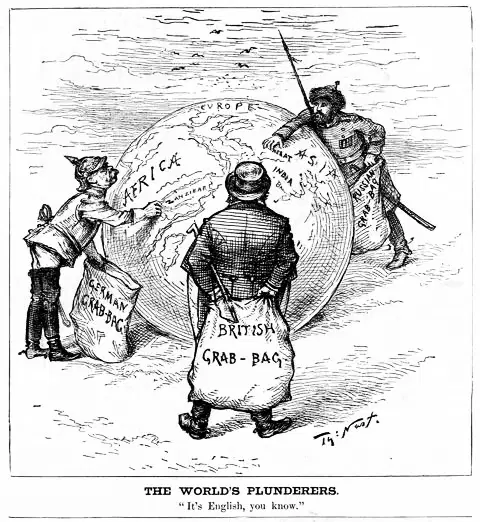
The events shown in this cartoon most directly resulted from which of the following?
desire for new markets and natural resources among European nations
fear of the spread of communism
the creation of the United Nations
the rise of Adolf Hitler and Germany's invasion of Poland
"To begin with, there are the exporters and manufacturers of certain goods used in the colonies. The makers of cotton and iron goods have been very much interested in imperialism. Their business interests demand that colonial markets should be opened and developed and that foreign competitors should be shut out. Such aims require political control and imperialism. Finally, the most powerful of all business groups are the bankers. Banks make loans to colonies and backward countries for building railways and steamship lines. They also make loans to colonial plantation owners, importers, and exporters. The imperialist business interests have powerful allies. Military and naval leaders believe strongly in extending the white man's rule over the 'inferior races,' To this company may be added another element—the missionary. Missionaries went forth to preach a kingdom beyond this world. But they often found themselves the builders of very earthly empires. . ..Last, but by no means least, let us add politicians to our list of empire builders.
-"Imperialism and World Politics, Parker T. Moore, 1926
The political and economic system described in this passage most directly resulted from
the plan for reparations in the Treaty of Versailles
the sale of indulgences by the Catholic Church
a belief in self-determination for all nations
a desire for new markets and natural resources by industrialized countries
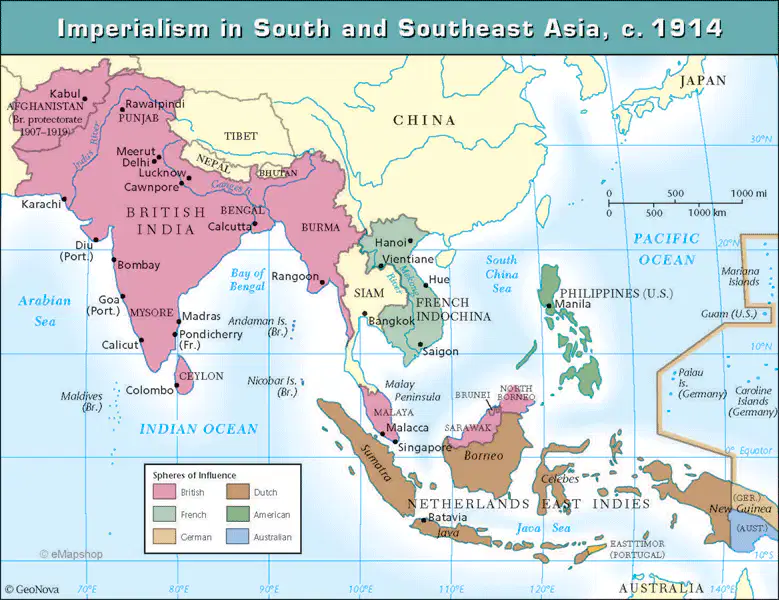
Which event played a major role in the expansion shown on this map?
Russo-Japanese War
French Revolution
Industrial Revolution
World War I
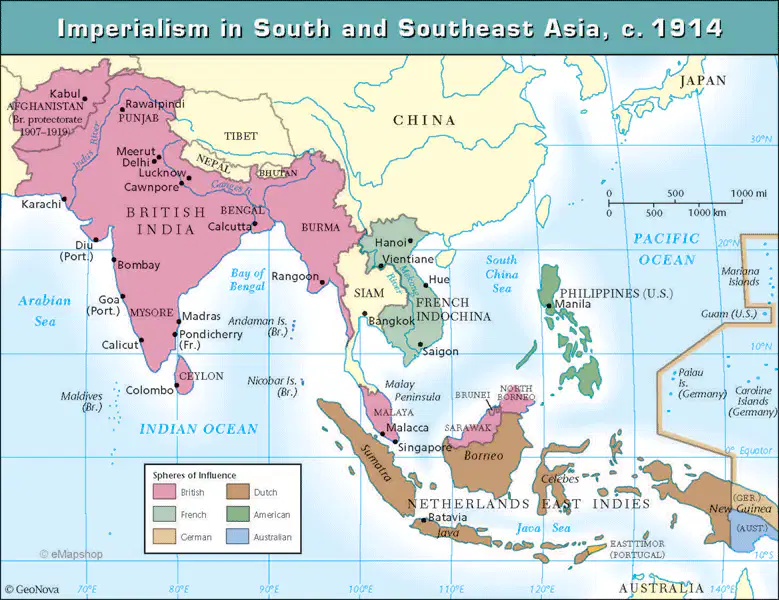
Based on this map, countries from which part of the world gained the most power in Southeast Asia during the late 1800s?
North America
Africa
Europe
Southwest Asia
. . .As late as the 1870s, only 10% of the continent was under direct European control, with Algeria held by France, the Cape Colony and Natal (both in modern South Africa) by Britain, and Angola by Portugal. And yet by 1900, European nations had added almost 10 million square miles of Africa—one-fifth of the land mass of the globe—to their overseas colonial possessions. Europeans ruled more than 90% of the African continent. . . .
Which event most directly influenced the change referred to in this passage?
outbreak of the Boxer Rebellion
meeting of the Berlin Conference
signing of the Munich Pact
collapse of the Ottoman Empire
The terms of the Treaty of Nanjing and of the Treaty of Kanagawa demonstrate the
unequal relationships that characterized imperialism
humanitarian ideals that accompanied missionary activity
importance of technology in developing economies
changing roles of men and women associated with modernization

This cartoon suggests that political power is often acquired through
the inheritance of land
market demands
religious conversion
the use of technology
Which description of trade patterns best represents the relationship between Africa and Europe during the late 19th century?
Trans-Saharan trade caravans led by Europeans were the most profitable
South Africa was of no interest to European traders
Raw materials were shipped from Africa to European industries
Rivers were the key highways connecting Europeans to much of the African interior
Which policy is most directly associated with the terms spheres of influence, extraterritoriality, and protectorate?
collectivization
containment
isolationism
imperialism
The term empire is best defined as
a political unit that has a common religious faith
a government ruled by the consent of the people
an extensive territory under the rule of a single authority
a country that requires conquered peoples to assimilate
Commodore Matthew Perry's visits to Japan in 1853 and 1854 resulted in the
colonization of Japan by the United States
transfer of spheres of influence to China
introduction of Christianity to Japanese society
opening of trade and diplomatic relations with Japan
The major factor that enabled Western Europe to dominate large parts of Asia and Africa in the 19th and early 20th centuries was the
technological and military superiority of European nations
acceptance of Christianity by many Asians and Africans
desire of Asians and Africans for European raw materials
refusal of Asians and Africans to fight against European imperialism
One effect of the British landlord system in Ireland in the mid-1800s and in India in the early 1900s was that these landlord systems
contributed to famine and suffering
allowed local economies to prosper
emphasized food crops over mining
led to an agrarian revolution
The Sepoy Rebellion is considered an important event in Indian history because it was one cause of the
independence movement in India
secession of Bangladesh from Pakistand
establishment of French colonies in India
creation of the Mughal Empire by Muslims
Which historical development showed the desired group to gain independence from a colonial power?
rise of the Nazi Party in Germany
Solidarity movement in Poland
Tianamen Square uprising in China
Sepoy Mutiny in India
The government of Great Britain built railroads, schools, and irrigation systems in colonial India primarily to
to prepare India for independence
to strengthen its political and economic control in India
secure favorable trading arrangements with different Indian leaders
to help India maintain its traditional cultural systems
The primary goal of the Indian National Congress (1885-1947) was to
reform the Hindu religion
partition India between Muslims and Hindus
create a socialist economy
gain independence from Great Britain
British imperialism in India led to the
rejection of traditional values by most Indians
end of conflict between Hindus and Muslims
abolition of the caste system in India
introduction of a parliamentary form of government
Some of the ethnic strife in Africa today can be traced back to the European division of Africa resulting from the
Treaty of Tordesillas
Congress of Vienna
Berlin Conference
Yalta Conference
The Berlin Conference in 1884 was significant because it
promoted Belgium as a world power
established rules for the European division of Africa
called for a war against England
ensured ethnic harmony in the Middle East
Much of which area of the world came under European colonial control in the 19th century?
Japan
Southwest Asia
Africa
Latin America

Many of the political divisions shown on this map were directly related to the
Meiji Restoration
Opium Wars
Berlin Conference
Boer War
Early exploration of Africa by Europeans was hindered by the
lack of natural resources in Africa
alliances between African kingdoms
isolationist policies of European monarchs
many different physical features of Africa
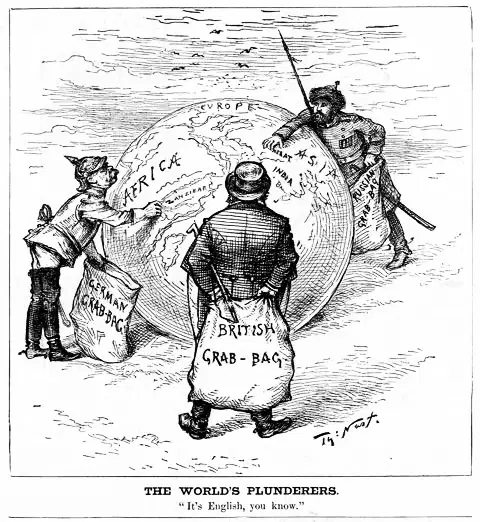
This Thomas Nast cartoon shows the
competition between European nations for overseas territories after the Berlin Conference
aggressive action of the Triple Alliance before World War I
spread of communism throughout the world during the 19th century
concern of European nations for the welfare of developing nations at the end of the 19th century
Which was a major effect of European rule in Africa?
decreased dependence of African nations on imports
development of subsistence farming
improved transportation and communication systems
increased use of barter
The boundaries of modern African nations do not usually follow tribal boundaries mainly because
African nations are trying to decrease tribal influence
most tribes are unwilling to cooperate with the new national governments
tribes have lost their importance in the lives of modern Africans
modern national boundaries tend to follow former colonial boundaries
Why were European nations able to conquer large sections of Africa in the 19th and early 20th centuries?
Europeans easily adapted to African climate and topography
Europeans possessed more advanced military technology
Europeans wanted to learn more about African cultures
Africans wanted to trade with European nations
Which cultures fought with the Zulus in the 19th century over the control of the land in South Africa?
German and French
Indian and Belgian
British and Boer
Ethiopian and Italian
Which phrase best expresses the ideas of 19th-century British foreign policy?
"blood and iron"
"white man's burden"
"liberty, equality, fraternity"
"peace,land, and bread"
Which was a direct result of European slave trade in Africa?
It promoted a feeling of racial superiority among Europeans
West African kingdoms prospered
Africans moved in large numbers to rural areas
African military forces ended the slave trade
An effect of the African slave trade was that it
decreased tribal warfare
introduced the idea of animism to Africa
contributed to racism in both the Middle East and the Western Hemisphere
preserved traditional extended family patterns
What is a long-term result of the conflict described in this letter?
The British were forced to pay reparations to China
The Chinese government closed all ports to the British
The British forced China to sign unequal treaties
The British agreed to respect Chinese sovereignty
The primary purpose of this letter was to persuade the British to
stop the flow of opium into China
increase trade with China
end all businesses with China
defend China against invasion
What is a long-term consequence of the historical development discussed in this 1839 letter?
establishment of British spheres of influence in China
accumulation of great wealth by the Chinese at British expense
successful enforcement of a Chinese embargo on all British imports
creation of a mutually beneficial trade alliance between Britain and China
What was an immediate result of the Opium War described in this passage?
signing the Treaty of Nanking
forming the Guomindang
beginning the Boxer Rebellion
organizing the Taiping Rebellion
The Opium Wars of the mid-19th century marked the beginning of the
rivalry between China and Taiwan
domination of China by foreign powers
decline of European influence in East Asia
global effort to combat drug use
What was a direct result of the Opium War in 19th-century China?
Japan gained control of Hong Kong
Kublai Khan rose to power in China
Chinese ports were opened for trade with European powers
Jiang Jieshi (Chiang Kai-shek) fled to Taiwan
The Opium Wars in China and expedition of Commodore Matthew Perry to Japan resulted in
the economic isolation of China and Japan
an increase in Chinese influence in Asia
the beginning of democratic governments in China and Japan
an increase in Western trade and influence in Asia
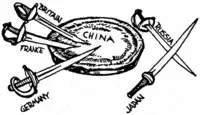
The situation depicted in the cartoon was brought about by the
economic agreements with Western nations signed by Deng Xiaoping
low level of cultural and economic development in China throughout its history
military weakness of China and the European desire for expansion
alliance of the Soviet union with the Communists and the aid given to the Nationalists by Western Europe
The Sepoy Rebellion and Boxer Rebellion are best characterized as responses to
civil conflicts in African colonies
wars of Russian aggression
imperialist practices of European countries
rivalries between Asian nations
What was a major goal of the Boxer Rebellion in China and the Sepoy Rebellion in India?
restoring divine right monarchs
obtaining aid from Europe
annexing neighboring territories
reducing foreign influences
The Boxer Rebellion and the work of Sun Yixian (Sun Yat-sen) are most closely associated with the
Long March
Golden Age of China
Cultural Revolution
rise of nationalism in China
Which phrase correctly completes this diagram?
Chinese exports of tea to Europe
Spread of Confucian principles
Failure of the Boxer Rebellion
Expanding power of Mao Zedong
The Boxer Rebellion, the Salt March, and the Iranian Revolution were reactions against
Mongol rule
rapid industrialization
Western influence
economic depression
During the 19th century, Western nations were able to gain control over parts of China mainly because
the Chinese had a strong tradition of non-violence
China lacked the military technology needed to stop the western nations
China was promised aid for its industries
the Chinese lacked a strong cultural identity
Based on this passage, which type of attitude does the Emperor display?
empathetic
ethnocentric
imperialistic
militaristic
In China, the building of the Great Wall, the use of the tribute system, and the government's support of the Boxer Rebellion are examples of attempts by different dynasties to limit
foreign influence
nationalism
communist expansion
industrialization
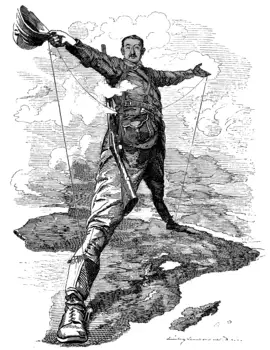
Which slogan best reflects the point of view of Cecil Rhodes as shown in this cartoon?
"Imperialism is a Glorious Pursuit"
"Embrace African Diversity"
"Unite All Africans"
"Connecting Constantinople to Cairo"
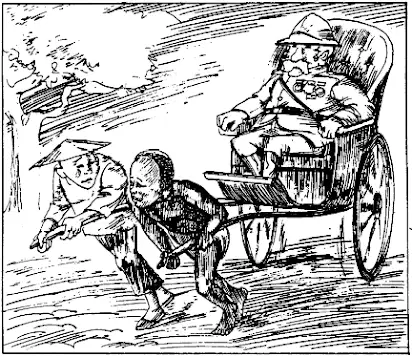
What is the main idea of the cartoon?
Many people assisted Western nations in acquiring overseas colonies
Western imperialism led to the exploitation of people and resources in the colonies.
Many job opportunities were created by Western colonization.
Western imperialism improved the quality of life for people in the colonies.
Which was a major effect of European imperialism on Africa?
Most African nations developed self-sufficient economies
Africans and Europeans developed a respect for each other’s culture
Africans became economically dependent on European nations
Most Africans voluntarily abandoned tribal or ethnic loyalties for European values
During the 19th century, European imperialism often led to the
development of self-sufficient economies in the colonies
exploitation of the colonial peoples and their lands
rapid industrialization of Africa and Asia
expansion of free-trade systems throughout the world

