wayground logo

Free Printable Worksheets

Font size

S
M
L
XL
Worksheets

Astronomy Unit Review

Total questions: 78

Worksheet time: 1hrs 11mins
Name
Class
Date
1.
Name the moon phase
a)
First Quarter
b)
Last Quarter
c)
New Moon
d)
Full Moon
2.
Name the phase of the moon for letter a
a)
First Quarter
b)
Last Quarter
c)
Waxing Gibbous
d)
Waning Gibbous
3.
What is illuminating the Moon?
a)
Nuclear Fusion
b)
Sunlight
c)
Mirrors
d)
Flood Lights
4.
The cycle of the moon lasts about a _.
a)
day
b)
year
c)
week
d)
month
5.
What is the difference between a gibbous moon and a crescent moon?
a)
The gibbous shows more than half of the bright side of the moon.
b)
The crescent shows more than half of the bright side of the moon.
c)
The gibbous shows less than half of the bright side of the moon. 
6.
Define Gibbous
a)
Less than half of moon visible
b)
More than half of moon visible
c)
All of moon visible
d)
None of moon visible
7.
Name the moon phase
a)
Waning Crescent
b)
Waxing Crescent
c)
Waning Gibbous
d)
Waxing Gibbous
8.
The 1st Quarter moon is lit on the:
a)
Left Side
b)
Right Side
9.
Name the moon phase that would come AFTER this moon.
a)
waning crescent
b)
waxing crescent
c)
waning gibbous
d)
waxing gibbous
10.

The first element formed in our universe were...

a)

Oxygen and Iron

b)

Nickel and Gold

c)

Hydrogen and Helium

d)

Sodium and Zinc

11.

Which is NOT true? Cosmic Microwave Background Radiation is...

a)

Is evidence for the Big Bang

b)

Is leftover energy from the start of the universe expansion

c)

Something that heats up our food

d)

Something that was first discovered by accident

12.

Which is NOT evidence to support the Big Bang Theory

a)

Red light from galaxies and stars moving away and expanding

b)

Hydrogen and Helium in stars and in the universe

c)

The finding of the singularity still floating in space

d)

The finding of leftover energy (CMB) in the universe

13.

Most scientists believe the Big Bang Theory explains which of the following questions?

a)

How our planets and moons formed

b)

How our universe began

c)

How the sun turns hydrogen into helium

d)

How fast light travels through space

14.

Galaxies that are REDSHIFTED are:

a)

actually BLUE

b)

really NEAR earth

c)

invisible or not visible

d)

moving AWAY from us.

15.

A DATE that is commonly accepted by Big Bang theorists for the Big Bang is ____ years ago.

a)

100,000

b)

250 million

c)

13.8 billion

d)

10 trillion

16.

Most distant galaxies show a RED SHIFT. This is considered EVIDENCE that the universe is ___.

a)

getting cooler

b)

expanding

c)

condensing into a small point

d)

swirling around

17.

How OLD do scientists think the Universe is?

a)

13.8 billion years old

b)

4.5 billion years old

c)

24,000 years old

d)

5 years old

18.

How is the "Big Bang" described?

a)

an explosion

b)

an expansion

c)

a contraction

19.

Which of the following is EVIDENCE for the Big Bang Theory?

a)

similar composition of Earth and the Moon

b)

stars appear to move

c)

cosmic background radiation

20.

Which description is considered most accurate regarding what actually happened during the Big Bang?

a)

Two galaxies collided causing an immense explosion as stars crashed into one another

b)

All of what would become the universe was concentrated in a single small point, or singularity, which rapidly expanded into what is now stars, planets, galaxies, matter, and energy.

c)

All matter emerged from a massive black hole at the center of the universe.

d)

Parts of the sun were ripped off by massive internal explosions and were thrown into space where they cooled to become other things, like plants, comets, and other galaxies.

21.
darkest, innermost part of the shadow
a)
penumbra
b)
umbra
22.
lighter, outer part of the shadow
a)
penumbra
b)
umbra
23.
What type of eclipse occurs when the moon blocks the sun's light and cast a shadow on earth?
a)
solar
b)
lunar
24.
What type of eclipse occurs when the earth's shadow is cast on a full moon?
a)
solar
b)
lunar
25.
What moon phase occurs during a solar eclipse?
a)
Full moon
b)
new moon
c)
1st quarter
d)
waxing gibbous
26.
What moon phase occurs during a lunar eclipse?
a)
full moon
b)
new moon
c)
3rd quarter
d)
waxing crescent
27.
What part of the shadow must I be in to see a total solar eclipse?
a)
umbra
b)
penumbra
28.
What type of eclipse is this?
a)
Solar eclipse
b)
Lunar eclipse
29.
What type of eclipse is this?
a)
Solar Eclipse
b)
Lunar Eclipse
30.

This image is showing us a.....

a)

solar eclipse

b)

lunar eclipse

c)

phases of the moon

d)

earth eclipse

31.

When the moon passes between the earth and the sun, this results in a.....

a)

Waxing moon

b)

lunar eclipse

c)

solar eclipse

d)

sun rise

32.

When is a lunar eclipse visible ?

a)

day

b)

night

c)

varies

33.

What time is a solar eclipse visible ?

a)

day

b)

night

c)

varies

34.

Why are most people unlikely to see a total solar eclipse?

a)

It only happens at night.

b)

the Moon's shadow is small and you have to be in its path

35.

Why don't we see lunar eclipses every month?

a)

the Moon's orbit is tilted

b)

it has to be nighttime

c)

we actually do see them every month

36.

Which eclipse is the most rare?

a)

solar

b)

lunar

37.
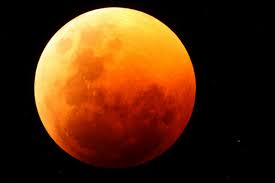
This image is an example of 
a)
Lunar Eclipse
b)
New Moon
c)
Solar Eclipse
d)
Full Moon
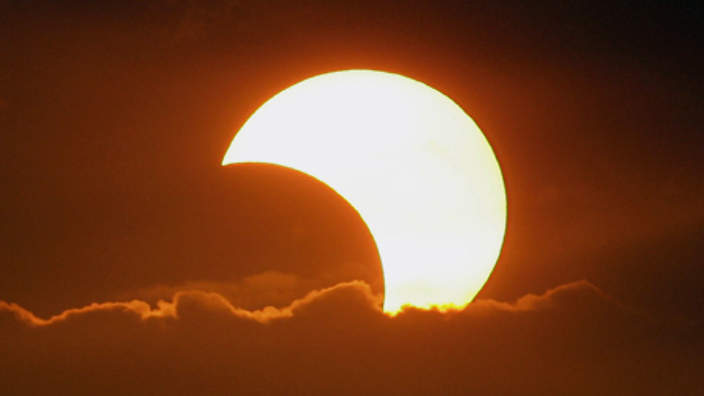
38.
This image is an example of
a)
Lunar Eclipse
b)
Full Moon
c)
New Moon
d)
Solar Eclipse
39.

Wha type of tide would this arrangement of earth-moon-sun create?

a)

full moon tide

b)

new moon tide

c)

neap tide

d)

spring tide

40.
What type of tides would this arrangement of earth-moon-sun create?
a)
neap tide
b)
spring tide
c)
new moon tide
d)
full moon tide
41.
Tides are caused by
a)
strong winds that blow over ocean waters.
b)
the interaction of Earth, the moon and the sun.
c)
the shifting of the plates on the ocean floor.
d)
variations in the salinity of ocean water
42.
If tides alternate from high to low and there are two of each type of tide a day, about how many hours will generally be between each different tide?
a)
2 hours
b)
6 hours
c)
12 hours
d)
24 hours
43.
How many low tides and high tides happen in a day?
a)
1 low tide, 1 high tide
b)
4 low tides, 4 high tides
c)
3 low tides, 3 high tides
d)
2 low tides, 2 high tides
44.
You visited the beach at 12 pm (noon) and it is high tide. If you return 6 hours later what tide will you see? 
a)
high 
b)
low 
c)
none
d)
spring 
45.
What do we call the small tides that happen when the sun and moon are at right angles to each other?
a)
Neap Tide
b)
Spring Tide
c)
Larger Change
d)
Smaller Change
46.
The Moon has a greater influence on Earth tides than the Sun because...
a)
it is smaller than the Sun
b)
it revolves around the Earth
c)
it is closer to the Earth
47.
The bulge of water on the side of the Earth closest to the moon produces ___________.
a)
high tide
b)
low tide
c)
neap tide
d)
spring tide
48.

The tidal force exerted by the ______ is stronger that the tidal force exerted by the _______.

a)

earth, ocean

b)

sun, moon

c)

moon, stars

d)

moon, sun

49.

The tidal bulge follows the movement of the _____.

a)

moon

b)

sun

c)

Earth

d)

ocean

50.

What type of tide does this represent?

a)

Neap

b)

Full

c)

Quarter

d)

Spring

51.
How many times per month does a spring tide occur?
a)
Once
b)
twice
c)
three times
d)
it changes every month
52.

Neap tides happen at _________ and _________ phases of the moon.

a)

first quarter and new moon

b)

last quarter and full moon

c)

waxing and waning

d)

1st quarter and 3rd quarter

53.

Neap tides are the ________ tides.

a)

strongest

b)

weakest

54.

What is the rise and fall of the level of the water in the ocean?

a)

tides

b)

waves

c)

tsunamis

d)

hurricanes

55.

Spring tides are the __________ tides.

a)

strongest

b)

weakest

56.

As the moon’s shape appears to get smaller, it is said that the moon is _____

a)

waxing

b)

waning

c)

swelling

57.
a)

Waxing Crescent

b)

Waning Gibbous

c)

First Quarter

d)

Waxing Gibbous

58.

What number represents a Waning Crescent

a)

2

b)

4

c)

6

d)

7

e)

8

59.
Phases of the moon in which the moon appears to be getting larger are referred to as _.
a)
waxing
b)
waning
c)
new
d)
eclipse
60.
What phase is this?
a)
Waning Gibbous Moon
b)
Waxing Gibbous Moon
c)
Waning Crescent Moon
d)
Waxing Crescent Moon
61.
What moon phase is this picture?
a)
This is the waning crescent phase.
b)
This is the waxing gibbous phase.
c)
This is the waning gibbous phase.
d)
This is the new moon phase.
62.
What part of the moon do we see from Earth?
a)
all of it
b)
the same side
c)
none of it
d)
only one quarter
63.
The Moon orbits Earth in a ________________ direction
a)
clockwise
b)
counterclockwise
c)
upwards
d)
downwards
64.
which planet is the third from the sun?
a)
Mercury 
b)
Neptune 
c)
Pluto 
d)
Earth 
65.
The spinning of an object on its axis is called______
a)
orbit
b)
rotation
c)
revolution
d)
tide
66.

What are the four terrestrial (inner) planets?

a)

Earth, Uranus, Mercury, Venus

b)

Mercury Venus Earth Saturn

c)

Mars, Earth , Mercury, Venus

d)

Mars, Earth, Neptune, Mercury

67.
The inner planets are also called...
a)
terrestrial planets
b)
gas giants
68.
Gas giants
a)
Inner planets
b)
Outer planets
c)
Both
d)
Venus
69.

Which is the farthest planet from the sun?

a)

Neptune

b)

Saturn

c)

Jupiter

d)

Uranus

70.
The order of the planets is:
a)
Mars,Venus,Earth,
Mercury,Saturn
Jupiter, Uranus, Neptune
b)
Earth,Venus,Mars
Jupiter, Neptune,
Mercury,Saturn,
Uranus
c)
Mercury,Venus,Earth
Mars,Jupiter,
Saturn,Uranus
Neptune
71.

Select all that apply to the ROCKY or TERRESTRIAL planets

a)

They are small

b)

They are made of gas

c)

They have a rocky surface

d)

They are closer to the sun

72.

The inner planets are known as “gas giants” and the outer planets are known as “terrestrial planets.”

a)

True

b)

False

73.

What are the 4 outer planets?

a)

Mercury, Venus, Earth, Mars

b)

Uranus, Mercury, Earth, Mars

c)

Jupiter, Uranus, Saturn, Neptune

d)

Jupiter, Saturn, Earth, Mars

74.
About how long does it take a new moon to become a full moon?
a)
2 weeks
b)
2 days
c)
1 month
d)
2 months
75.
Which best describes the order of the phases of the Moon?
a)
New, waxing, full, waning
b)
New, full, waxing, waning
c)
New, waning, full, waxing
d)
Waxing, waning, full, new
76.

_____ is in the center of our Solar System.

a)

Mercury

b)

Mars

c)

The Sun

d)

Earth

77.
What determines the measurement of a full year on Earth? 
a)
Hemisphere
b)
Axis
c)
Rotation
d)
Revolution
78.

How much of the moon is illuminated by the sun?

a)

50%

b)

100%

c)

0%

d)

25%