
Font size
 Worksheets
Ecological Relationships review
Total questions: 36
Worksheet time: 28mins
Aphids are small insects that live on various types of plants and feed on their sap. When there is a large population of aphids occupying a plant, they may remove too much sap causing damage to the plant. Ladybugs eat aphids and are often used in greenhouses to control the aphid population. Which type of relationship exists between aphids, ladybugs, and plants?
The relationship between the ladybugs and aphids is an example of competition.
The ladybugs and aphids are an example of predation while the aphid and plants are an example of parasitism.
The ladybugs and plants are an example of mutualism while the aphid and plants are an example of parasitism.
The aphids and plants are an example of commensalism while the ladybugs and plants are an example of predation.

A student researching a northern forest ecosystem learns the following information about the ecosystem: Insect larvae consume white spruces Shrews and snowshoe hares are prey for lynx, red-tailed hawks, and red foxes The willows and white spruces are producers consumed by Snowshoe hares Shrews consume insect larvae Red foxes sometimes consume insect larvae Which food web illustrates the transfer of energy in these relationships?
A
B
C
D
One limiting factor that impacts the sea turtle population is their nesting sites. Which of the following actions would continue to limit the nesting sites of sea turtles?
monitoring reproductive rates of the turtles
removal of beaches to build new businesses
relocating turtle nests to a less populated area
restricting access to the beaches during the breeding season

There are four different examples of relationships between organisms. Which example is correctly matched to a relationship between the organisms?
Example 1
Example 2
Example 3
Example 4

Examine the food web. Which of the following describes the role of bacteria in this food web?
Controls the population by removing energy from living organisms.
As the bacteria break down the dead organisms and waste, it is absorbing energy.
The bacteria provide the living organisms with energy by being consumed by the producers
Uses energy from light to combine oxygen, carbon dioxide, and water and converts it into energy in the form of sugar.
Which of the following describes a native population where there has been a decrease in the availability of food ?
An extinct wolf population remains extinct in a local forest.
A goldfish population that has fewer individuals than the prior year.
A pigeon population that has the same number of offspring as the past two years.
A frog population has more adults in a pond than when they were counted last year.

Use the food web below to answer the following question. Which of the following best describes a relationship in the food web?
The mouse is a producer because it consumes the green plant.
The goat is a primary consumer because it is consumed by the jackal.
The wild cat is a secondary consumer because it consumes the rabbit.
The green plant is a decomposer because it is consumed by the rabbit.
Gopher tortoises create their homes by digging holes in well-drained sandy soils throughout the southeast region of the U.S. The Florida pine snakes will sometimes use the hole to shelter from weather or fire. Which of the following example demonstrates the same type of relationship?
Tapeworms live in the digestive system and eat partially digested food which eventually harms the host.
A Pseudoscorpion is a tiny scorpion with no stinger that moves from place to place by hitching a ride on much larger insects.
The goby fish and blind shrimp live in a tunnel in the sand created by the shrimp and when a predator is near the goby fish will touch the shrimp to warn it.
Moths lay eggs in the seedpods of the yucca plant, the larvae hatch and feed on some but not all the seeds, and the moth acts as a pollinator for the plant.
Which of the following actions would negatively impact a local red-tailed hawk population?
reduce the use of chemicals on local crops
stock the local lakes and rivers with more fish
cut down the local forest to make room for a new business
planting new trees to replace the ones that were previously cut down

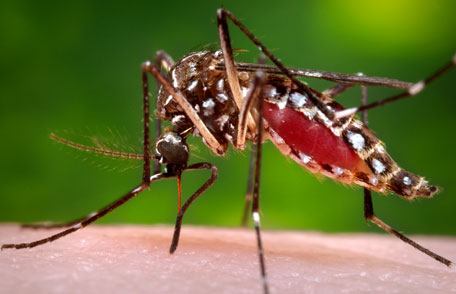

Aphids are tiny insects that live on and eat the leaves of plants, removing vital nutrients from the plants.
Predation
Parasitism
Commensalism
Mutualism

The close relationship between two different species in an ecosystem
Biosphere
Ecology
Symbiosis
Environment
A frog eats a fly. The frog and fly are demonstrating ________.
mutualism
competition
predator/prey
parasitism
A producer is something that:
Eats plants
Makes its own food
Eats animals
Eats plants and animals
Producers are always at the __________ of a food chain
Beginning
Middle
End
Producers are not part of the food chain
Consumers...
Make their own food
Go through photosynthesis
Eat other organisms
Breathe in carbon dioxide
Which of these things is NOT a consumer
Human
Whale
Tree
Chicken
What do the arrows show in this food chain:
plant → grasshopper → bird → snake → owl.
The arrow points from the organism being eaten to the organism that eats it.
The arrow points from the organism that eats it to the organism that is being eaten.
The arrow points from biggest animal to smallest animal.
The arrow points from the consumers to the producers.
As you move through a food chain, the amount of energy stored....
Increases
Decreases
Stays the same
It depends on the ecosystem

How much energy does trophic level 2 store from trophic level 1? (and so on..)
1%
10%
50%
100%
Multiple food chains that interact together is called a ....
Spider Web
Food Spider
Food Web
Web of Food
What do decomposers eat?
Dead things
Living things
An autotroph is another word for a ________, meaning it needs to ________
Consumer, eat other animals
Consumer, eat other plants
Producer, make its own food
Producer, survive without water
An heterotroph is another word for a ________, meaning it needs to ________
Consumer, eat other organisms
Consumer, go through photosynthesis
Producer, make its own food
Producer, survive without water

Cactus
Abiotic
Biotic

How would the removal of earthworms from the food chain affect the other organisms?
The number of bass will increase.
The number of crayfish will decrease.
The crayfish will get their energy directly from the sun.
The number of bass and ospreys (bird) will increase.

The picture provided shows an ocean bay food chain. Sea otters move into the ocean bay. They eat all of the sea urchins. This change will cause the
kelp to have less food.
crabs to have more food.
sea ducks to have less food.
arctic foxes to have more food.
What is NOT an example of limiting factors?
Predation
Food Source
Space
Migration

Carrying capacity is...
The maximum number of individuals that can fit into an area
Ability of an area to accommodate a growing population
The greatest # of individuals an area can support over time.
The maximum number of species that can co-exist in an area
What is an Abiotic Factor?
A NON-living factor that can affect an ecosystem
A living factor that can affect an ecosystem
The carrying capacity of an ecosystem
What is a Biotic Factor?
The carrying capacity of an ecosystem
A NON-living factor that can affect an ecosystem
A living factor that can affect an ecosystem
If there was a wildfire in the forest that destroyed the plant life, what would happen to the herbivore population?
Herbivores would decrease due to a lack of food
Herbivores would increase due to an increase of food
Herbivores would not be affected
Herbivores would decrease due to an increase in predators
Choose the 4 limiting factors.
Food
Water
Time
Space
Shelter
What would happen to the omnivore population if there was an increase in rain?
The population would increase
The population would decrease
The population would stay the same
The population would die off completely

