
 Worksheets
Atmosphere Unit Review
Total questions: 49
Worksheet time: 33mins
Name the 3 main gases in the atmosphere.
(a)
What percentage of the atmosphere is made up of Nitrogen?
21%
78%
0.02%
0.9%
What percentage of the atmosphere is made up of Oxygen?
21%
78%
0.02%
0.9%
What percentage of the atmosphere is made up of Argon?
21%
78%
0.02%
0.9%
List the layers of the atmosphere in order from closest to farthest.
(a)
In which layer of the atmosphere would you find meteors being burned up?
troposphere
stratosphere
mesosphere
thermosphere
exosphere
In which layer of the atmosphere would you find weather?
troposphere
stratosphere
mesosphere
thermosphere
exosphere
In which layer of the atmosphere would you find the ozone layer?
troposphere
stratosphere
mesosphere
thermosphere
exosphere
In which layer of the atmosphere would you find a high amount of helium and hydrogen?
troposphere
stratosphere
mesosphere
thermosphere
exosphere
Which of the following events do scientists NOT believe led to the formation of our current atmosphere?
Condensation of water vapor into oceans
Dissolving of carbon dioxide into oceans
Algae and plants photosynthesizing to form oxygen
Death of the dinosaurs
Describe weather conditions that occur at low pressure.
(a)
Describe weather conditions that occur at high pressure.
(a)

In this diagram, what season is represented in the northern hemisphere?
Spring
Summer
Fall
Winter
During an El Niño, Trade Winds are typically...
about average
stronger
weaker
During a(n) ____ event, trade winds are much stronger than usual.
El Niño
La Niña
Normal ENSO
During __________, warmer water is found on the western side of the Pacific Ocean (Asia and Australia).
Normal ENSO Conditions
El Niño
La Niña
One consequence of El Niño is _______ in South America (eastern Pacific Ocean).
warm, wet conditions
stronger Trade Winds
strong winter storms
drought
Which best explains why El Niño could cause an increase in precipitation in California (eastern Pacific Ocean)?
Colder ocean water causes the air to warm and brings low air pressure South of the United States
Warmer ocean water allows for warm air to be blown toward the United States and cause droughts.
Cooler ocean water causes the air to cool, and brings high air pressure to the United States.
Warmer ocean water allows for warmer, wet air to travel east toward the United States.
During a(n) ____ event, trade winds are much stronger than usual.
El Niño
La Niña
Normal ENSO
What causes the rising surface temperatures in the eastern Pacific Ocean and warm, wet conditions on the Pacific coast of South American?
the Gulf Stream
The jet stream
La Niña
El Niño

"A" is labeling which type of Global Circulation Pattern?
Polar Cells
Ferrell Cells
Hadley Cells
Westerlies
Southeasterlies
"B" is labeling which type of Global Circulation Pattern?
Polar Cells
Ferrell Cells
Hadley Cells
Westerlies
Southeasterlies
"C" is labeling which type of Global Circulation Pattern?
Polar Cells
Ferrell Cells
Hadley Cells
Westerlies
Southeasterlies
At the equator (0˚) and at 60˚, belts of __________ are found due to the Global Circulation Pattern typically causing a _________ pressure system from _________ air circulation.
rainforest, low, rising
desert, low, rising
rainforest, low, falling
desert, high, falling
rainforest, high, rising
At the 30˚ and at the poles (90˚), belts of __________ are found due to the Global Circulation Pattern typically causing a _________ pressure system from _________ air circulation.
rainforest, low, rising
desert, low, rising
rainforest, low, falling
desert, high, falling
rainforest, high, rising
As a result of the Coriolis effect in the northern hemisphere, winds and water currents in the oceans are affected by a _________ movement.
counterclockwise
clockwise
A person near 90˚N (north pole) and a person near 0˚ (equator) experience Earth's rotation in the same amount of time yet travel a much different distance in that time. Therefore, the Earth's north pole is rotating more ________ than it's equator.
quickly
slowly

What type of map is this (showing air pressure)?
isobaric
isothermic
streamline
physical

What type of map is shown (showing temperature)?
isobaric
isothermic
streamline
physical
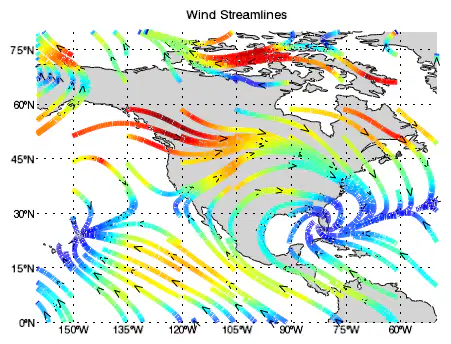
What type of map is shown (showing wind directions)?
isobaric
isothermic
streamline
physical
Winds in Kansas today are blowing to the west and are called (a) winds.
Winds in Kansas tomorrow will be blowing to the north and are called (a) winds.
Air always blows away from an area of _________ toward an area of ___________.
high pressure; low pressure
hot air; cold air
low pressure; high pressure
cold air; hot air

The process of nitrogen fixation in the atmosphere is caused by __________.
lightning
wind
humans
airplanes

What process is shown at B?
nitrogen fixation
denitrification
absorption
photosynthesis
What three molecules are converted by nitrogen fixation in the nitrogen cycle?
nitrogen dioxide - NO₂
ammonia (NH₃⁺)
nitrite (NO₂⁻)
nitrate (NO₃⁻)
A ______ stores nutrients for a short time and a _______ stores nutrients for a long time.
sink; reservoir
reservoir; sink
source; sink
reservoir; source
Humans add synthetic fertilizer to soil, which impacts what two cycles?
phosphorus
nitrogen
carbon
oxygen
Humans add extra carbon to the atmosphere by which of the two following activities?
destroying areas with photosynthetic plants such as rainforests
burning fossil fuels for transportation and electricity
dumping trash into the ocean
running water treatment plants
The SLOW carbon cycle involves which two of the following processes?
ocean sedimentation (beginning to form sedimentary rocks)
volcanic eruptions (formation of igneous rocks)
photosynthesis (chemical process in which plants create their food)
respiration (both plants and animals absorbing and releasing gases)
decomposition (living things breaking down after death)
The FAST carbon cycle involves which three of the following processes?
ocean sedimentation (beginning to form sedimentary rocks)
volcanic eruptions (formation of igneous rocks)
photosynthesis (chemical process in which plants create their food)
respiration (both plants and animals absorbing and releasing gases)
decomposition (living things breaking down after death)

global average temperature goes up
global average temperature goes down
local temperature goes up
local temperature goes down
Without the Greenhouse Effect, the Earth would be...
hot
cold
The warming of a planet due to trapped radiation.
The cooling of a planet due to the pollution of the atmosphere.
The heating of a solid, such as a rock.

