
 Worksheets
B5:Respiratory System MID TERM Past Questions
Total questions: 40
Worksheet time: 10hrs 0mins
John is 60 years old man with Chronie Obstructive Pulmonary Disease. He was tested by Pulmonary Faction Test and showed that his FEVI/EVC< 70%, and FEVI is 60% of predicted value with persistent symptom. What is his severity?
I Mild
II Moderate
III Severe
III Very severe
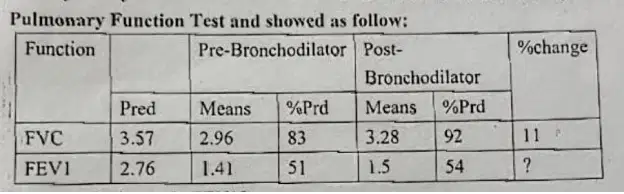
Sammy is 70 years old woman with Chronic Obstructive Pulmonary Disease. She was tested by Pulmonary Function Test and showed as follow:
How much %change in FEV1?
3
4
5
6
When does anaerobic threshold occur?
When energy demands of the resting muscles exceed the body's ability to produce energy by aerobic metabolism
When energy demands of the exercising muscles exceed the body's ability to produce energy by
aerobic metabolism.
When energy demands of the exercising muscles exceed the body's ability to produce energy by anaerobic metabolism
When energy demands of the resting muscles exceed the body's ability to produce energy by anaerobic metabolism
What of the following is the primary indication for performing exercise tests?
Hypercapnia on an arterial blood gas
Dyspnea on exertion
Pain associated with myocarditis
Recent diagnosis of obstructive sleep apnea
Where did the nasal septum develop from?
Medial nasal prominences
Lateral nasal prominences
Maxillary prominence
Mandibular prominence
Where did the parietal pleura develop from?
Paraxial mesoderm
Intermediate mesoderm
Somatic mesoderm
Splanchnic mesoderm
Where did the Nasal sac develop from?
Mesoderm
Endoderm
Oral Ectoderm
Surface Ectoderm
Where did the epithelium of trachea develop from?
Mesoderm
Endoderm
Oral Ectoderm
Surface Ectoderm
The opening of paranasal sinuses, which is incorrect?
Sphenoid sinus → superior meatus
Ethmoid sinus → superior and middle meatus
Frontal sinus →middle meatus
Maxillary sinus →middle meatus
Which of the following movements does not match the muscle contraction?
Tense vocal fold - cricothyroid muscle
Open rima glottidis - lateral cricoarytenoid muscle
Loose vocal fold - thyroarytenoid muscle
Close rima glottidis -* transverse arytenoid muscle
Which of the following muscle is not innervation by recurrent laryngeal nerve?
Thyroarytenoid muscle
Cricothyroid muscle
Transverse arytenoid
Lateral cricoarytenoid muscle
Which of the following statement is not correct?
The impression of aortic arch is on the left lung
The number of lobes is 2 on the left and 3 on the right lung
Lingula on the left lung is the impression of heart
Right primary bronchus is thicker and shorter than the left one
Which of the following will increase alveolar POs?
increase in metabolism and no change in alveolar ventilation
breathing air with 15% oxygen at sea level
increase in alveolar ventilation matched by an increase in metabolism
increased alveolar ventilation with no change in metabolism
Which of the following will cause the largest increase in systemic arterial oxygen saturation in the blood?
an increase in red cell concentration (hematocrit) of 20%
breathing 100% Oz in a healthy subject at sea level
an increase in arterial PO, from 40 to 60 mmHg
hyperventilation in a healthy subject at sea level
in arterial blood with a PO, of 60 mmHg, which of the following situations will result in the lowest blood oxygen saturation?
decreased DPG with normal body temperature and blood pH
increased body temperature, acidosis, and increased DPG
decreased body temperature, alkalosis, and increased DG
normal body temperature with alkalosis
The rhythmic control of breathing is produced by the activity of inspiratory and expiratory neurons in
the medulla oblongata.
the apneustic center of the pons.
the pneumotaxic center of the pons.
the cerebral cortex.
John Snow's investigation of cholera is considered a model for epidemiology field investigations because it included a _____Which is the following statement is false?
Biologically plausible hypothesis
Comparison of a health outcome among exposed and unexposed groups
Multivariate statistical model
Recommendation for public health action
A study in which children are randomly assigned to receive either a newly formulated vaccine or the currently available vaccine, and are followed to monitor for side effects and effectiveness of each vaccine , is an example of which type of study?
Experimental
Observational
Cohort
Case-control
Which of the following is NOT a vaccine-preventable disease?
Polio
Hepatitis B
Asthma
Measles
Which disease mainly affects children under 5 and remain as endemic in only 2 countries
Rubella
Polio
Measles
Tetanus
A 23-year-old woman is using an albuterol inhaler for frequent acute episodes of asthma and complains of symptoms that she ascribes to the albuterol. Which of the following is not a recognized action of albuterol?
Diuretic effect
Positive inotropic effect
Skeletal muscle tremor
mooth muscle relaxation
Which of the following in its parenteral form is life-saving in severe status asthmaticus and acts, at least in part, by inhibiting phospholipase A2?
Aminophylline
Prednisone
Salmeterol
Zafirlukast
Which of the below is a bronchodilator?
Beta 1 agonists
Beta 1 antagonists
Beta 2 agonists
Beta 2 antagonists
Which of the below is an anti-IgE mAb drug?
Omalizumab
Budesonide
Mometasone
Ciclesonide
Which of the below are inhaled corticosteroids?
Acetylcysteine
Beclomethasone
Benzonatate
Glycopyrronium
Which one is a muscarinic receptor antagonist for the treatment of asthma?
Fenoterol
Ipratropium
Theophylline
Montelukast
Which of the following description is wrong?
Pneumoconioses encompass a group of chronic fibrosing diseases of the lung
Pulmonary alveolar macrophages play a central role in the pathogenesis of lung injury by promoting inflammation and producing reactive oxygen species and fibrogenic cytokines.
Coal dust-induced disease is the most common pneumoconiosis in the world
Asbestos exposure is linked with parenchymal interstitial fibrosis and recurrent pleural effusions
Which of the following descriptions is wrong?
Sarcoidosis is a multisystem disease of unknown etiology
Almost all large pulmonary artery thrombi are embolic in origin
H. influenzae is the most common cause of community-acquired acute pneumonia
Lobar pneumonias evolve through four stages: congestion, red hepatization, gray hepatization. and resolution,
Which of the following description is wrong?
Lung abscess is often caused by mixed infections and frequently occur in debilitated individuals following aspiration of oral flora.
Smoking is the most important risk factor for lung cancer
Precursor lesions of lung cancer include squamous dysplasia for squamous cancer and atypical adenomatous hyperplasia for adenocarcinomas
Lung cancers unusual cause paraneoplastic syndromes
Which of the following descriptions is wrong?
Rhinitis can be infectious or allergie in nature
Pharyngitis and tonsillitis are common upper respiratory tract viral infections typically caused by rhinoviruses, echoviruses, and adenoviruses
Nasopharyngeal carcinoma is most often associated with HPV
Laryngitis can be caused by a host of etiologies, including allergic, viral, bacterial, and chemical insults
A 25-year-old previously well woman presents to your office with complaints of episodic shortness of breath and chest tightness. She has had the symptoms on and off for about 2 years but states that they have worsened lately, occurring two or three times a month. She notes that the symptoms are worse during the spring months. She has no exercise-induced or nocturnal symptoms. The family history is notable for a father with asthma. She is single and works as an administrative assistant in a high-tech firm. She lives with a roommate, who moved in approximately 2 months ago. The roommate has a cat. The patient smokes occasionally when out with friends and drinks socially, but has no history of illicit drug use. Examination is notable for mild end-expiratory wheezing. The history and physical examination are consistent with a diagnosis of Pulmonary function tests are ordered to confirm the diagnosis.
Asthma
Chronic Obstructive Pulmonary Disease (COPD)
Pulmonary Edema
Interstitial Pulmonary Fibrosis
Which disorder is NOT a metabolic acidosis?
Acute vomiting (10 minutes after vomiting)
Acute methanol ingestion
Diarrhea
Accidental hypoventilation of a patient on a mechanical ventilator for 10 minutes
A 57-year-old man undergoes total knee replacement for severe degenerative joint disease. Four days after surgery, he develops an acute onset of shortness of breath and right-sided pleuritic chest pain. He is now in moderate respiratory distress with a respiratory rate of 28/min, heart rate of 120 bpm, and blood pressure of 110/70 mm Hg. Oxygen saturation is 90% on room air, Lung examination is normal. Cardiac examination reveals tachycardia but is otherwise unremarkable.
The right lower extremity is postsurgical, healing well, with 2+ pitting edema, calf tenderness, erythema, and warmth; the left leg is normal. He has a positive Homan sign on the right. What disease is suspected in the 57-year-old man?
Chronic Obstructive Pulmonary Disease (COPD)
noncardiogenic pulmonary edema
Asthma
Acute Pulmonary Embolism
Which statement of Cystic fibrosis is true?
People with cystic fibrosis often do not get the nutrition they need to grow normally due to the thick mucus blocks ducts in the pancreas
People with cystic fibrosis inherit a defective gene on chromosome 7 called CFTR (cystic fibrosis transmembrane conductance regulator)
The level of trypsinogen protein is higher than normal in people with cystic fibrosis
All of the above
Which is not the factor that accounts for almost all cases of pulmonary edema?
an increase in vascular endothelial cell and/or alveolar epithelial cell permeability (noncardiogenic pulmonary edema)
a decrease in the oncotic pressure gradient (usually owing to a low plasma protein content)
Impaired lymphatic drainage either from physical lymphatic obstruction or from lymphatic obliteration, which can occur in the setting of radiation treatment.
a decrease in the hydrostatic pressure gradient (cardiogenic pulmonary edema)
Which disease will cause the abnormality of impaired perfusion of blood into lungs?
Right-to-left shunts of great vessels
Pulmonary embolism and pulmonary infarction
Selected lung cancers
All of above
In comparing uncompensated respiratory acidosis and uncompensated metabolic acidosis which one of the following is true?
Plasma pH change is always greater in uncompensated respiratory acidosis compared to uncompensated metabolic acidosis.
There are no compensation mechanisms for respiratory acidosis, whereas there is respiratory compensation for metabolic acidosis.
Uncompensated respiratory acidosis involves changes in plasma HCO3-], whereas plasma HC03- is unchanged in uncompensated metabolic acidosis
Uncompensated respiratory acidosis is associated with a change in Pco2, whereas in uncompensated metabolic acidosis Pco2 is constant.
A 68-year-old man presents to the clinic with a complaint of shortness of breath. He states that he has become progressively more short of breath over the last 2 months, such that he is now short of breath with walking one block. In addition, he has noted a nonproductive cough. He denies fever, chills, night sweats, chest pain, orthopnea, and paroxysmal nocturnal dyspnea. He has noted no lower extremity edema. The medical history is unremarkable. Physical examination reveals a respiratory rate of 19/min and fine, dry inspiratory crackles heard throughout both lung fields.
Digital clubbing is present. A diagnosis of
_______is made.
pulmonary embolism
Acute Respiratory Distress Syndrome (ARDS)
Chronic Obstructive Pulmonary Disease (COPD)
Interstitial Pulmonary Fibrosis
Which of the following sentences about Fluorine-18 Fluorodeoxyglucose (F-18 FDG) is correct?
F-18 FDG is a glucose analog that is taken into the cell and phosphorylated by the same mechanism as glucose
The primary route of F-18 FDG excretion occurs by the kidneys, although F-18 FDG excretion also takes place through the bowel.
Serum glucose actively competes with F-18 FDG uptake.
All of the above
Which of the following sentences about lung nodule survey is wrong?
F-18 FDG PET/CT may be considered if the sizes of the solid lung nodules are larger than 8mm.
F-18 FDG PET/CT shows acceptable accuracy for ground-glass opacity nodules.
Nodules caused by cancer have specific traits such as spiculations, fast-growing and not likely to have calcium buildup
During chest CT follow-up, increases in size or density, or a change in shape may be a sign of cancer.

