
 Worksheets
MTEL Technology and Engineering Review
Total questions: 75
Worksheet time: 2hrs 34mins

Student A
Student B
Student C
Cannot be determined

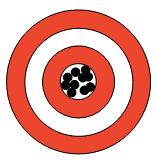
This bullseye demonstrates...
High Accuracy & High Precision
High Accuracy & Low Precision
Low Accuracy & High Precision
Low Accuracy & Low Precision


Recognize the view for the given isometric figure.
Top view
Right side view
Left side view
Bottom view


Before starting the drill press, what should be removed from the machine?
Drill bit
Chuck key
Material
None of the above

The Lathe machine is used to …
Turn wood pieces into cylinder shaped projects
Shape wood into bowls, candlesticks, and pens
Spins wood and uses tools to shape wood into cylinder shapes
All the above
Materials are classified as
Natural, plastic, and leather
Natural, synthetic, and mixed
Metal, synthetic, and leather
Metal, plastic, and leather
Which of the answers below lists actual material properties?
Mechanical, radiant, and nuclear
Thermal, radiant, and electrical
Thermal, radiant, and nuclear
Mechanical, thermal, and electrical
Manufacturing production systems can be classified as
Customized, batch, and continuous
Natural, batch, and continuous
Customized, synthetic, and continuous
Customized, batch, and natural
The effectiveness of the manufacturing process was increased by the introduction of
Custom made parts
Batch production methods
Interchangeable parts
Natural materials
What is tensile strength?
Measures the material’s resistance to being squeezed.
Measures the material’s resistance to various types of rapidly changing stresses.
Measures the material’s resistance to being pulled apart.
The material’s resistance to permanent indentation.
What is the definition of composite materials?
Inorganic and nonmetallic materials formed from powdered materials through the application of heat.
Elements, compounds, or alloys that account for roughly two-thirds of all materials.
Elements commonly referred to as plastics or rubber
Any combination(s) of two or more distinct materials, in which those materials maintain their original properties.
1. Forming is a process that changes the shape of the metal by changing its phase.
True
False
4. Metal forming is a process in which the metal is deformed plastically to get into the desired shape.
True
False
7. Which of the following processes is not the type of metal forming process?
Extrusion
Injection moulding
Forging
Drawing
Extrusion is an example of a:
Squeezing force
Drawing force
Bending force
None of the above
The ___ is a machine tool that operates on the principle of the work being rotated against a cutting tool
broach
drill press
lathe
milling machine
_____ is an operation that removes material by rotating an abrasive wheel against the workpiece.
drilling
grinding
milling
turning
With computer numerical control (CNC) machining centers, the ____ is controlled by the computer program.
tool changing process
tool movement
workpiece movement
All options
A stamping operation in which shapes in metal are cut with punches and dies is known as ____.
blanking
grinding
milling
shearing
____ is a process in which molten metal is forced into a mold under pressure.
Die casting
Investment casting
Permanent mold casting
Sand casting

is when information is passed from a sender to a receiver.
information
communication
signals
analog signals
is where the information is going.
source
destination
retrieval
storage

to send a message. When you hit send or post for a text message.
encode
transmit
decode
electrical signals

What type of voltage signal is shown?
Digital
Analog
Neither
Could be both

What type of voltage signal is shown?
Digital
Analog
Neither
Could be both

What type of voltage signal is shown?
Digital
Analog
Neither
Could be both

What is the frequency of this digital signal?
1Hz
2Hz
100Hz
1000Hz


A ship has a satellite communication device to identify the ship’s position at sea. For which of the following activities is this device most likely used?
Control
Guidance
Propulsion
Suspension

In order for a glider to fly, its weight must be opposed by
Lift
Drag
Gravity
Friction

Which Design would experience the least amount of drag?
Car A
Car B
Car C
Car D
Which of the following parts of a car belong to its control system?
Gas Tank
Hydraulic Jack
Steering Wheel
Power Windows

A pilot lowers the flaps before takeoff to increase which of the following forces?
Drag
Gravity
Lift
Thrust
What are the four possible zones of transportation?
Land, Sea, Air, Space
Roads, Paths, Channels, Airways
East, South, West, North
Zone 1, Zone 2, Zone 3, Zone 4
What are the five parts of any transportation system?
Structure, Suspension, Thrust, Control, Guidance
Speed, Brakes, Turning, Fuel, Motor, Effort
Chassis, Exhaust, RPM, Steering, Hydraulics
Tracks, Roads, Paths, Airways, Channels
What forces can act on a given transportation system?
Lift, Drag, Gravity, Friction, Thrust
Weight, Force, Dead load, Liveload
The sun, the moon, the tides
Electrical, Subliminal, Magnetic, Ionic
Which of the following statements explains fluid power.
Fluid power is the method of using pressurized fluid to transmit energy
Fluid power is the method of using pressurized fluid to transmit motion.
Fluid power is the method of using pressurized fluid to transmit machines
Fluid power is the method of using pressurized air to transmit energy
Hydraulic systems use ________ to transfer force from one point to another.
Air
Liquid
Solid
Gas
All industrial hydraulic systems consist of the following basic components:
Power input device
Control Device
Liquid
Conductors
Power Output device
Hydraulic jack
Power input device
Control Device
Liquid
Power Output device
Power input device
Control Device
Liquid
Conductors
Power Output device
Power input device
Control Device
Power Output device
Hydraulic systems provide a means for the operation of
landing gear, control surfaces and brakes
engines, galleys and stowage bins
brakes, landing gear and replenishment carts
all options are correct
The r-value of a material indicates:
Its resistance to water vapor
How well it it will resist the transfer of heat
The percentage of heat that it will move from cold to hot
the amount of time required to reach a balance with the ambient temp.
R-values can be:
Added together only if there are for similar materials
Added together to create a composite r-value
divided to calculate the ratio of insulated to uninsulated wall area
Multiplyed by a factor of 10% to account for aif infiltration
Fiberglass insulation relies on pockets of ________ to resist heat transfer
Air
Inert Gas
Heat
Melted salt
High density ( closed cell ) spray foams have high R-values because________________.
the bubbles used are trapped gas rather than air
they expand nearly 120 times the original volume
they completely seal each cavity
the foam wxpands very quickly, trapping a second layer of air behind it.
What is the resistance of a 45-Watt lightbulb when connected to a 120-V power source?
0.375 Ω
2.7 Ω
320 Ω
540 Ω
The difference between conductors and insulators is that...
conductors have higher resistance than insulators
conductors have lower resistance than insulators
conductors have higher voltage than insulators
conductors allow less current than insulators
A current of 0.15 A runs through a circuit to a capacitor. How long would it take for the capacitor to accumulate 6 C of charge?
0.9 seconds
25 seconds
40 seconds
0.9 minutes

How many different pathways are there for current to travel through this circuit?
2
3
4
5
How is the power source in an AC circuit different from the power source in a DC circuit?
The AC power source is toggled on and off, while the DC power source stays on permanently.
The AC power source keeps changing polarity, while the DC power source's terminals are fixed in place.
The AC power source is connected in parallel, while the DC power source is connected in series.
The AC power source has a lower voltage than the DC power source.
How much current will travel through a single 60-Ω resistor connected to a 120-V power source?
0.5 A
2 A
6 A
7.2 A
What is effort (input) force?
the force one exerts on a machine
the force which an effort force must overcome in order to do work on an object via a simple machine.
the force the machine exerts on a object
the output work times the input distance


Does the Driving Gear or Driven Gear have the motor attached?
The Driving Gear has the motor attached
The Driven Gear has the motor attached

What is the mechanical advantage of this gear ratio?
1: 3 Torque Advantage
1: 3 Speed Advantage
no Mechanical Advantage
A 36 tooth driving gear (connected to the motor) is moving a 12 tooth driven gear. What is the gear ratio?... It has a speed advantage.
3:1
1:3
3:3
1:1

Looking at the picture, what is the gear ratio?
The arrow indicates how the motor is turning the gear.
4 : 6
6 : 4
2 : 3
3 : 2

