
 Worksheets
5.10A Adaptations!
Total questions: 48
Worksheet time: 41mins
The sharp talons of a hawk, help it
run across the ground
fly
dig for food
catch, hold and eat prey
Flowers are a structural adaptation that helps a plant to
conserve water
make seeds to grow new plants
protect itself
absorb water

Which two traits best help a cactus conserve water in the dry conditions of a West Texas desert ecosystem?
Large flowers and sweet fruit
Sweet fruits and sharp spines
Sharp spines and waxy stems
Waxy stems and large flowers

What is HIBERNATION?
when a weak animal copies stronger animal to warn off predators.
when an animal hides in the cold winter and sleeps until the spring
when a larger animal eats its prey

Which foot is best suited for a wet environment?
Clawed foot with talon
Human-like foot
Webbed foot
Small clawed foot without a talon
Which bird beak is best adapted for opening hard-shelled nuts and seeds?


What is the function of large padded paws on a snow leopard?
camouflage
protection from predators
keep it warm
walking in snow
What is the function of a beaver's tail?
protects from predators
packs and flattens mud and gives greater mobility on rocky ground
help swim through water
helps swim fast to catch prey

Adaptations help animals ___________.
survive
get food
protect themselves
all of the above
When a plant stops growing and conserves energy until it is warmer or it rains
Disadvantage
Environment
Compare
Dormancy

An instinct or action that helps an organism survive.
Behavioral adpatation
Structural Adaptation

A physical part of an organism's body that has a function that helps the organism survive.
Behavioral adpatation
Structural Adaptation
All of the following are behavioral adaptations EXCEPT -
being nocturnal and only active at night
hibernating during the winter months
migrating to avoid cold weather
being camouflaged to remain unseen
Some bears have thick layers of fat and fur that help to keep them warm. These physical body parts are best adapted to an environment that is –
dry
cold
dark
windy
Some bird have large, sharp claws and beaks. These birds most likely eat -
tall grasses
small animals
pond microorganisms
tiny insects

The whiskers of a river otter and the antennae of a cockroach are shown here. How do structures such as whiskers and antennae benefit organisms?
They help the organisms detect their surroundings.
They help the organisms eat food quickly.
They help the organisms fight predators.
None of these
Some animals have fur that is dark for part of the year and white for part of the year. This adaptation would be an advantage to animals that live in an environment with –
heavy rains for most of the year.
seasons that include a snowy winter.
a very hot and dry climate.
many forests with tall trees.
Which of the following adaptations of a cow helps it to survive by allowing it to eat and digest large amounts of grass?
Long, thick tail it can swing about.
Large, brown eyes with long lashes.
Wide, flat teeth and four stomachs.
Tough, divided hooves and strong legs.
The bright colors on the males of many bird species are a structural adaptation that helps the birds –
attract females.
avoid predators.
hunt insects.
stay warm.
When animals hibernate during the winter, they spend most of their time sleeping. This behavior is an adaptation that helps animals by –
allowing them to avoid the harsh sun and rains.
building strong muscles for fighting enemies.
conserving energy when food is hard to find.
making them easy for predators to see.

As the weather turns colder, the fur of an Arctic Fox changes from a brownish/gray color to all white. This adaptation helps the fox to –
blend into its environment
hibernate for winter
migrate south for winter
find a mate
Which characteristic allows the seaweed to survive the powerful waves of the ocean?
It is green.
It is algae.
It is eaten by many animals.
It has thick, rubbery stems.

The diagram below shows an Emperor Penguin. They live in Antarctica, the coldest place on Earth. Four structural adaptations have been labeled.
Which structural adaptation is used to catch food like fish and krill?
Beak
Flippers
Feathers
Webbed feet
The diagram below shows an Emperor Penguin. They live in Antarctica, the coldest place on Earth. Four structural adaptations have been labeled.
Which structural adaptation helps the penguin live in very cold temperatures?
Beak
Flippers
Feathers
Webbed feet
If a species is NOT able to adapt to its environment over time, what will most likely happen?
Hibernation
Extinction
Camouflage
Survival

What is an adaptation of the snowshoe hare that allows it to remain unseen by predators in the winter time?
heavy fur on feet to stay warm
small ears to prevent heat loss
turns white in winter to match snow
sense of smell to detect food
Which adaptation of a cactus allows it to prevent water loss in dry desert conditions?
Shallow roots that spread out very widely
Bright flowers that attract insects
Waxy outer covering on stems
None of these
Which of the following describes a behavioral adaptation?
being nocturnal to avoid extremely hot day time temperatures
having a sharp beak and talons to devour prey
using webbed feet and paddle tail to propel through water
having long eyelashes that prevent sand from entering the eye
Organism's body part
Offspring
Structure
Function
mimicry
The job of the body part or what it does
Offspring
Structure
Function
Webbed Feet
An adaptation where color allows an organism to blend in with its environment
talons
Offspring
Webbed Feet
Camouflage
The type of stem on a plant that helps to protect it from herbivores
Camouflage
thorns
talons
mimicry
Type of leaves that help protect plants from the sun by preventing water loss and to protect from consumers.
talons
spines/needle like leaves
mimicry
thorns
The ability of an animal to look like another more harmful animal to confuse predators
mimicry
talons
spines/needle like leaves
Webbed Feet
A part of a living thing (body part, plant part)
Function
Structure
Adaptation
Niche
This structure would help an aquatic animal to swim.
Hooves
Flat Teeth
Large Ears
Fins

An animal that copies another animal or plant has an adaptation called:
Migration
Hibernation
Mimicry
Camouflage
Which adaptation of a cactus allows it to collect water quickly in dry desert conditions?
Shallow roots that spread out very widely
Bright flowers that attract insects
Waxy outer covering on stems
None of these

Plants have different needs depending on where they live. In what kind of environment would you find a plant that has an adaptation for storing water?
rainforest
grasslands
tundra
desert

What type of leaf slows the loss of water?
waxy
small
hairy
all of the above

Desert plants have a coat of wax on their leaves to
keep water from escaping
protect them from animals eating them
absorb water from the air
release scent to attract animals
What is one reason that some plants have a strong scent?
to shed extra water off the plant
to take in nutrients from the soil
to attract animals to spread its pollen
to conserve water during dry periods
A small plant is adapted to a forest with tall trees and little sunlight. Identify the BEST adaptation this plant might have to ensure it gets enough sunlight to survive.
extremely long root system
thick, waxy, spike covered leaves
ability to attach to and grow upwards on taller trees
shallow root system near the surface

Water lilies live in lakes and ponds. The lilies have very long stems. How do long stems help water lilies live in ponds?
They absorb food for the plant.
They absorb water from the pond.
They enable the pads and flower to reach sunlight.
They help the plants float away.

Why might some plants that grow on the shady rain forest floor have large leaves?
to stay safe from predators
to attract different animals
to survive harsh winters with heavy snowfall
to take in as much sunlight as possible
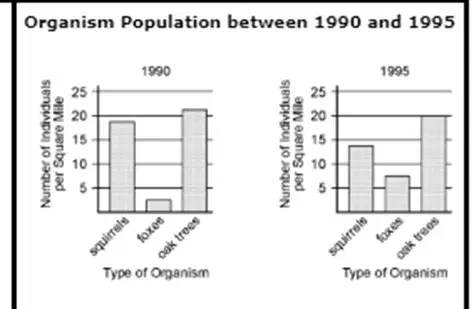
The fox population increased in 1995 because -
more food was available
more shelter was available
less food was available
less shelter was available
Choose the correct sequence of the frog's life cycle
froglet, tadpole, frog, and egg
egg, frog, tadpole, and froglet
egg, tadpole, froglet, and frog
tadpole, froglet, frog, and egg

What does a tadpole have that a frog does not?
legs
eyes
tail
mouth

