
 Worksheets
KMT and Gas Laws review
Total questions: 99
Worksheet time: 4hrs 19mins
The energy of movement is ___.
potential energy
kinetic energy
mechanical energy
The more energy that particles have, the ___ they move.
slower
faster
The force of attraction between molecules is ___.
intermolecular forces
bridge forces
chemical bonds

These properties describe a ___.
solid
liquid
gas

These properties describe a ___.
solid
liquid
gas

These properties describe a ___.
solid
liquid
gas
Collisions in which particles transfer all their kinetic energy to other particles are called ___.
elastic
inelastic
Which one of these is NOT an Ideal Gas Assumption?
Gas particles are hard, round spheres.
Gas particles are strongly attracted to one another.
Gas particles do not take up space.
Gas particles collide perfectly elastically.
Liquid particles have more energy than ___ particles.
solid
gas
The particles of ___ generally have the least amount of energy.
solids
liquids
gases
Define kinetic energy
energy of motion
static energy
stored energy
energy use
Which picture best illustrates the particle arrangement in a solid?


Which picture best illustrates the particle arrangement in a liquid?
Which picture best illustrates the particle arrangement in a gas?
Which best describes the movement of particles in a solid?
free to flow, constant volume
free to flow, volume changes
vibrates in place,
volume changes
vibrates in place, constant volume
Which best describes the movement of particles in a liquid?
free to flow, constant volume
free to flow, volume changes
vibrates in place,
volume changes
vibrates in place, constant volume
Which best describes the movement of particles in a gas?
free to flow, constant volume
free to flow, volume changes
vibrates in place,
volume changes
vibrates in place, constant volume
Which best describes the kinetic energy of particles in a gas?
lowest amount of energy
more energy than solids but less than liquids
more energy than solids or liquids
less energy than solids but more than liquids
Which best describes the kinetic energy of particles in a solid?
lowest amount of energy
more energy than solids but less than gases
more energy than solids or liquids
less energy than solids but more than liquids
What happens to the temperature of a substance when the volume is constant but heat is continuously added?
it decreases
it stays constant
it increases
How is temperature related to the movement of particles?
directly
indirectly
What happens at absolute zero?
particles move slower
particles stop moving
particles move faster
particles are unaffected
What temperature (in Celsius) is absolute zero?
0
-100
-200
-273
Pressure is caused by:
Gas molecules colliding with surfaces
Gas molecules reacting with each other
Gas molecules colliding with each other
Gravity
Pressure and volume have an (a) relationship.
When the pressure of a gas (a) , the volume decreases.
A gas confined in a closed container is heated. What will happen to the gas?
a. The gas molecules move faster.
b. The gas molecules settle to the bottom of the container.
c. The gas molecules collide with each other less frequently.
d. The gas molecules collide with the wall of the container less frequently.

Each of the following containers has the same size. Which of following
containers has the most compressed gas molecules?
a
b
c
d
What will happen to the gas pressure as the temperature increases, if the amount and volume of the gas are kept constant?
a. the gas pressure remains the same.
b. the gas pressure decreases
c. the gas pressure increases
d. there is no significant effect
All of these are properties of gases EXCEPT
a. can conduct electricity
b. can be compressed easily
c. can move from one place to another randomly
d. can expand when the temperature is increased by increasing the distances
between molecules.
Boyle's Law describe the relation between...
Volume and Pressure
Pressure and Temperature
Volume and Temperature
Temperature and Shape
Charle's Law describe the relation between...
Volume and Pressure
Pressure and Temperature
Volume and Temperature
Temperature and Shape
What can be said about the particles of a gas that are moving quickly?
The particles have a lot of energy
The particles have a little energy
The particles are getting tired
The particles need to calm down


The amount of force exerted per unit of area of a surface is the gas's:
pressure
voulume
temperature
surface tension


Which measurement expresses Absolute Zero
0 K
0°F
0°C
-273°C
Select all that are true.
Pressure and Volume have an inverse relationship
Temperature and Volume have a direct relationship
Pressure and Temperature have a direct relationship
Number of moles (n) and Volume (v) have a direct relationship
______measures the amount of space a gas will occupy
temperature
volume
pressure
_____measures the force a gas applies to the container
temperature
volume
pressure
All of the following are gas law variables EXCEPT:
Temperature
Volume
Mass
Pressure
In all gas laws calculations, temperature must be measured in
Kelvin (K)
Celcius (ºC)
Farenheit (ºF)

_______ is an explanation of how particles in matter behave
Boyle's Law
Charles' Law
Kinetic Molecular Theory
A student measures the pressure and volume of an empty water bottle to be 1.4 atm and 2.3 L. She then decreases the pressure to 0.65 atm. What is the new volume?
2.1 L
5.0 L
8.2 L
3.9 L
A student inflates a balloon with helium then places it in the freezer. The student should expect
the balloon's volume to increase
the balloon's volume to decrease
the balloon's moles to increase
the balloon's moles to decrease
What is the pressure of a car tire that had an initial pressure of 1.8 atm but was heated from 38°C to 123°C?
0.9 atm
2.1 atm
1.6 atm
3.4 atm
Three gases are mixed together in a container with a total pressure of 4.8 atm. If two of the gases have pressures of 1.2 atm and 1.5 atm, what is the pressure of the third gas?
2.5 atm
1.8 atm
2.1 atm
1.3 atm
If a hairspray can is heated, what can be expected of the pressure of the gas inside the can?
The pressure will increase
The pressure will decrease
The pressure will remain constant
The pressure will equalize
Determine the temperature required for 0.0470 mol of gas to fill a balloon to 1.20 L under .998 atm pressure.
0 K
107 K
207 K
307 K
Pressure is
defined as the mass that an object exerts when at rest.
not a measurable in gases.
defined as the number of moles of substance divided by the mass of the substance.
created by the force of the gas particles impacting the walls of the container.
Absolute zero is
0 K
where there is no molecular movement
the coldest temperature possible
all of these
A sample of gas with a volume of 30.0 mL at 25.0oC is heated to 50.0oC. What is the new volume of the gas?
60.0 mL
15.0 mL
27.5 mL
32.5 mL
What is the pressure exerted by 5.00 moles of nitrogen gas contained in a 30.0 Liter container at 25.0 °C?
3670 atm
0.245 atm
4.08 atm
605 atm
A student measures the pressure and volume of an empty water bottle to be 1.4 atm and 2.3 L. She then decreases the pressure to 0.65 atm. What is the new volume?
2.1 L
5.0 L
8.2 L
3.9 L
A student inflates a balloon with helium then places it in the freezer. The student should expect
the balloon's volume to increase
the balloon's volume to decrease
the balloon's moles to increase
the balloon's moles to decrease
What is the pressure of a car tire that had an initial pressure of 1.8 atm but was heated from 38°C to 123°C?
0.9 atm
2.1 atm
1.6 atm
3.4 atm
Three gases are mixed together in a container with a total pressure of 4.8 atm. If two of the gases have pressures of 1.2 atm and 1.5 atm, what is the pressure of the third gas?
2.5 atm
1.8 atm
2.1 atm
1.3 atm
If a hairspray can is heated, what can be expected of the pressure of the gas inside the can?
The pressure will increase
The pressure will decrease
The pressure will remain constant
The pressure will equalize
223.15
323.15
100.15
50.15
A sample of gas with a volume of 30.0 mL at 25.0oC is heated to 50.0oC. What is the new volume of the gas?
60.0 mL
15.0 mL
27.5 mL
32.5 mL
Match the following units to their names.
Pressure
mmHg
Volume
L
Temperature
K
Pressure
atm
Moles
mol
A 1.11 L sample of neon gas at 18 C and 0.799 atm is heated to 49 C. The new gas pressure is 1.11 atm. What is the change in volume of the neon gas? Remember temp must be in K!
A gas is at a pressure of 12 atm, a volume of 23 L, and a temperature of 200K. If the pressure is raised to 14 atm, and the temperature is increased to 300K. What is the new volume of the gas?
P1V1T2 / P2T1
P2V2T1 /P1V1
P1V1T2 / P2V2
P2V2T1 /V1T2
If 10L of Oxygen at 273K and 1 atm is compressed to a 7L container at 250K, what is the new pressure?
6.0 atm
9.16 atm
0.76 atm
1.31 atm
A weather balloon has a volume of 105L at 0.97 atm when the temperature is 318K. What is the volume at 293K and 1.05 atm?
89.4 L
0.32 L
93.8 L
3.13 L
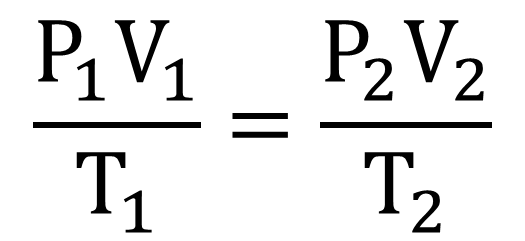
PV=nRT
What does R stand for
Ideal gas constant
Real gas constant
Temperature constant
Ideal gas law
1.5 mol is:
P
T
n
V
272 K is:
P
T
n
V
9.10 atm is:
P
T
n
V
32oC is:
P
T
n
V

