
 Worksheets
Unit 6 Study Guide
Total questions: 90
Worksheet time: 45mins
In his transformation experiments, what phenomenon did Griffith observe?
Infecting mice with nonpathogenic strains of bacteria makes them resistant to pathogenic strains.
Mixing a heat-killed pathogenic strain of bacteria with a living nonpathogenic strain can convert some of the living cells into the pathogenic form.
Mixing a heat-killed nonpathogenic strain of bacteria with a living pathogenic strain makes the pathogenic strain nonpathogenic.
Mice infected with a pathogenic strain of bacteria can spread the infection to other mice.

Timing and coordination of specific events are necessary for the normal development of an organism. These events are regulated by a variety of mechanisms.
Use the accompanying diagram of the key developmental events in the life cycle of the fruit fly Drosophila to select the statement that best describes the timing and coordination of events necessary for normal fruit fly development.
Fruit flies have an ordered series of segments in their bodies that are switched during metamorphosis.
Cytoplasmic determinants localized in the unfertilized egg provide positional information for placement of the anterior-posterior axis in the embryo.
Nurse cells in the fertilized egg trigger segmentation in the three different larval stages that occur in the fruit fly’s development.
The male gamete contains cytoplasmic determinants that determine the fate of the embryo and regulate gene expression for metamorphosis.
Proto-oncogenes can change into oncogenes that cause cancer. Which of the following best explains the presence of these potential time bombs in eukaryotic cells?
Proto-oncogenes first arose from viral infections.
Proto-oncogenes are mutant versions of normal genes.
Proto-oncogenes are genetic "junk."
Proto-oncogenes normally help regulate cell division.
Within a cell, the amount of protein made using a given mRNA molecule depends partly on
the degree of DNA methylation.
the rate at which the mRNA is degraded.
the number of introns present in the mRNA.
the types of ribosomes present in the cytoplasm.
What would occur if the repressor of an inducible operon were mutated so it could not bind the operator?
irreversible binding of the repressor to the promoter
reduced transcription of the operon's genes
buildup of a substrate for the pathway controlled by the operon
continuous transcription of the operon's genes
Cell differentiation always involves
transcription of the myoD gene.
the movement of cells.
the production of tissue-specific proteins.
the selective loss of certain genes from the genome.
Muscle cells differ from nerve cells mainly because they
express different genes.
contain different genes.
use different genetic codes.
have unique ribosomes.
Forms of the Ras protein found in tumors usually cause which of the following events to occur?
DNA replication to stop
cell-to-cell adhesion to be nonfunctional
cell division to cease
excessive cell division
Why are BRCA1 and BRCA2 considered to be tumor-suppressor genes?
Their normal products participate in repair of DNA damage.
The mutant forms of either one of these prevent breast cancer.
The normal genes make estrogen receptors.
They block penetration of breast cells by chemical carcinogens.
Which of the following processes do normal proto-oncogenes typically exhibit?
They normally suppress tumor growth.
They enhance tumor growth.
They stimulate normal cell growth and division.
They are underexpressed in cancer cells.
Which of the following types of mutation would convert a proto-oncogene into an oncogene?
a mutation that blocks transcription of the proto-oncogene
a mutation that creates an unstable proto-oncogene mRNA
a mutation that greatly increases the amount of the proto-oncogene protein
a deletion of most of the proto-oncogene coding sequence
Mutations in which of the following genes lead to transformations in the identity of entire body parts?
segmentation genes
egg-polarity genes
homeotic genes
inducers
Which of the following molecules are involved in pattern formation during development?
cytoplasmic determinants
miRNAs
cAMP
transcription factors
Among the newly discovered small noncoding RNAs, one type helps to reestablish ethylation patterns during gamete formation and blocks expression of some transposons. Which of the following types of RNA is responsible for this function?
miRNA
piRNA
lncRNA
siRNA
Which of the following processes destroys RNA molecules in a cell if they have a sequence complementary to an introduced double-stranded RNA?
RNA interference
RNA obstruction
RNA blocking
RNA disposal
Which of the following methods is utilized by eukaryotes to control their gene expression that is different from the type of control found in bacteria?
control of chromatin remodeling
control of RNA splicing
transcriptional control
control of both RNA splicing and chromatin remodeling
DNA methylation and histone acetylation are examples of which of the following processes?
genetic mutation
chromosomal rearrangements
epigenetic phenomena
translocation
A researcher found a method she could use to manipulate and quantify phosphorylation and methylation in embryonic cells in culture. One of her colleagues suggested she try increased methylation of cytosine (C) nucleotides in the DNA of promoters of a mammalian system. Which of the following results would she most likely see?
decreased chromatin condensation
activation of histone tails for enzymatic function
higher levels of transcription of certain genes
inactivation of the selected genes
Gene expression is often assayed by measuring the level of mRNA produced from a gene. What level of the control of gene expression can by analyzed by this type of assay?
replication control
transcriptional control
alternative splicing
translational control
The reason for differences in the sets of proteins expressed in a nerve and a pancreatic cell of the same individual is that nerve and pancreatic cells contain different ________.
genes
regulatory sequences
sets of regulatory proteins
promoters
Imagine that you've isolated a yeast mutant that contains histones resistant to acetylation. What phenotype would you predict for this mutant?
The mutant will grow rapidly.
The mutant will require galactose for growth.
The mutant will show decreased levels of gene expression.
The mutant will show increased levels of gene expression.
The cAMP receptor protein (CRP) is said to be responsible for positive regulation of the lac operon because ________.
CRP binds cAMP
CRP binds to the CAP-binding site
CRP prevents binding of the repressor to the operator
CRP bound to the CRP-binding site stimulates the transcription of the lac operon
How does extracellular glucose inhibit transcription of the lac operon?
by strengthening the binding of the repressor to the operator
by weakening the binding of the repressor to the operator
by inhibiting RNA polymerase from opening the strands of DNA to initiate transcription
by reducing the levels of intracellular cAMP
Under what conditions does the trp repressor block transcription of the trp operon?
when the repressor binds to the inducer
when the repressor binds to tryptophan
when the repressor is not bound to tryptophan
when the repressor is not bound to the operator
Which of the following results would occur if the repressor of an inducible operon were mutated so that it could not bind the operator?
the irreversible binding of the repressor to the promoter
the reduced transcription of the operon's genes
the continuous transcription of the operon's genes
the overproduction of cAMP receptor protein (CRP)
How does the transcription of structural genes in an inducible operon occur?
It occurs continuously in the cell.
It starts when the pathway's substrate is present.
It starts when the pathway's product is present.
It stops when the pathway's product is present.
Which of the following conditions is most likely to cause the lactose operon to be transcribed?
There is more glucose in the cell than lactose.
There is glucose but no lactose in the cell.
The cyclic AMP and lactose levels are both high within the cell.
The cAMP level is high and the lactose level is low.
Which of the following processes would result from a mutation that deactivates a regulatory gene of a repressible operon in an E. coli cell?
continuous transcription of the structural gene controlled by that regulator
complete inhibition of transcription of the structural gene controlled by that regulator
irreversible binding of the repressor to the operator
continuous translation of the mRNA because of alteration of its structure
Most repressor proteins are allosteric. Which of the following molecules binds with the repressor to alter its conformation and therefore affect its function?
inducer
promoter
transcription factor
cAMP
When taken up by a cell, which of the following molecules binds to a repressor so that the repressor no longer binds to the operator?
inducer
promoter
repressor
corepressor
Which of the following molecules is a protein produced by a regulatory gene?
operon
inducer
promoter
repressor

The template strand of a gene contains this sequence:
3¢-TAC TAG GCT AGT TGA-5¢. A mutation occurs that changes the gene sequence to 3¢-TAC TAG ACT AGT TGA-5¢. How does this mutation affect the resulting amino acid sequence?
The mutation changes a single amino acid to another amino acid.
The mutation does not affect the amino acid sequence.
The mutation eliminates the stop codon in the third triplet.
The mutation introduces a stop codon.

Using Figure 17.6, identify a 5¢ ® 3¢ sequence of nucleotides in the DNA template strand for an mRNA coding for the polypeptide sequence Phe-Pro-Lys.
5-UUUCCCAAA-3
5-GAACCCCTT-3
5-CTTCGGGAA-3
5-AAACCCUUU-3
An original section of DNA has the base sequence AGCGTTACCGT. A mutation in this DNA strand results in the base sequence AGGCGTTACCGT. What type of mutation does this change represent?
a missense mutation
a point mutation
a silent mutation
frameshift mutation
Which of the following molecules are required for the process of translation?
mRNA, tRNA, DNA, and rRNA
mRNA, DNA, and rRNA
mRNA, tRNA, and rRNA
mRNA, tRNA, and DNA
Which of the following properties is associated with a protein that will be secreted from a eukaryotic cell?
It must be translated by a ribosome that remains free within the cytosol.
Its signal sequence must target it to the ER, after which it goes to the Golgi.
Its signal sequence must be cleaved off before the polypeptide can enter the ER.
Its signal sequence must target it to the plasma membrane, where it causes exocytosis.
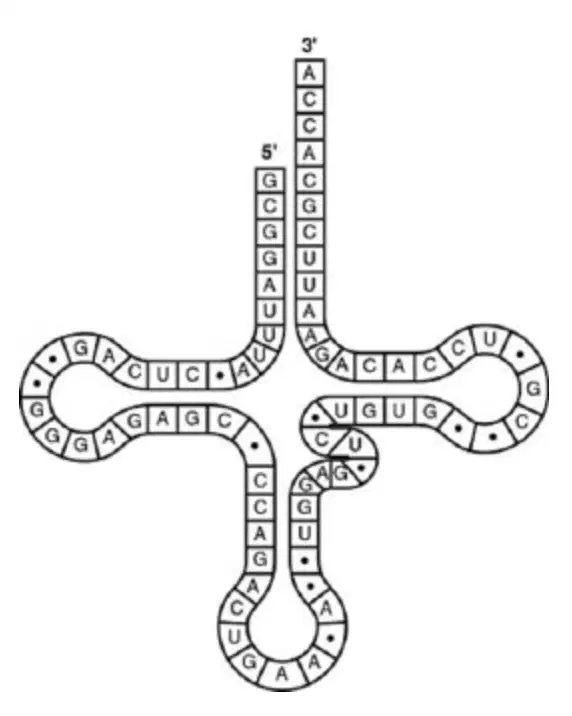
Use the figure to answer the question.
The tRNA shown in the figure has its 3¢ end projecting beyond its 5¢ end. Which of the following processes will occur at this 3¢ end?
The amino acid binds covalently.
The excess nucleotides (ACCA) will be cleaved off at the ribosome.
The small and large subunits of the ribosome will attach to it.
The 5¢ cap of the mRNA will become covalently bound.
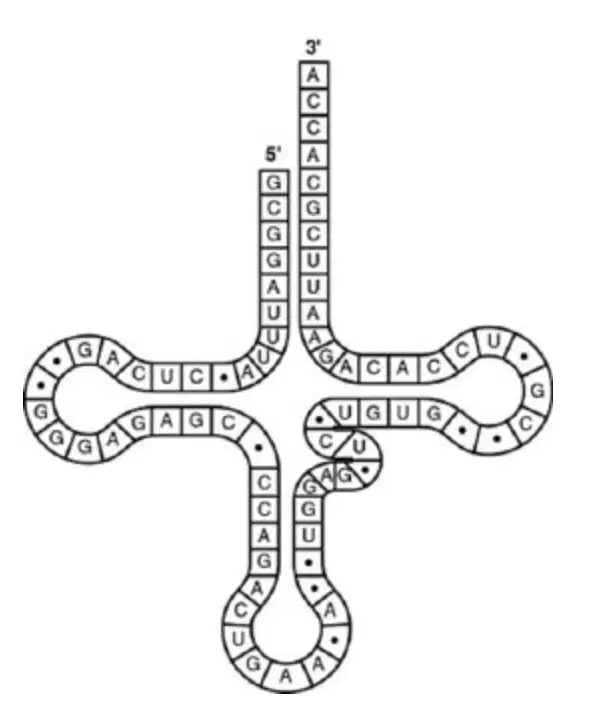
Use the figure to answer the question.
The figure represents tRNA that recognizes and binds a particular amino acid (in this instance, phenylalanine). Which codon on the mRNA strand codes for this amino acid?
5¢-UGG-3¢
3¢-GUG-5¢
5¢-GUA-3¢
5¢-UUC-3¢
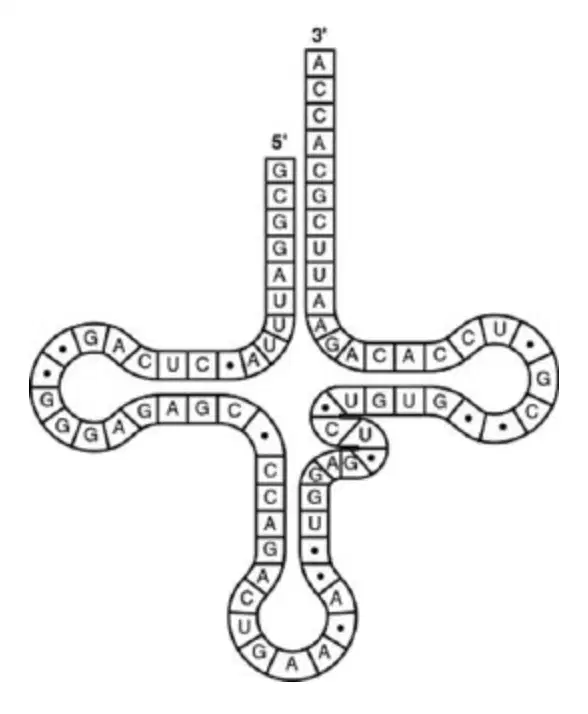
Use the figure to answer the question.
What type of bonding is responsible for maintaining the shape of the tRNA molecule shown in the figure?
ionic bonding between phosphates
hydrogen bonding between base pairs
van der Waals interactions between hydrogen atoms
peptide bonding between amino acids
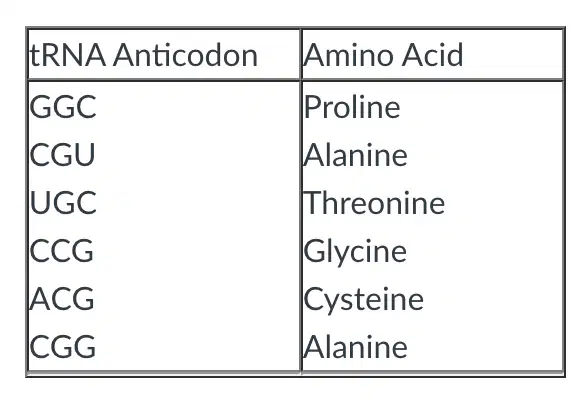
Use the following information to answer the question.
A part of an mRNA molecule with the following sequence is being read by a ribosome: 5¢-CCG-ACG-3¢ (mRNA). The following charged transfer RNA molecules (with their anticodons shown in the 3¢ to 5¢ direction) are available. Two of them can correctly match the mRNA so that a dipeptide can form.
Which of the following anticodons in the first tRNA to bind will complement this mRNA?
3¢-GGC-5¢
5¢-GGC-3¢
5¢-UGC-3¢
3¢-UGC-5¢
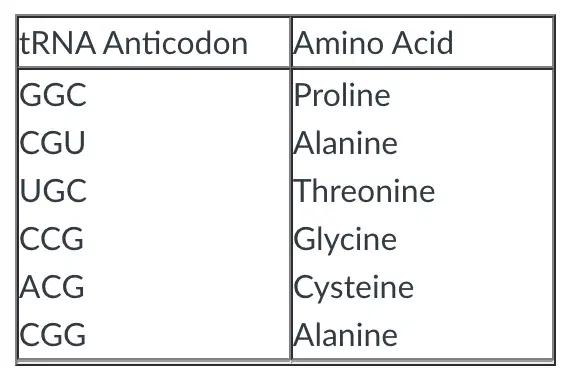
Use the following information to answer the question.
A part of an mRNA molecule with the following sequence is being read by a ribosome: 5¢-CCG-ACG-3¢ (mRNA). The following charged transfer RNA molecules (with their anticodons shown in the 3¢ to 5¢ direction) are available. Two of them can correctly match the mRNA so that a dipeptide can form.
Which of the following dipeptides will form from this mRNA?
cysteine-alanine
proline-threonine
glycine-cysteine
alanine-alanine
A particular triplet of bases in the coding sequence of DNA is AAA. The anticodon on the tRNA that binds the mRNA codon is ________.
TTT
UUA
UUU
AAA
Which of the following statements correctly describes a ribozyme?
It is a catalyst that uses RNA as a substrate.
It is an RNA with catalytic activity.
It is an enzyme that catalyzes the association between the large and small ribosomal subunits.
It is an enzyme that synthesizes RNA as part of the transcription process.
Which of the following processes occurs in eukaryotic gene expression?
mRNA, tRNA, and rRNA are translated.
RNA polymerase binds to the terminator sequence.
A cap is added to the 5¢ end of the mRNA.
RNA polymerase requires tRNA to elongate the molecule.
In eukaryotes, there are several different types of RNA polymerase. Which type is involved in transcription of mRNA for a globin protein?
RNA polymerase I
RNA polymerase II
RNA polymerase III
primase
Which of the following statements best describes the termination of transcription in prokaryotes?
RNA polymerase transcribes through the polyadenylation signal, causing proteins to associate with the transcript and cut it free from the polymerase.
RNA polymerase transcribes through the terminator sequence, causing the polymerase to separate from the DNA and release the transcript.
Once transcription has initiated, RNA polymerase transcribes until it reaches the end of the chromosome.
RNA polymerase transcribes through a stop codon, causing the polymerase to stop advancing through the gene and release the mRNA.
Which of the following processes occurs in prokaryotes but not in eukaryotes?
post-transcriptional splicing
transcription and translation occur simultaneously
translation in the absence of a ribosome
gene splicing
Codons are three-base sequences in mRNA that specify the addition of a single amino acid to the growing protein chain during translation. How do eukaryotic codons and prokaryotic codons compare?
Prokaryotic codons usually contain different bases than those of eukaryotes.
Prokaryotic codons usually specify different amino acids than those of eukaryotes.
The translation of codons is mediated by tRNAs in eukaryotes, but translation requires no intermediate molecules such as tRNAs in prokaryotes.
Codons are a nearly universal language among all organisms.
According to the central dogma, what is the intermediate molecule involved in the flow of information in a cell that should go in the blank?
DNA ® ________ ® Proteins
mtDNA
rRNA
mRNA
tRNA
The genetic code is redundant. What is meant by this statement?
A single codon can specify the addition of more than one amino acid.
The genetic code is different for different domains of organisms.
The genetic code is universal (the same for all organisms).
More than one codon can specify the addition of the same amino acid.
Which of the following molecular structures contain codons?
a protein
mRNA
tRNA
rRNA
Which of the following processes occurs during transcription?
DNA is replicated
RNA is synthesized
proteins are synthesized
mRNA attaches to ribosomes
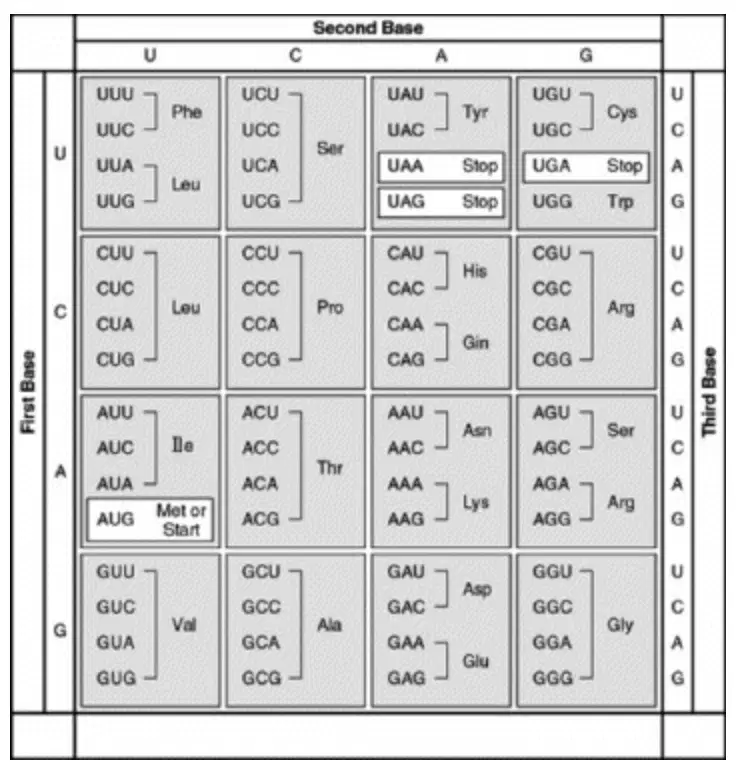
The following question refers to this table of codons.
Refer to the figure. Which of the triplets below is a possible anticodon for a tRNA that transports proline to a ribosome?
3¢-UUC-5¢
3¢-CCG-5¢
3¢-GGC-5¢
3¢-CCC-5¢
Which of the following characteristics is directly related to the coding of a single amino acid during the process of translation?
the base sequence of the tRNA
the amino acetyl tRNA synthase
the three-base sequence of mRNA
the complementarity of DNA and RNA
Which of the following statements supports the one gene-one enzyme hypothesis?
A mutation in a single gene can result in a defective protein.
Alkaptonuria results when individuals lack multiple enzymes involved in the catalysis of homogentisic acid.
Sickle-cell anemia results in normal hemoglobin.
Multiple antibody genes can code for different related proteins, depending on the splicing that takes place post-transcriptionally.
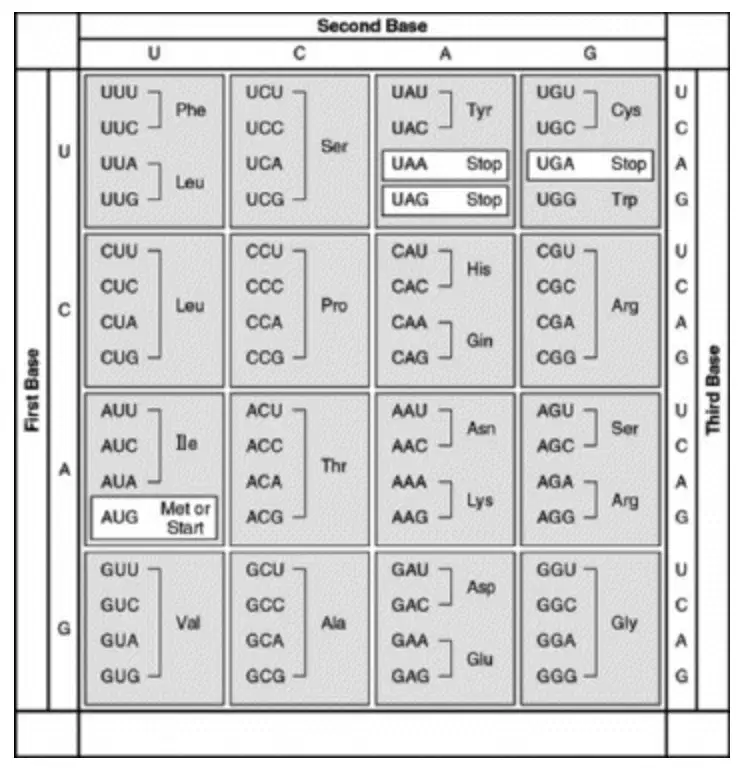
The following question refers to this table of codons.
What amino acid sequence will be generated, based on the following mRNA codon sequence?
5¢-AUG-UCU-UCG-UUA-UCC-UUG-3¢
Met-Arg-Glu-Arg-Glu-Arg
Met-Glu-Arg-Arg-Glu-Leu
Met-Ser-Leu-Ser-Leu-Ser
Met-Ser-Ser-Leu-Ser-Leu
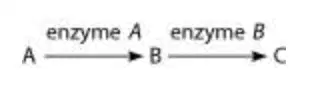
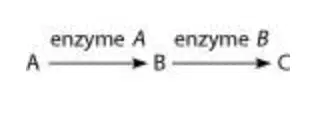
Use the figure to answer the question.
Refer to the metabolic pathway illustrated. If A, B, and C are all required for growth, a strain mutant for the gene encoding enzyme B would be able to grow on medium supplemented with which of the following nutrient(s)?
nutrient A only
nutrient B only
nutrient C only
nutrients A and C
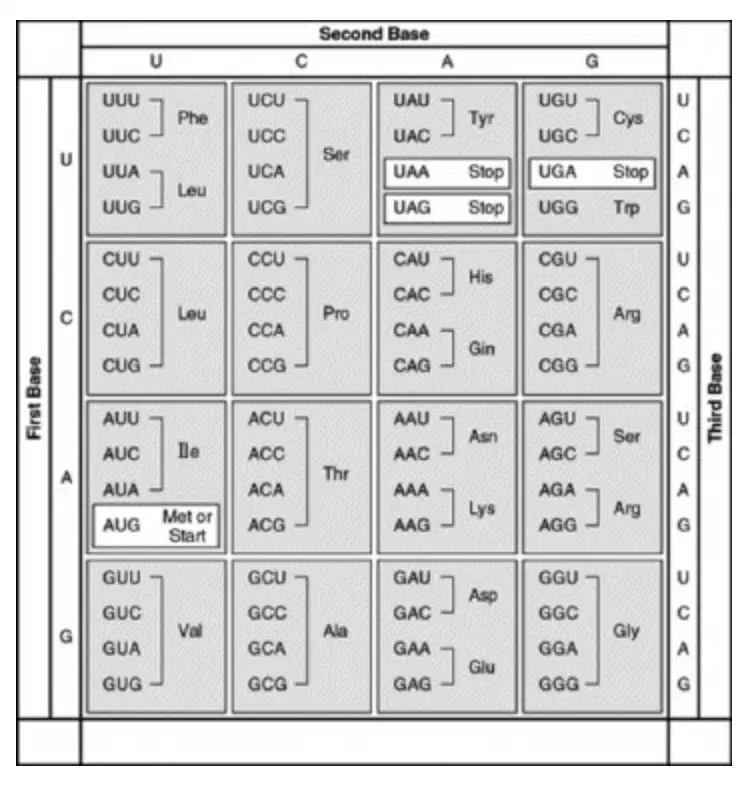
The following question refers to this table of codons.
Which of the following sequences of nucleotides are possible in the template strand of DNA that would code for the polypeptide sequence Phe-Leu-Ile-Val?
5¢-TTG-CTA-CAG-TAG-3¢
5¢-AUG-CTG-CAG-TAT-3¢
3¢-AAA-AAT-ATA-ACA-5¢
3¢-AAA-GAA-TAA-CAA-5¢
Use the figure to answer the question.
Refer to the metabolic pathway illustrated. If A, B, and C are all required for growth, a strain that is mutant for the gene-encoding enzyme A would be able to grow on medium supplemented with which of the following nutrient(s)?
nutrient A only
either nutrient B or C
nutrient C only
nutrients A and C
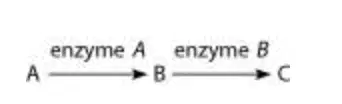
Use the figure to answer the question.
The figure shows a simple metabolic pathway. According to Beadle and Tatum's hypothesis, how many genes are necessary for this pathway?
1
2
3
It cannot be determined from the pathway.
A particular triplet of bases in the template strand of DNA is 5¢-AGT-3¢. What would be the corresponding codon for the mRNA that is transcribed?
3¢-UCA-5¢
3¢-UGA-5¢
5¢-TCA-3¢
3¢-ACU-5¢
The lagging strand is characterized by a series of short segments of DNA (Okazaki fragments) that will be joined together to form a finished lagging strand. The experiments that led to the discovery of Okazaki fragments gave evidence for which of the following ideas?
DNA polymerase is a directional enzyme that synthesizes leading and lagging strands during replication.
DNA is a polymer consisting of four monomers: adenine, thymine, guanine, and cytosine.
DNA is the genetic material.
Bacterial replication is fundamentally different from eukaryotic replication. The key shouldn’t be way longer than the distractors.
Hershey and Chase used a DNA-based virus for their work. What would the results have been if they had used an RNA virus?
With an RNA virus radioactive protein would have been in the final pellet.
With an RNA virus radioactive RNA would have been in the final pellet.
With an RNA virus neither sample would have had a radioactive pellet.
With an RNA virus the protein shell would have been radioactive in both samples.
In E. coli replication the enzyme primase is used to attach a 5 to 10 base ribonucleotide strand complementary to the parental DNA strand. The RNA strand serves as a starting point for the DNApolymerase that replicates the DNA. If a mutation occurred in the primase gene, which of the following would you expect?
Replication would only occur on the leading strand.
Replication would only occur on the lagging strand.
Replication would not occur on either the leading or lagging strand.
Replication would not be affected as the enzyme primase in involved with RNA synthesis.
The spontaneous loss of amino groups from adenine in DNA results in hypoxanthine, an uncommon base, opposite thymine. What combination of proteins could repair such damage?
telomerase, helicase, single-strand binding protein
telomerase, primase, DNA polymerase
nuclease, DNA polymerase, DNA ligase
DNA ligase, replication fork proteins, adenylyl cyclase
A biochemist isolates, purifies, and combines in a test tube a variety of molecules needed for DNA replication. When she adds some DNA to the mixture, replication occurs, but each DNA molecule consists of a normal strand paired with numerous segments of DNA a few hundred nucleotides long. What has she probably left out of the mixture?
DNA ligase
Okazaki fragments
DNA polymerase
primase
In a nucleosome, the DNA is wrapped around
polymerase molecules.
a thymine dimer.
histones.
ribosomes.
The elongation of the leading strand during DNA synthesis
progresses away from the replication fork.
depends on the action of DNA polymerase.
occurs in the 3¢ ® 5¢ direction.
produces Okazaki fragments.
In analyzing the number of different bases in a DNA sample, which result would be consistent with the base-pairing rules?
A + T = G + C
A = C
A + G = C + T
A = G
The lagging strand is characterized by a series of short segments of DNA (Okazaki fragments) that will be joined together to form a finished lagging strand. The experiments that led to the discovery of Okazaki fragments gave evidence for which of the following ideas?
DNA is a polymer consisting of four monomers: adenine, thymine, guanine, and cytosine.
DNA is the genetic material.
Bacterial replication is fundamentally different from eukaryotic replication. The key should not be way longer than the distractors.
DNA polymerase is an enzyme that synthesizes leading and lagging strands during replication only in one direction.
Hershey and Chase used a DNA-based virus for their work. How might the results have been different if they had used an RNA virus?
With an RNA virus, neither sample would have had a radioactive pellet.
With an RNA virus, radioactive RNA would have been in the final pellet.
With an RNA virus, the protein shell would have been radioactive in both samples.
With an RNA virus, radioactive protein would have been in the final pellet.
Which of the following structural characteristics is most critical for the association between histones and DNA?
Histones are positively charged.
Histones are highly conserved (that is, histones are very similar in every eukaryote).
Histones are small proteins.
There are at least five different histone proteins in every eukaryote.
Telomere shortening puts a limit on the number of times a cell can divide. Research has shown that telomerase can extend the life span of cultured human cells. How might adding telomerase affect cellular aging?
Telomerase will speed up the rate of cell proliferation.
Telomerase shortens telomeres, which delays cellular aging.
Telomerase would have no effect on cellular aging.
Telomerase eliminates telomere shortening and retards aging.
Which of the following lists represents the order of increasingly higher levels of organization of chromatin?
nucleosome, 30-nm chromatin fiber, looped domain
looped domain, 30-nm chromatin fiber, nucleosome
30-nm chromatin fiber, nucleosome, looped domain
nucleosome, looped domain, 30-nm chromatin fiber
What are telomeres?
the sites of origin of DNA replication
the ends of linear chromosomes
enzymes that elongate the DNA strand during replication
the structures that hold two sister chromatids together
Which of the following statements correctly describes the difference between the leading strand and the lagging strand in DNA replication?
The leading strand is synthesized continuously in the 5¢ ® 3¢ direction, while the lagging strand is synthesized discontinuously in the 5¢ ® 3¢ direction.
There are different DNA polymerases involved in elongation of the leading strand and the lagging strand.
The leading strand requires an RNA primer, whereas the lagging strand does not.
The leading strand is synthesized in the 3¢ ® 5¢ direction in a discontinuous fashion, while the lagging strand is synthesized in the 5¢ ® 3¢ direction in a continuous fashion.
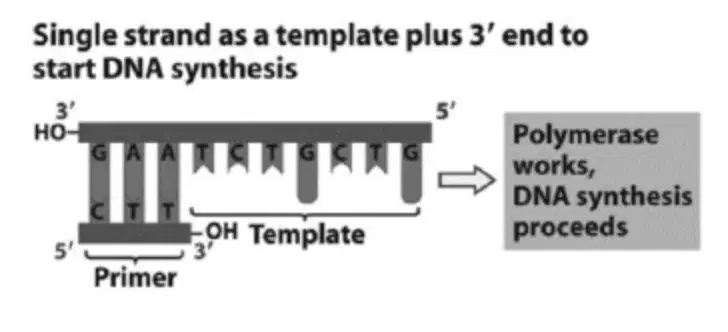
Use the figure to answer the following question.
Referring to the figure, what bases will be added to the primer as DNA replication proceeds?
3¢ T, C, T, G, C, T, G 5¢
5¢ A, G, A, C, G, A, C 3¢
5¢ C, A, G, C, A, G, A 3¢
3¢ G, T, C, G, T, C, T 5¢
DNA contains the template needed to copy itself, but it has no catalytic activity in cells. What catalyzes the formation of phosphodiester bonds between adjacent nucleotides in the DNA polymer being formed during DNA replication?
ribozymes
RNA primers
DNA polymerase
ATP
Who performed classic experiments that supported the semiconservative model of DNA replication?
Watson and Crick
Franklin and Wilkins
Hershey and Chase
Meselson and Stahl
In DNA replication, the resulting daughter molecules contain one strand of the original parental DNA and one new strand. What is the explanation for this phenomenon?
DNA replication is conservative.
DNA replication is semiconservative.
RNA synthesis is conservative.
DNA replication is not conservative.
Semiconservative replication involves a template. What is the template?
one strand of the DNA molecule
DNA polymerase
an RNA molecule
single-stranded binding proteins
Within a double-stranded DNA molecule, adenine forms hydrogen bonds with thymine, and cytosine forms hydrogen bonds with guanine. What is the significance of the structural arrangement?
It determines the type of protein produced.
It permits complementary base pairing.
It allows variable width of the double helix.
It determines the tertiary structure of a DNA molecule.
You briefly expose bacteria undergoing DNA replication to radioactively labeled nucleotides. When you centrifuge the DNA isolated from the bacteria, the DNA separates into two classes. One class of labeled DNA includes very large molecules (thousands or even millions of nucleotides long), and the other includes short stretches of DNA (several hundred to a few thousand nucleotides in length). Which two classes of DNA do these different samples represent?
lagging strands and Okazaki fragments
leading strands and Okazaki fragments
leading strands and RNA primers
Okazaki fragments and RNA primers
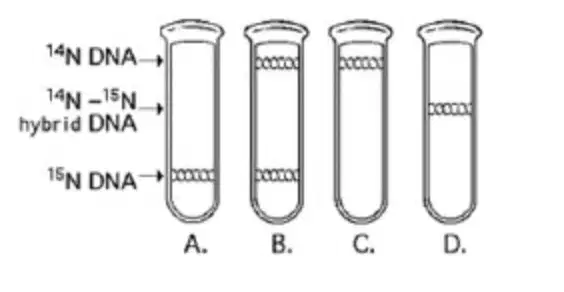
Use the figure to answer the following question.
A space probe returns with a culture of a microorganism found on a distant planet. Analysis shows that it is a carbon-based life-form that has DNA. You grow the cells in 15N medium for several generations and then transfer them to 14N medium. Which pattern in the figure would you expect if the DNA was replicated in a conservative manner?
D
A
C
B
Which of the following types of molecules help to hold the DNA strands apart while they are being replicated?
ligase
single-strand DNA binding proteins
DNA polymerase
primase
What is the role of DNA ligase in the elongation of the lagging strand during DNA replication?
It stabilizes the unwound parental DNA.
It unwinds the parental double helix.
It joins Okazaki fragments together.
It synthesizes RNA nucleotides to make a primer.
At a specific area of a chromosome, the sequence of nucleotides below is present where the chain opens to form a replication fork:
3¢ C C T A G G C T G C A A T C C 5¢
An RNA primer is formed starting at the underlined T (T) of the template. Which of the following represents the primer sequence?
5¢ A C G T T A G G 3¢
5¢ A C G U U A G G 3¢
5¢ G C C U A G G 3¢
5¢ G C C T A G G 3¢
Thymine makes up 28% of the nucleotides in a sample of DNA from an organism. Approximately what percentage of the nucleotides in this sample will be guanine?
22%
8%
72%
16%
Cytosine makes up 42% of the nucleotides in a sample of DNA from an organism. Approximately what percentage of the nucleotides in this sample will be thymine?
58%
8%
42%
16%
Which of the following facts did Hershey and Chase make use of in trying to determine whether DNA or protein is the genetic material?
DNA contains sulfur, whereas protein does not.
DNA contains purines, whereas protein includes pyrimidines.
DNA contains nitrogen, whereas protein does not.
DNA contains phosphorus, whereas protein does not.

