
 Worksheets
6th Grade Heat Transfer and Wind
Total questions: 56
Worksheet time: 57mins
Where does prevailing westerlies blow?
west to east
north to west
south to east
east to west
What conditions does a sea breeze give to the land?
rainy weather
rainy and windy weather
tropical weather
hot and sunny weather
Is it true that land breezes happen at day?
true
false
Heat from the sun warming our face.
conduction
convection
radiation
insulator
Which winds effect the U.S.A the most?
polar winds
prevailing westerlies
trade winds
global winds
The movement of groups of molecules within fluids such as liquids of gases as they heat and cool.
polar easterlies
pola zone
conduction
convection currents
Large winds that circle the Earth in each climate zone as a result of convection and changes in air pressure.
global winds
land breeze
Gulf Stream current
jet stream
The nearly constant easterly winds that dominate most of the tropics between the equator and 30 degrees latitude.
Local winds
Trade winds
Global winds
Radiation
A local wind that blows cooler air from an ocean or lake toward land during the daytime.
polar easterlies
mountain breeze
sea breeze
horse latitude
A narrow belt or ribbon of strong winds that blow in the upper troposphere and affect weather patterns.
jet stream
trade winds
Coriolis effect
ocean currents
What causes the wind to rotate in circles instead of the wind in straight lines?
Coriolis effect
the Great Conveyor effect
the Earth spinning on its axis
the Sun
Causes a curved movement of winds because the Earth is constantly spinning
prevailing winds
doldrum
Earth's rotation
Coriolis effect
At the equator, the air is:
warm, less dense, and rising
warm, more dense, and rising
cool, more dense, and sinking
cool, less dense, and sinking
The air over the north and South Pole is:
warm, less dense, and rising
warm, more dense, and rising
cool, less dense, and sinking
cool, more dense, and sinking
Global winds travel from:
high to low pressure
low to high pressure
high pressure to cool temperatures
low pressure to cold temperatures

What type of heat transfer is going on here?
insulator
radiation
convection
conduction
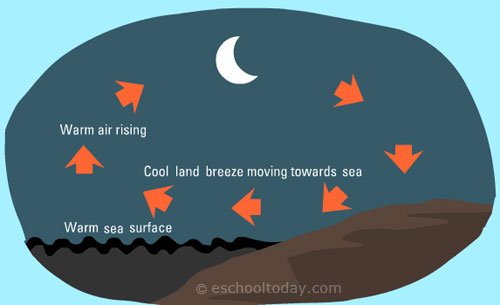
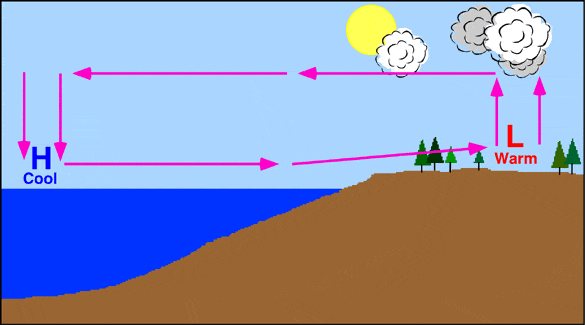

The kind of energy transfer that causes air particles to heat up over land?
Convection
Radiation
Conduction
The Floss
What are jet streams?
The trail left from an airplane.
Bands of strong wind.
The winds that push jets through the air.
Wind made from tornadoes.
Which direction do jet streams generally blow?
North to South
South to North
East to West
West to East
Where are the two polar jet streams located?
Near the north and south poles.
Near the equator.
You can't tell.
Only near the north pole.
If you were in a plane traveling from west to east, you would get there ________ than if you travel from east to west.
faster
slower
in the same amount of time
If a storm started in California, due to the jet stream, which direction would the storm eventually move?
Towards the Pacific Ocean
Towards North Carolina
Towards Canada
Towards the Gulf of Mexico

Transfer of thermal energy from one object to another or one region to another.
Thermal Energy
Temperature
Heat
Waves

Transfer of thermal energy through direct contact.
Radiation
Conduction
Convection
Density

Transfer of thermal energy through circulation of fluids.
Convection
Radiation
Conduction
Thermal Energy

Transfer of thermal energy through waves.
Radiation
Convection
Conduction
Ocean
What is the process by which heat is transferred through direct contact?
Radiation
Conduction
Convection
Boiling
What is the process by which hot material rises and cooler material sinks?
Radiation
Conduction
Convection
Burning
How does the density of warm air compare to the density of cold air?
Warm air is more dense than cold air and rises
Warm air is less dense than cold air and rises
Warm air is more dense than cold air and sinks
Warm air is less dense than cold air and sink
Differences in density create differences in air
temperature
pressure
luminosity
quality
Air pressure at the Earth's surface is _______ than higher up in the atmosphere
higher
lower
The higher you rise into the atmosphere, the _________ the air pressure becomes.
higher
lower
How does the tilted Earth affect the distribution of the Sun's energy?
sunlight strikes the poles more directly than the equator
sunlight strikes the equator more directly than the poles
all areas on the Earth receive the same amount of sunlight
sunlight strikes the North Pole directly year-round
The major patterns of movement of air and water on Earth are the result of –
different densities of seawater and fresh water.
diversity in the height of coastal landforms.
uneven heating and the rotation of Earth.
irregular durations of daytime and nighttime.
What is one effect of the uneven heating of Earth caused by the Sun?
Rotation of Earth
Generation of wind
Oceans losing salt
Plants failing to grow
The energy that generates wind comes from what source?
The energy that generates wind comes from what source?
Solar radiation
Electromagnetic waves
Severe thunderstorms
Causes sunburns
Xrays
Ultraviolet
visible light
gamma rays
Which of the following as a higher frequency than visible light and lower frequency than x rays?
Ultraviolet
gamma ray
infrared
microwaves
Which of the following has longer wavelength than visible light but shorter wavelength than microwaves.
radio waves
infrared
UV
x ray

Which rays are DIRECT? A or B
A
B
Which rays are INDIRECT? A or B
A
B
Which rays are spread out?
Direct
Indirect
Which rays do not spread out?
Direct
Indirect
Which rays are stronger?
Direct
Indirect
Which rays are weaker?
Direct
Indirect
Which rays heat the Earth more?
Direct
Indirect

