
 Worksheets
U4 Unit 4 STUDY GUIDE
Total questions: 11
Worksheet time: 6mins

How did the environment change between TIME 1 and TIIME 2? How did the population change?
You cannot tell how the environment changed. With each generation, more squirrels passed on the gene for black fur to their offspring.
There were more black trees. Squirrels with black fur are more likely to survive, so the squirrels with gray fur changed to have black fur.
There were more black trees. Squirrels with black fur are more likely to survive, so both types of squirrels passed on the gene for black fur to their offspring.
There were more black trees. With each generation, more squirrels with black fur survived long enough to pass on the gene for black fur to their offspring.

If their environment changes to have only brown dirt, which of the following fox populations will most likely survive?
Populations 1 and 2 will most likely survive.
Populations 2 and 3 will most likely survive.
Only Population 2 will survive because it is the only population with variation.
All the populations will survive because the foxes will change the color of their fur if they need to.

Examine the pedigree above. Which of the following statements best fits the data?
Two parents with widow’s peaks only have widow’s peak children
Two parents with no widow’s peak only have children with no widow’s peak
If parents do not match on the widow's peak trait, the children will all have no widow's peak
If parents do not match on the trait, the children will all have widow’s peak
A population can be described by the (,____ , ) present and by the number of individuals who have each trait.
organisms
traits
variation
RNA
The number of individuals with each trait in a population can (, , ) over time.____
gene
mutate
reduce
change
Over many generations, individuals with adaptive traits become (, ___, ) common in a population, while individuals with non-adaptive traits become (less, more, equal) common.
less
more
equal
equals
Whether or not a trait is adaptive depends on the (, ____, ).
mutation
distribution
environment
species
Mutations are changes to genes that can lead to changes to (,____ , ) molecules, which can result in changes to traits.
protein
lipids
carbon
RNA
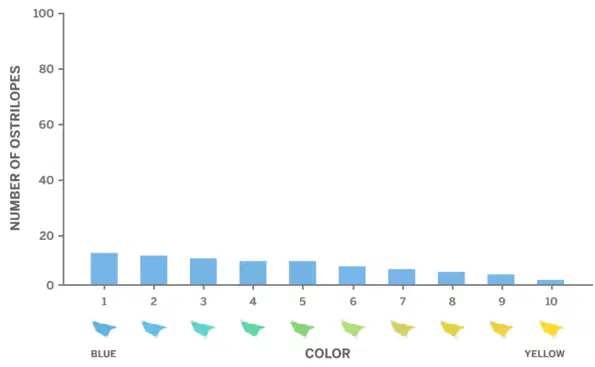
This Ostrilope Color Histogram focus on how reproduction affects traits at the population level.
Based on the data in the Histogram how does reproduction affect traits at the population level. LESSON 2.1
Reproduction always creates individuals with adaptive traits.
Reproduction never creates individuals with adaptive traits.
Reproduction sometimes creates individuals with adaptive traits.
Reproduction doesn’t determine the trait an individual has.
(___ ) are instructions for making protein molecules and protein molecules determine an organism's traits.
Genes
Proteins
Evidence
RNA
Individuals with adaptive traits are (___) likely to live longer and have offspring; individuals with non-adaptive traits are (less, more, equal) likely to die without having offspring.
more
less
equal

