
Font size
 Worksheets
Chapter nine: incomplete and codominance
Total questions: 32
Worksheet time: 1hrs 1mins


The trait this pedigree traces is recessive because it skips a generation and individuals can be carriers. What is the most likely genotype for person III-3?
GG
Gg
gg
Which gender has an X and a Y chromosome?
male
female

On a pedigree, this symbol represents a ----
not affected male.
not affected female.
affected male.
affected female.

What is the mode of inheritance shown here?
Recessive because it "skips" a generation
Dominant because it shows up in every generation

How are individuals III-2 and II-4 related?
Brother and sister
Dad and daughter
Uncle and niece
Grandfather and granddaughter

Based off this punnett square, what fraction of the offspring will have wrinkled, yellow seeds?
9/16
3/16
1/16
16/16

In the second generation of this pedigree, how many people are carriers of the trait? *Remember: a carrier does not have the disorder/disease, but can pass it on to his/her children.
1
2
3
5

Why do all the daughters in Generation II carry the colorblind gene?
Because mom passed on the gene.
Because dad passed on the X chromosome.

Which individual in the first generation is a carrier?
I-1
I-2
What you see, or the physical appearance of an organism, is called the ---
genotype.
phenotype.

If this pedigree shows a recessive disorder, what MUST the genotype of individual II-3 be?
HH
Hh
hh
The different forms of a gene are called ---
traits
hybrids
alleles
The blending of two traits in which one is not completely dominant over the other is known as ---
incomplete dominance
codominance

____ is an inheritance pattern that results in offspring that are a MIXTURE of the two traits of its parents, like yellow and blue flowers making green offspring.
incomplete dominance.
codominance
An inheritance pattern in which both alleles for a gene are expressed in the offspring so that both traits show up on its body is known as ---
Codominance
Incomplete dominance

If you cross a black chicken with a white chicken and only black AND white feathered chickens are produced, then feather color follows the inheritance pattern of ---
Incomplete dominance
Codominance
Snap dragon color is a incomplete dominant trait. A red flower (RR) is crossed with white flower (WW)? What color are flowers that are RW?
Red and white spotted
Red
Pink
White

A red flowered plant (RR) is crossed with a white flowered plant (WW). The gene for petal color in these plants expresses incomplete dominance. What percentage of the offspring will have pink (RW) flowers?
0%
25%
50%
100%
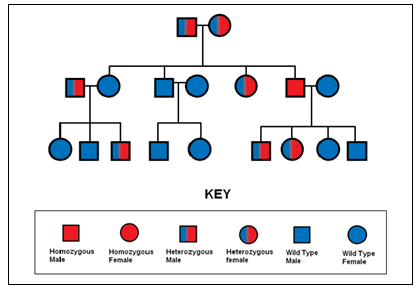
In a pedigree, which shape represents a male?
circle
square

Codominance occurs in calico cats, which allows for the Black and Tan colors to show. What percentage of the offspring represented in this P square will be calico (black and tan spotted)?
25%
50%
75%
100%


Based off this punnett square, what fraction of the offspring will have wrinkled, green seeds?
9/16
3/16
1/16
16/16
A white mouse with red eyes is crossed with a black mouse with brown eyes. The white mouse is recessive for both of its traits. The black mouse is dominant for both of its traits.
This cross would be
BBEE x bbee
BBEe x BbEe
BbEE x BbEe
BBee x BBEE
Linked genes are located on
the X chromosome but not the Y chromosome.
the same chromosome.
the Y chromosome but not the X chromosome.
different chromosomes.


On a pedigree, this symbol represents a ---
not affected female.
not affected male.
affected male.
affected female.
What contributes to genetic variation?
crossing over
law of independent assortment
law of segregation
gene linkage

