
 Worksheets
ISTQB Question Bank 301 to 340
Total questions: 40
Worksheet time: 10hrs 0mins
Name
Class
Date
1.
Cost of the reviews will not include.
a)
Review process itself
b)
Metrics analysis
c)
Tool support.
d)
Process improvement.
2.
Regression testing always involves
a)
Testing whether a known software fault been fixed.
b)
Executing a large number of different tests.
c)
Testing whether modifications have introduced adverse side effects.
d)
Using a test automation tool.
3.
Capture and replay facilities are least likely to be used to _______
a)
Performance testing
b)
Recovery testing
c)
GUI testing
d)
User requirements.
4.
Which tool will be used to test the flag memory leaks and unassigned pointers
a)
Dynamic analysis tool
b)
Static Analysis tool.
c)
Maintenance tool.
d)
Configuration tool
5.
Cyclomatic complexity is used to calculate
a)
Number of independent paths in the basis set of a program
b)
Number of binary decisions + 1
c)
Number bound for the number of tests that must be conducted to ensure that all statements have been executed at least once
d)
Number of branches and decisions
6.
Which of the following is not included in Test Plan.
a)
Features to be tested.
b)
Environmental needs.
c)
Suspension criteria.
d)
Expected results.
7.
Software quality is not relevant to _______
a)
Correctness
b)
Usability
c)
Viability
d)
Reusability
8.

Match the following:
a)
1-b, 2-c, 3-a
b)
1-b, 2-a, 3-c
c)
1-c, 2-a, 3-b
d)
1-a, 2-b, 3-c
9.
When do you stop testing?
a)
When the specified number of faults are found.
b)
When the test completion criteria are met.
c)
When all high and medium priority tests are complete.
d)
When all statements have been executed
10.
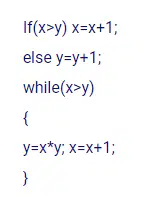
What is the smallest number of test cases required to Provide 100% branch coverage?
a)
1
b)
2
c)
3
d)
4
11.

Match the following.
a)
1-d, 2-c, 3-d, 4-a.
b)
1-d, 2-a, 3-c, 4-b.
c)
1-a, 2-b, 3-d, 4-c.
d)
1-c, 2-b, 3-a, 4-d.
12.
Integration testing in the large involves:
a)
Testing the system when combined with other systems.
b)
Testing a sub-system using stubs and drivers.
c)
Testing a system with a large number of users.
d)
Combing software components and testing them in one go.
13.
How are error guessing and exploratory testing similar?
a)
Both are widely used formal techniques
b)
Both are white-box test design techniques
c)
Both are experience-based testing
d)
Both are effective at all testing levels
14.
What technique would be MOST appropriate to check status changes based on certain events?
a)
State transition
b)
Equivalence partitioning
c)
Boundary value analysis
d)
Decision table
15.
In a formal review, who is primarily responsible for the documents to be reviewed?
a)
Author
b)
Manager
c)
Moderator
d)
Reviewers
16.
What type of testing will you perform on internet banking solution?
a)
System integration
b)
Functional testing
c)
Non-functional testing.
d)
Requirements testing
17.
Which of the following are false?
a)
Incidents should always be investigated and resolved.
b)
Incidents occur when expected and actual results differ.
c)
Incidents can be analyzed to assist in test process improvement.
d)
An incident can be raised against documentation.
18.
Testing is not done to ______
a)
Find faults
b)
Improve quality
c)
Check user friendliness.
d)
Improve software accuracy
19.
A field failure occurs when multiple users access a system. Which of the following is true?
a)
This is an acceptable risk of a multi-user system.
b)
Insufficient functional testing has been performed.
c)
This indicates an important non-functional requirement was not specified and tested.
d)
It is not possible to test against such events prior to release.
20.
People who don't participate in technical reviews
a)
Analysts
b)
Management
c)
Developers
d)
Testers
21.
What is failure?
a)
Deviation from expected result to actual result
b)
Defect in the software.
c)
Error in the program code.
d)
Fault in the system.
22.
Which test support tool can be used to enforce coding standards?
a)
Static analysis tool
b)
Performance testing tool
c)
Test comparator
d)
Test management tool
23.
Which of the following is least important in test management?
a)
Estimating test duration.
b)
Incident Management.
c)
Configuration Management.
d)
De-bugging.
24.
A standard for software testing terminology is:
a)
IEEE 802.11
b)
ISO 9001
c)
BS 7925-1
d)
BS 7925-2
25.
Which of the following is NOT a characteristic of User Acceptance Testing?
a)
Use of automated test execution tools.
b)
Testing performed by users.
c)
Testing against acceptance test criteria.
d)
Integration of system with user documentation.
26.
Integration of system with user documentation.
a)
Test management
b)
Test design
c)
Test planning
d)
Test execution
27.
What type of testing is done to supplement the rigorous testing?
a)
Regression testing.
b)
Integration testing.
c)
Error Guessing
d)
System testing.
28.
To make a test effective it is most important that:
a)
It is easy to execute.
b)
It is designed to detect faults if present.
c)
The expected outcome is specified before execution.
d)
It is unlikely to delay progress.
29.
Error guessing is:
a)
An appropriate way of deriving system tests.
b)
Only used if good requirements are not available.
c)
Only used when good requirements are available.
d)
The most appropriate way of deriving system tests.
30.
Amount of testing performed will not depend on
a)
Risks involved
b)
Contractual requirements
c)
Legal requirements
d)
Test data.
31.
For software to be reliable it must:
a)
Be easy to maintain.
b)
Be unlikely to cause a failure.
c)
Never fail under any circumstances.
d)
Be written according to coding standards
32.
Which test design techniques should a tester use to respectively achieve the following:
<br>
(a) Check the documented features of the system,
(b) ensure 100 % decision c overage, and
(c) detect likely defects and distribution?
a)
Specification-based, data driven testing, and defect density techniques
b)
Specification-based, branch coverage, and exploratory techniques
c)
Structure-based, equivalence partitioning, and exploratory techniques
d)
Specification-based, structure-based, and experience-based techniques
33.
Faults found by users are due to:
a)
Faults found by users are due to:
b)
Poor software and poor testing
c)
Bad luck
d)
Insufficient time for testing
34.
An incident logging system
a)
Only records defects
b)
Is of limited value
c)
Is a valuable source of project information during testing if it contains all incidents
d)
Should be used only by the test team.
35.
The later in the development life cycle a fault is discovered, the more expensive it is to fix. Why?
a)
The documentation is poor, so it takes longer to find out what the software is doing.
b)
Wages are rising
c)
The fault has been built into more documentation,code,tests, etc
d)
None of the above
36.
Which set of test data demonstrates equivalence partitioning to check whether a customer is a teenager or not?
a)
10, 15 and 19 years
b)
13, 19 and 25 years
c)
13, 16 and 19 years
d)
12, 13 and 20 years
37.
Which technique if OFTEN considered as an extension of equivalence partitioning?
a)
Decision table testing
b)
State transition testing
c)
Use case testing
d)
Boundary value analysis
38.
Software testing activities should start
a)
As soon as the code is written
b)
During the design stage
c)
When the requirements have been formally documented
d)
As soon as possible in the development life cycle
39.
A company by the name Software Testing Genius Inc. decides to use functional test execution automation tool for testing GUI of their product. The GUI is expected to change frequently. Software Testing Genius Inc. has put some of the manual testers through a 3-day training program on how to use the tool. Which of the following is likely to be true?
a)
Automation is likely to fail because of frequent changes and lack of experience
b)
Automation is likely to fail because of GUI automation is not the right way to automate
c)
Automation is likely to succeed because automation is very useful for frequent changes
d)
Automation is likely to succeed because the team has been trained on tool.
40.
A test design technique is
a)
A process for selecting test cases
b)
A process for determining expected outputs
c)
A way to measure the quality of software
d)
A way to measure in a test plan what has to be done
100 %

