
 Worksheets
PE CHAPTER24
Total questions: 133
Worksheet time: 4hrs 26mins
Babe Ruth, the famous baseball player, earned $80,000 in 1931. Today, the best baseball players can earn more than 400 times as much as Babe Ruth earned in 1931. However, prices have also risen since 1931. We can conclude that
the best baseball players today are about 400 times better off than Babe Ruth was in 1931.
because prices have also risen, the standard of living of baseball stars hasn't changed since 1931.
one cannot make judgments about changes in the standard of living based on changes in prices and changes in incomes.
one cannot determine whether baseball stars today enjoy a higher standard of living than Babe Ruth did in 1931 without additional information regarding increases in prices since 1931.
The consumer price index is used to
A. monitor changes in the level of wholesale prices in the economy.
B. monitor changes in the cost of living over time.
C. monitor changes in the level of real GDP over time.
D. monitor changes in the stock market.
A
B
C
D
When the consumer price index rises, the typical family
A. has to spend more dollars to maintain the same standard of living.
B. can spend fewer dollars to maintain the same standard of living.
C. finds that its standard of living is not affected.
D. can offset the effects of rising prices by saving more.
A
B
C
D
When the consumer price index falls, the typical family
A. has to spend more dollars to maintain the same standard of living.
B. can spend fewer dollars to maintain the same standard of living.
C. finds that its standard of living is not affected.
D. can save less because they do not need to offset the effects of rising prices.
A
B
C
D
Economists use the term inflation to describe a situation in which
A. some prices are rising faster than others.
B. the economy's overall price level is rising.
C. the economy's overall price level is high, but not necessarily rising.
D. the economy's overall output of goods and services is rising faster than the economy's overall price level.
A
B
C
D
When the overall level of prices in the economy is increasing, economists say that the economy is experiencing
A. economic growth.
B. stagflation.
C. inflation.
D. deflation.
A
B
C
D
The inflation rate you are likely to hear on the nightly news is calculated from
A. the GDP deflator.
B. the CPI.
C. the Dow Jones Industrial Average.
D. the unemployment rate.
A
B
C
D
The CPI is more commonly used as a gauge of inflation than the GDP deflator is because
A. the CPI is easier to measure.
B. the CPI is calculated more often than the GDP deflator is.
C. the CPI better reflects the goods and services bought by consumers.
D. the GDP deflator cannot be used to gauge inflation.
A
B
C
D
The CPI is a measure of the overall cost of
A. the inputs purchased by a typical producer.
B. the goods and services purchased by a typical consumer.
C. the goods and services produced in the economy.
D. the stocks on the New York Stock Exchange.
A
B
C
D
Which of the following agencies calculates the CPI?
A.the National Price Board
B. the Department Of Weight and Measurements
C. the Bureau of Labor Statistics
D. the Congressional Budget Office
A
B
C
D
Which entity within the U.S. government is responsible for computing and reporting the CPI?
A. the Department of Commerce
B.the Department of Labor
C. the General Accounting Office
D. the Council of Economic Advisers
A
B
C
D
he CPI is calculated
A. monthly by the Department of Commerce.
B. monthly by the Bureau of Labor Statistics.
C. quarterly by the Department of Commerce.
D. quarterly by the Bureau of Labor Statistics.
A
B
C
D
Reports on the current consumer price index are released every
A. quarter.
B. two weeks.
C. month.
D. week.
A
B
C
D
In the CPI, goods and services are weighted according to
A. how long a market has existed for each good or service.
B. the extent to which each good or service is regarded by the government as a necessity.
C. how much consumers buy of each good or service.
D. the number of firms that produce and sell each good or service.
A
B
C
D
To calculate the CPI, the Bureau of Labor Statistics uses
A. the prices of all goods and services produced domestically.
B. the prices of all final goods and services.
C. the prices of all consumer goods.
D. the prices of some consumer goods.
A
B
C
D
For any given year, the CPI is the price of the basket of goods and services in the
given year divided by the price of the basket in the base year, then multiplied by 100.
given year divided by the price of the basket in the previous year, then multiplied by 100.
base year divided by the price of the basket in the given year, then multiplied by 100.
previous year divided by the price of the basket in the given year, then multiplied by 100.

A
B
C
D

A
B
C
D

A
B
C
D

A
B
C
D
Suppose a basket of goods and services has been selected to calculate the CPI and 2012 has been chosen as the base year. In 2012, the basket’s cost was $80.00; in 2013, the basket’s cost was $84; and in 2014, the basket’s cost was $87.60.The value of the CPI was
100 in 2012.
105 in 2013.
109.5 in 2014.
All of the above are correct.
Suppose a basket of goods and services has been selected to calculate the CPI and 2012 has been selected as the base year. In 2012, the basket’s cost was $77; in 2013, the basket’s cost was $82; and in 2014, the basket’s cost was $90. The value of the CPI in 2014 was
109.8 and the inflation rate was 9.8%.
109.8 and the inflation rate was 16.9%.
116.9 and the inflation rate was 9.8%.
116.9 and the inflation rate was 16.9%.
The price index was 220 in one year and 238.2 in the next year. What was the inflation rate?
A. 8.3 percent
B. 108.3 percent
C. 4.8 percent
D. 38.2 percent
A
B
C
D
From 2013 to 2014, the CPI for medical care increased from 150 to 159. What was the inflation rate for medical care?
A. 5.7 percent
B. 6.0 percent
C. 9.0 percent
D. 59.0 percent
A
B
C
D

What belongs in space C?
A. 120
B. 25%
C. 8.7%
D. 12%
A
B
C
D
Between October 2014 and October 2015, the CPI in Canada rose from 120 to 124 and the CPI in Mexico rose from 210 to 229.1. What were the inflation rates for Canada and Mexico over this one-year period?
3.3 percent for Canada and 9.1 percent for Mexico
3.3 percent for Canada and 8.3 percent for Mexico
3.2 percent for Canada and 9.1 percent for Mexico
3.2 percent for Canada and 8.3 percent for Mexico
If the price index was 90 in year 1, 100 in year 2, and 95 in year 3, then the economy experienced
10 percent inflation between years 1 and 2, and 5 percent inflation between years 2 and 3.
10 percent inflation between years 1 and 2, and 5 percent deflation between years 2 and 3.
11.1 percent inflation between years 1 and 2, and 5 percent inflation between years 2 and 3.
11.1 percent inflation between years 1 and 2, and 5 percent deflation between years 2 and 3.
Which of the following changes in the price index produces the greatest rate of inflation: 106 to 112, 112 to 118, or 118 to 124?
A. 106 to 112
B. 112 to 120
C. 118 to 126
D. All of these changes produce the same rate of inflation.
A
B
C
D
If the CPI was 125 this year and 120 last year, then
A. the cost of the CPI basket of goods and services increased by 4.2 percent this year.
B. the price level increased by 4.2 percent this year.
C. the inflation rate for this year was 4.2 percent.
D. All of the above are correct.
A
B
C
D
In an imaginary economy, consumers buy only sandwiches and magazines. The fixed basket consists of 20 sandwiches and 30 magazines. In 2006, a sandwich cost $4 and a magazine cost $2. In 2007, a sandwich cost $5. The base year is 2006. If the inflation rate in 2007 was 16 percent, then how much did a magazine cost in 2007?
$1.87
$2.08
$2.32
$3.00
The price index was 128 in 2013, and the inflation rate was 24 percent between 2012 and 2013. The price index in 2012 was
A. 104.0.
B. 103.2.
C. 158.7.
D. 152.0.
A
B
C
D
Assume an economy experienced a positive rate of inflation between 2003 and 2004 and again between 2004 and 2005. However, the inflation rate was lower between 2004 and 2005 than it was between 2003 and 2004. Which of the following scenarios is consistent with this assumption?
The CPI was 100 in 2003, 110 in 2004, and 105 in 2005.
The CPI was 100 in 2003, 120 in 2004, and 135 in 2005.
The CPI was 100 in 2003, 105 in 2004, and 130 in 2005.
The CPI was 100 in 2003, 90 in 2004, and 88 in 2005.

A
B
C
D

The cost of the basket
A. increased from 2013 to 2014 and increased from 2014 to 2015.
B. increased from 2013 to 2014 and decreased from 2014 to 2015.
C. decreased from 2013 to 2014 and increased from 2014 to 2015.
D. decreased from 2013 to 2014 and decreased from 2014 to 2015.
A
B
C
D
Which of the following is not an example of a price index computed by the Bureau of Labor Statistics?
A. the Los Angeles price index
B. the energy price index
C. the producer price index
D. the stock price index
A
B
C
D
The price index that measures the cost of a basket of goods and services bought by firms is called the
A. industrial price index.
B. producer price index.
C. core price index.
D. GDP deflator.
A
B
C
D
Suppose that in 2010, the producer price index increases by 1.5 percent. As a result, economists most likely will predict that
GDP will increase in 2011.
the producer price index will increase by more than 1.5 percent in 2011.
interest rates will decrease in the future.
the consumer price index will increase in the future.
By far the largest category of goods and services in the CPI basket is
A. housing.
B. transportation.
C. education & communication.
D. food & beverages.
A
B
C
D
The relative importance of housing in the breakdown of consumer spending is
A. 41 percent.
B. 15 percent.
C. 6 percent.
D. 4 percent.
A
B
C
D
For purposes of calculating the CPI, the transportation category of consumer spending includes the cost of
A. subways.
B. gasoline.
C. both subways and gasoline.
D. neither subways nor gasoline.
A
B
C
D
For purposes of calculating the CPI, the apparel category of consumer spending includes the cost of
A. clothing, but not footwear or jewelry.
B. clothing and footwear, but not jewelry.
C. clothing and jewelry, but not footwear.
D. clothing, footwear, and jewelry.
A
B
C
D
In the basket of goods that is used to compute the consumer price index, which of the following categories of consumer spending is the smallest?
A. education & communication
B. apparel
C. medical care
D. recreation
A
B
C
D
Categories of U.S. consumer spending, ranked from largest to smallest, are
housing, food & beverages, education & communication, and transportation.
education & communication, housing, food & beverages, and transportation.
food & beverages, housing, transportation, and medical care.
housing, transportation, food & beverages, and medical care.
If the cost of housing increases by 10 percent, then, other things the same, the CPI is likely to increase by about
A. 1.7 percent.
B. 3.3 percent.
C. 4.1 percent.
D. 10 percent.
A
B
C
D
The goal of the consumer price index is to measure changes in the
A. costs of production.
B. cost of living.
C. relative prices of consumer goods.
D. production of consumer goods.
A
B
C
D
The consumer price index tries to gauge how much incomes must rise to maintain
A. an increasing standard of living.
B. a constant standard of living.
C. a decreasing standard of living.
D. the highest standard of living possible.
A
B
C
D
The consumer price index tires to measure how much consumer incomes must rise in order to maintain a constant
A. level of real GDP.
B. ratio of consumption to GDP.
C. ratio of net exports to GDP.
D. standard of living.
A
B
C
D
The consumer price index is
A. not very useful as a measure of the cost of living.
B. a perfect measure of the cost of living.
C. a useful measure, but not a perfect measure, of the cost of living.
D. not used as a measure of the cost of living.
A
B
C
D
The three problems with using the consumer price index as a measure of the cost of living are
A. widely acknowledged and easy to solve.
B. widely acknowledged and difficult to solve.
C. nearly unacknowledged and easy to solve.
D. nearly unacknowledged and difficult to solve.
A
B
C
D
When the relative price of a good increases, consumers respond by buying
A. a larger quantity of that good and a larger quantity of substitutes for that good.
B. a larger quantity of that good and a smaller quantity of substitutes for that good.
C. a smaller quantity of that good and a larger quantity of substitutes for that good.
D. a smaller quantity of that good and a smaller quantity of substitutes for that good.
A
B
C
D
Suppose the price of a quart of milk rises from $1.00 to $1.20 and the price of a T-shirt rises from $8.00 to $9.60. If the CPI rises from 150 to 195, then people likely will buy
A. more milk and more T-shirts.
B. more milk and fewer T-shirts.
C. less milk and more T-shirts.
D. less milk and fewer T-shirts.
A
B
C
D
One problem with the consumer price index stems from the fact that, over time, consumers tend to buy larger quantities of goods that have become relatively less expensive and smaller quantities of goods that have become relatively more expensive. This problem is called
price-change neglect.
unmeasured quality change.
substitution bias.
relative bias.
The substitution bias in the consumer price index refers to the
substitution by consumers toward new goods and away from old goods.
substitution by consumers toward a smaller number of high-quality goods and away from a larger number of low-quality goods.
substitution by consumers toward goods that have become relatively less expensive and away from goods that have become relatively more expensive.
Substitution of new prices for old prices in the CPI basket of goods and services from one year to the next.
Suppose that the prices of dairy products have risen relatively less than prices in general over the last several years. To which problem in the construction of the CPI is this situation most relevant?
A. substitution bias
B. introduction of new goods
C. unmeasured quality change
D. income bias
A
B
C
D
By not taking into account the possibility of consumer substitution, the CPI
A. understates the cost of living.
B. overstates the cost of living.
C. may overstate or understate the cost of living, depending on how quickly prices rise.
D. may overstate or understate the cost of living, regardless of how quickly prices rise.
A
B
C
D
When new goods are introduced, consumers have more variety from which to choose. As a result, each dollar is worth
A. more, and the cost of living increases.
B. more, and the cost of living decreases.
C. less, and the cost of living increases.
D. less, and the cost of living decreases.
A
B
C
D
The introduction of a new good
increases the cost of maintaining the same level of economic well-being.
decreases the cost of maintaining the same level of economic well-being.
has no impact on the cost of maintaining the same level of economic well-being.
may increase or decrease the cost of maintaining the same level of economic well-being, depending on how expensive the new good is.
One of the widely acknowledged problems with using the consumer price index as a measure of the cost of living is that the CPI
fails to account for consumer spending on housing.
accounts only for consumer spending on food, clothing, and energy.
fails to account for the fact that consumers spend larger percentages of their incomes on some goods and smaller percentages of their incomes on other goods.
fails to account for the introduction of new goods.
To which of the problems in the construction of the CPI is the invention of pocket-sized computers most relevant?
A. substitution bias
B. introduction of new goods
C. unmeasured quality change
D. income bias
A
B
C
D
To which of the problems in the construction of the CPI is the creation of the mobile phone most relevant?
A. substitution bias
B. introduction of new goods
C. unmeasured quality change
D. income bias
A
B
C
D
If the quality of a good deteriorates while its price remains the same, then the value of a dollar
A. rises and the cost of living increases.
B. rises and the cost of living decreases.
C. falls and the cost of living increases.
D. falls and the cost of living decreases.
A
B
C
D
When the quality of a good improves while its price remains the same, the purchasing power of the dollar
increases, so the CPI overstates the change in the cost of living if the quality change is not accounted for.
increases, so the CPI understates the change in the cost of living if the quality change is not accounted for.
decreases, so the CPI overstates the change in the cost of living if the quality change is not accounted for.
decreases, so the CPI understates the change in the cost of living if the quality change is not accounted for.
One of the widely acknowledged problems with using the consumer price index as a measure of the cost of living is that the CPI
fails to measure all changes in the quality of goods.
displays a housing bias.
accounts for changes in prices of some goods, but prices of certain goods are assumed to remain constant.
All of the above are correct.
Suppose lawn mowers are part of the market basket used to compute the CPI. Suppose also that the quality of lawn mowers deteriorates while the price of lawn mowers stays the same. If the Bureau of Labor Statistics is able to precisely adjust the CPI for the improvement in quality, then, other things equal,
the CPI will rise.
the CPI will fall.
the CPI will stay the same.
lawn mowers will no longer be included in the market basket.
For some racquet sports, there have been increases in the size of the racquets; also, the methods and materials used for making racquets have improved. To which problem in the construction of the CPI is this situation most relevant?
substitution bias
introduction of new goods
unmeasured quality change
income bias
Which of the following is the most accurate statement about the effects of quality change on the CPI?
Even though the BLS adjusts the prices of products in the CPI basket when the quality of the products changes, changes in quality are still a problem because quality is so hard to measure.
Because the BLS adjusts the prices of products in the CPI basket when the quality of the products changes, changes in quality are no longer a problem for the CPI.
The BLS does not adjust the CPI for quality changes.
Most economists believe that changes in the quality of goods included in the CPI basket do not bias the CPI as a measure of the cost of living.
Which of these events would cause the consumer price index to overstate the increase in the cost of living?
Car makers benefit from a new technology that allows them to sell higher-quality cars to consumers with no increase in price.
Energy prices decrease, and consumers respond by buying more gas and electricity.
A new good is introduced that renders cellular telephones inferior and obsolete.
All of the above are correct.
Several studies in the 1990s concluded that the consumer price index overstated inflation by about
3 percentage points per year, and that number of percentage points likely still applies now.
3 percentage points per year, but recent improvements to the CPI probably have reduced the overstatement of inflation to something less than 3 percentage points.
1 percentage point per year, and that number of percentage points likely still applies now.
1 percentage point per year, but recent improvements to the CPI probably have reduced the overstatement of inflation to something less than 1 percentage point
Recent changes in methods used to compute the CPI have made the
A. upward bias in the CPI inflation rate more severe than it used to be.
B.upward bias in the CPI inflation rate less severe than it used to be.
C. downward bias in the CPI inflation rate more severe than it used to be.
D. downward bias in the CPI inflation rate less severe than it used to be.
A
B
C
D
The problems with using the consumer price index as a measure of the cost of living are important because
even the appearance of high rates of inflation cause voters to become disenchanted.
politicians have manipulated the measurement problems to their advantage.
many government programs use the CPI to adjust for changes in the overall level of prices.
if the price level is overstated, consumers will be taken advantage of by sellers of consumer goods.
The GDP deflator reflects the
A. level of prices in the base year relative to the current level of prices.
B. current level of prices relative to the level of prices in the base year.
C. level of real output in the base year relative to the current level of real output.
D. current level of real output relative to the level of real output in the base year.
A
B
C
D
Two alternative measures of the overall level of prices are
A. the inflation rate and the consumer price index.
B.the inflation rate and the GDP deflator.
C. the GDP deflator and the consumer price index.
D. the cost of living index and nominal GDP.
A
B
C
D
The GDP Deflator reflectsf all final goods and services currently produced domestically,
the prices of all final goods and services currently produced domestically, as does the CPI.
the price of a fixed basket of goods and services purchased by a typical consumer, as does the CPI.
the prices o
while the CPI reflects the price of a fixed basket of goods and services purchased by a typical consumer.
the price of a fixed basket of goods and services purchased by a typical consumer, while the CPI reflects the prices of all final goods and services produced domestically.
An increase in the price of dairy products produced domestically will be reflected in
A. both the GDP deflator and the consumer price index.
B. neither the GDP deflator nor the consumer price index.
C. the GDP deflator but not in the consumer price index.
D. the consumer price index but not in the GDP deflator.
A
B
C
D
If the price of domestically produced power tools increases, then
A. the consumer price index and the GDP deflator will both increase.
B. the consumer price index will increase, and the GDP deflator will be unaffected.
C. the consumer price index will be unaffected, and the GDP deflator will increase.
D. the consumer price index and the GDP deflator will both be unaffected.
A
B
C
D
A decrease in the price of domestically produced nuclear reactors will be reflected in
A. both the GDP deflator and the consumer price index.
B. neither the GDP deflator nor the consumer price index.
C. the GDP deflator but not in the consumer price index.
D. the consumer price index but not in the GDP deflator.
A
B
C
D
In the United States, if the price of imported oil rises so that the prices of gasoline and heating oil rise, then the
GDP deflator rises much more than does the consumer price index.
consumer price index rises much more than does the GDP deflator.
GDP deflator and the consumer price index rise by about the same amount.
consumer price index rises slightly more than does the GDP deflator.
In general, if a consumer good is produced domestically and consumed domestically, an increase in its price will have which of the following effects?
The consumer price index will increase relatively more than will the GDP deflator.
The consumer price index and the GDP deflator will increase by the same amount.
The consumer price index will increase relatively less than will the GDP deflator.
One cannot generalize about the increase in the consumer price index relative to the increase in the GDP deflator.
The price of milk increases dramatically, causing a 0.5 percent increase in the CPI. The price increase will most likely cause the GDP deflator to increase by
A. more than 0.5 percent.
B. less than 0.5 percent.
C. 0.5 percent.
D. None of the above is correct; this particular price increase will not affect the GDP deflator.
A
B
C
D
If the price of Italian shoes imported into the United States increases, then
A. both the GDP deflator and the consumer price index will increase.
B. neither the GDP deflator nor the consumer price index will increase.
C. the GDP deflator will increase, but the consumer price index will not increase.
D. the consumer price index will increase, but the GDP deflator will not increase.
A
B
C
D
Suppose that U.S. mining companies purchase German-made ore trucks at a reduced price. By itself, what effect will this purchase have on the GDP deflator and on the consumer price index?
The consumer price index and the GDP deflator will both fall.
The consumer price index and the GDP deflator will both be unaffected.
The consumer price index will fall, and the GDP deflator will be unaffected.
The consumer price index will be unaffected, and the GDP deflator will fall.
Most, but not all, athletic apparel sold in the United States is imported from other nations. If the price of athletic apparel increases, the GDP deflator will
A. increase less than will the consumer price index.
B. increase more than will the consumer price index.
C. not increase, but the consumer price index will increase.
D. increase, but the consumer price index will not increase.
A
B
C
D
An increase in the price of Irish whiskey imported into the United States will be reflected in
A. both the U.S. GDP deflator and the U.S. CPI.
B. neither the U.S. GDP deflator nor the U.S. CPI.
C. the U.S. GDP deflator, but not the U.S. CPI.
D. the U.S. CPI, but not the U.S. GDP deflator.
A
B
C
D
In addition to the consumer price index, the Bureau of Labor Statistics also calculates the
A. macroeconomic price index.
B. producer price index.
C. rental unit price index.
D. terms of trade.
A
B
C
D
Price changes from year to year are not proportional, and consumers respond to these changes by altering their spending patterns. The problem this creates for inflation calculations is called
A. deflation.
B. inflation.
C. unmeasured quality change.
D. substitution bias.
A
B
C
D
Which of the following statements regarding the consumer price index and the GDP deflator is correct?
A. The two price measures are always equal.
B. Divergence between the two price measures is the rule, not the exception.
C. Divergence between the two price measures is the exception, not the rule.
D. None of the above is correct.
A
B
C
F
Suppose the typical household spends $3,500 on goods and services during the month of January, and $4,300 on the same goods and services in February. Using January as the base period, what is the consumer price index for February?
A. 151.4
B. 81.4
C. 55.1
D. 122.9
A
B
C
D
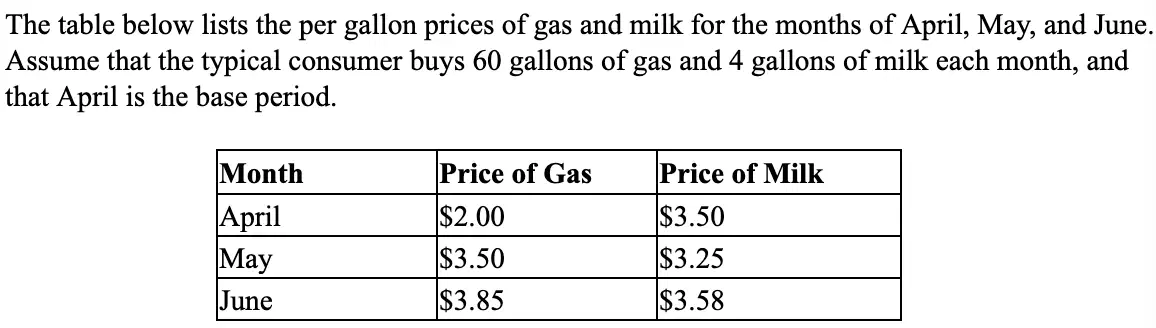
What is the inflation rate for May?
A. 66.4%
B. 60.1%
C. -4.1%
D. 10%
A
B
C
D
The introduction of the video cassette recorder in the 1970s exemplified a problem in measuring the cost of living; that problem is the problem of
A. substitution bias.
B. product-improvement bias.
C. introduction of new goods.
D. unmeasured quality change.
A
B
C
D
An increase in the price of imported coffee shows up
A. in the consumer price index and in the GDP deflator.
B. in the consumer price index, but not in the GDP deflator.
C. in the GDP deflator, but not in the consumer price index.
D. in neither the consumer price index nor in the GDP deflator.
A
B
C
D
For the purpose of calculating the consumer price index, the basket of goods
is kept the same from year to year so that the effects of price changes are isolated from the effect of any quantity changes that might be occurring at the same time.
is kept the same from year to year; otherwise, the value of the index would remain constant from year to year.
varies from year to year; otherwise, the value of the index would remain constant from year to year.
varies from year to year so that consumers’ buying patterns are updated in a timely fashion.
With respect to the consumer price index, the substitution bias arises because
prices of goods and services do not change in the same proportion from year to year.
consumers are slow to adjust their buying patterns from year to year in response to price changes.
consumers are eager to buy new products as they are introduced, despite their lack of full information about the quality of those products until they buy and use them.
All of the above are correct.
With respect to the consumer price index, which of the following does not serve as an example of how the substitution bias arises? Between 2010 and 2011, the price of a pound of peanuts
rises from $0.80 to $1.00 while the price of a loaf of bread rises from $2.00 to $2.50.
rises from $1.00 to $1.30 while the price of a loaf of bread rises from $2.00 to $2.30.
remains constant, while the price of a loaf of bread rises from $2.00 to $2.30.
falls from $1.00 to $0.80 while the price of a loaf of bread falls from $2.00 to $1.80.
Which of the following pairs of values of the consumer price index (CPI) is consistent with an inflation rate of 10 percent for 2014?
A. CPI in 2014 = 90; CPI in 2015 = 100
B. CPI in 2014 = 102; CPI in 2015 = 112
C. CPI in 2013 = 210; CPI in 2014 = 220
D. CPI in 2013 = 210; CPI in 2014 = 231
A
B
C
D

A
B
C
D
A
B
C
D
The primary purpose of measuring the overall level of prices in the economy is to
A. allow for the measurement of GDP.
B. allow consumers to know what kinds of prices to expect in the future.
C. allow for the comparison of dollar figures from different points in time.
D. allow for the comparison of dollar figures from the same point in time.
A
B
C
D
In 1931 the price of a movie ticket was $0.25. The consumer price index was 15.2 in 1931, and 210 in 2008. Using 2008 prices, the real price of a movie in 1931 was
A. $13.82.
B. $52.50.
C. $1.81.
D. $3.45.
A
B
C
D
A
B
C
D
A
B
C
D
If the CPI was 95 in 1955 and is 475 today, then $100 today purchases the same amount of goods and services as
A. $4.75 purchased in 1955.
B. $20.00 purchased in 1955.
C. $95.00 purchased in 1955.
D. $500 purchased in 1955.
A
B
C
D
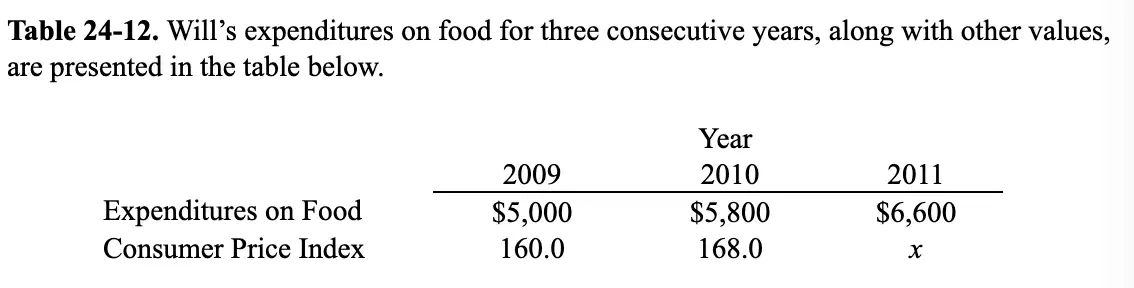
Suppose Will’s 2009 food expenditures in 2011 dollars amount to $5,750. Then x, the consumer price index for 2011, has a value of
A. 184.0.
B. 185.8.
C. 187.5.
D. 189.4.
A
B
C
D
Suppose today’s CPI is 134.85, and suppose one must spend $580 today to purchase the same basket of goods and services that could be bought for $400 in 1989. Then the CPI in 1989 was
A. 24.27.
B. 60.68.
C. 93.00.
D. 195.53.
A
B
C
D
In 1983, one could buy a model radio-controlled airplane for $11.50 each. Those same planes are available today and the price increased at exactly the rate of inflation. If the CPI today is 220.5 and in 1983 was 105, what is the price of the airplane today?
A. $24.15
B. $11.50
C. $5.48
D. $2.10
A
B
C
D
John just graduated law school and has two competing job offers. The first is in Phoenix and pays a salary of $150,000. He has a similar job offer in Cleveland that pays $90,000. Which pair of CPIs would make the two salaries have the same purchasing power?
70 in Phoenix and 42 in Cleveland
68 in Phoenix and 34 in Cleveland
42 in Phoenix and 70 in Cleveland
34 in Phoenix and 68 in Cleveland
When box office receipts are corrected for inflation, the most popular movie of all time is
A. Star Wars.
B. Titanic.
C. Gone With the Wind.
D. The Sound of Music.
A
B
C
D
When ranking movies by nominal box office receipts, what important fact is overlooked?
A. More people go to movies now than in the past.
B. There are no good substitutes for movies currently.
C. Prices, including those for movie tickets, have been rising over time.
D. Movies and DVD are complements.
A
B
C
D
A COLA automatically raises the wage when
A. GDP increases.
B. taxes increase.
C. the consumer price index increases.
D. the producer price index increases.
A
B
C
D
Of Social Security benefits and federal income tax brackets, which is indexed?
A. Both are indexed.
B. Only Social Security benefits are indexed.
C. Only federal income tax brackets are indexed.
D. Neither is indexed.
A
B
C
D
Marion collected Social Security payments of $250 a month in 1985. If the price index rose from 90 to 108 between 1985 and 1986, then her Social Security payments for 1986 should have been
A. $268.
B. $292.
C. $300.
D. $358.
A
B
C
D
Social Security payments are indexed for inflation using
A. the CPI.
B. the PPI.
C. the GDP deflator.
D. real interest rates.
A
B
C
D
Which of the following statements is correct about the relationship between the nominal interest rate and the real interest rate?
The real interest rate is the nominal interest rate times the rate of inflation.
The real interest rate is the nominal interest rate minus the rate of inflation.
The real interest rate is the nominal interest rate plus the rate of inflation.
The real interest rate is the nominal interest rate divided by the rate of inflation.
The real interest rate tells you
A. how fast the number of dollars in your bank account rises over time.
B. how fast the purchasing power of your bank account rises over time.
C. the number of dollars in your bank account today.
D. the purchasing power of your bank account today.
A
B
C
D
As long as prices are rising over time, then
A. the nominal interest rate exceeds the real interest rate.
B. the real interest rate exceeds the nominal interest rate.
C. the real interest rate is positive.
D. the nominal interest rate is a better indicator than the real interest rate of how fast the purchasing power of your bank account is changing over time.
A
B
C
D
If the nominal interest rate is 8 percent and the rate of inflation is 3 percent, then the real interest rate is
A. -5 percent.
B. 1.67 percent.
C. 5 percent.
D. 11 percent.
A
B
C
D
Suppose that over the past year, the real interest rate was 5 percent and the inflation rate was 3 percent. It follows that
the dollar value of savings increased at 5 percent, and the purchasing power of savings increased at 2 percent.
the dollar value of savings increased at 5 percent, and the purchasing power of savings increased at 8 percent.
the dollar value of savings increased at 8 percent, and the purchasing power of savings increased at 2 percent.
the dollar value of savings increased at 8 percent, and the purchasing power of savings increased at 5 percent.
Corey deposits $1,000 in a savings account that pays an annual interest rate of 5 percent. Over the course of a year, the inflation rate is 1.7 percent. At the end of the year, Corey has
$17 more in his account, and his purchasing power has increased by $10.
$30 more in his account, and his purchasing power has increased by $50.
$40 more in his account, and his purchasing power has increased by $33.
$50 more in his account, and his purchasing power has increased by $33.
Which of the following is not correct?
A. The U.S. economy has never experienced deflation.
B. Since 1965, the U.S. nominal interest rate has exceeded the U.S. real interest rate.
C. Since 1965, the U.S. economy has experienced rising consumer prices in most years.
D. During deflation, the real interest rate exceeds the nominal interest rate.
A
B
C
D
In the United States in the late 1970s, nominal interest rates were high and inflation rates were very high. As a result, real interest rates were
A. very high.
B. high.
C. low, but never negative.
D. low, and in some years they were negative.
A
B
C
D
In the United States, real interest rates were
A. high in the 1970s and 1990s.
B. low in the 1970s and 1990s.
C. high in the 1970s and low in the 1990s.
D. low in the 1970s and high in the 1990s.
A
B
C
D
The consumer price index is used to monitor changes in an economy’s production of goods and services over time.
T
F
The inflation rate is the absolute change in the price level from the previous period.
T
F
Because the consumer price index reflects the goods and services bought by consumers better than the GDP deflator does, it is the more common gauge of inflation.
T
F
The Bureau of Labor Statistics is part of the U.S. Department of Labor.
T
F
By keeping the basket of goods and services the same when computing the CPI, the Bureau of Labor Statistics isolates the effects of price changes from the effect of any quantity changes that might be occurring at the same time.
T
F
The CPI is always 1 in the base year.
T
F
The inflation rate for 2007 is computed by dividing (the CPI in 2007 minus the CPI in 2006) by the CPI in 2006, then multiplying by 100.
T
F
Changes in the consumer price index are useful in predicting changes in the producer price index.
T
F
Data from the Bureau of Labor Statistics show that consumer spending on medical care is about equal to consumer spending on recreation and consumer spending on education and communication.
T
F
Substitution bias occurs because the CPI ignores the possibility of consumer substitution toward goods that have become relatively less expensive.
T
F
The CPI does not reflect the increase in the value of the dollar that arises from the introduction of new goods.
T
F
There is no longer much debate among economists concerning the severity of and the solution to the problems in using the CPI to measure the cost of living.
T
F
When the price of Italian wine rises, this change is reflected in the U.S. CPI but not in the U.S. GDP deflator.
T
F

