
Font size
 Worksheets
End of Year Test Review
Total questions: 112
Worksheet time: 1hrs 24mins
Which political activity in ancient Greece was a foundation for the democratic government of the United States?
citizen voted in elections
monarchs rules with unlimited power
religious leaders decided policy issues
wealthy citizens controlled the legislature
In which way was the ancient Greek polis system similar to the government system in the United States?
the people made all laws
the people held the political power
each polis allowed all residents to vote
each polis selected representatives in the same way
Which principle of the United States' democracy comes from ancient Greece?
the right to vote
the freedom of speech
the right to a fair and speedy trial
the separation of religion and state
Read the following information and answer the question below: Ancient Greece was the first civilization to develop a government based on democracy. The word democracy is taken from the word demokratia, which means rule by the entire body of citizens. Ancient Greece was the first to use an assembly of citizens to help create and approve laws that all citizens would follow. Which branch of the United States government most resembles the assembly described above?
the executive branch
the federal branch
the judicial branch
the legislative branch
Which idea did the Roman government contribute to democracy?
freedom of speech
separation of powers
citizens voting on laws
separation of religion and state
Which principle of government was supported by leaders of the Roman Republic with the placement of the Twelve Tables in the Roman Forum in 450 BCE?
rule of law
direct democracy
equal voting rights
checks and balances
Which democratic principle was practiced in the Roman Republic?
direct democracy
two-party government
single-party government
representative democracy
Why was the Roman government an important model for the Founding Fathers of the United States?
The roman government inspired them to crate term limits.
The Roman government inspired them to create a tax system.
The Roman government inspired them to create a federal capital.
The Roman government inspired them to create three branches of government.
Read the following information and answer the question below.
The Founding Fathers were impressed by the governments of ancient Greece and Rome. They created the U.S. Constitution that established a government that shared characteristics of these two ancient systems.
Based on the information, which form of government did the Founding Fathers choose for the United States?
limited democracy
democratic republic
absolute monarchy
constitutional democracy
Which political principle of the Roman Republic is present in modern-day U.S. government?
equality
federalism
direct democracy
representative government
Which is the MAIN difference between direct democracy in ancient Greece and representative democracy in the United States?
The ancient Greeks voted in private, while people in the United States vote in public.
The ancient Greeks created two branches of government, while the founders of the United State created three.
The ancient Greeks made all political decisions, while citizens in the United States elect people to make decisions on their behalf.
The ancient Greeks used elections to choose senators, while citizens in the United States use elections to make all political decisions.
Which early civilization inspired America's Founding Fathers to adopt the principle of civic participation?
Chinese
Egyptian
Mesopotamian
Roman
Read the following information and answer the question below.
The Inuit of North America
The Inuit of North America live in a region where the winters are long and harsh. It is too cold to grow crops or raise cattle. For much of their history, the inuit depended on fishing in the Arctic Ocean and hunting to feed their families. Parents taught their children how to hunt and fish, not just to provide food, but also for the animal skins they used for clothing. It was also important to pass down the skills needed to survive in in this cold climate.
Which statement best describes the economic system used by the Inuit?
traditional economy
command economy
market economy
mixed economy
Which statement describes an effect of a traditional economy in ancient civilizations?
families grow a surplus of crops
family leaders sell crops for profit
families grow only what they need
family leaders set a certain price for crops
Which statement shows an effect of social class in ancient Egypt?
slaves could hope to eventually become soldiers
children of slaves could be taught to read and write
only nobles were allowed to hold government posts
children of farmers could hope to rise to the nobility
Read the passage that follows and answer the question below.
Many rulers in ancient civilizations believed they had their power given to them by the gods. This usually resulted in dynasties where power was passed down to a person such as a family member.
What impact did this practice have on the relationship between rulers and the people they ruled?
rulers were not killed because people knew the dynasty would last
citizens were fearful of the gods, so they did not question the power of the ruler
citizens were related to their rulers, so they saw themselves as similar to the ruler
people were not fearful of their rulers because the prosperity of the kingdom allowed people to be equal
Which social class in ancient Egypt could expect to be taught to read and write?
farmers
scribes
servants
slaves
Which individuals made economic decisions for members of a given family in ancient Rome?
gens
kings
plebians
paterfamilias
What line of latitude divides the northern and southern hemispheres?
tropic of Capricorn
tropic of Cancer
prime meridian
equator
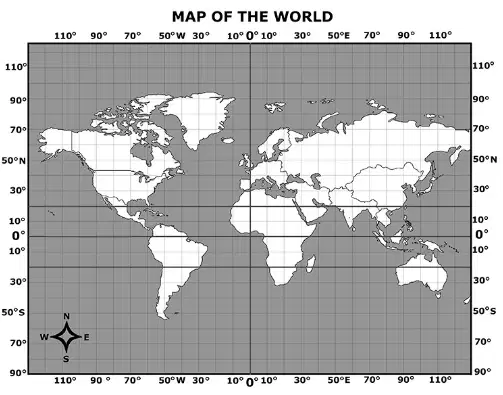
Look at the following map and answer the following question. Which grid line on the map has a longitude of 0?
equator
prime meridian
tropic of cancer
tropic of capricorn

Look at the following map and answer the following question. What latitude and longitude coordinates mark the location of Buenos Aires, Argentina?
35oS, 58oW
58oS, 35oW
35oN, 58oW
58oN, 35oW
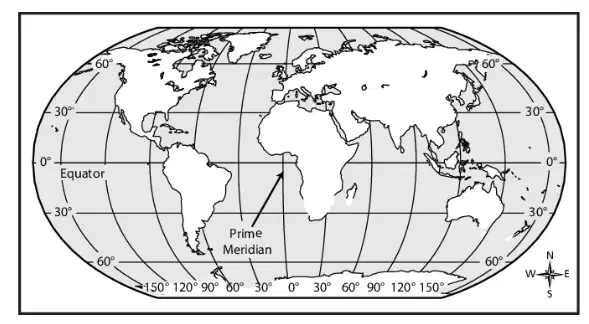
Look at the map and answer the following question. What is the location of the Prime Meridian?
0 degrees longitude
130 degrees longitude
60 degrees latitude
90 degrees latitude
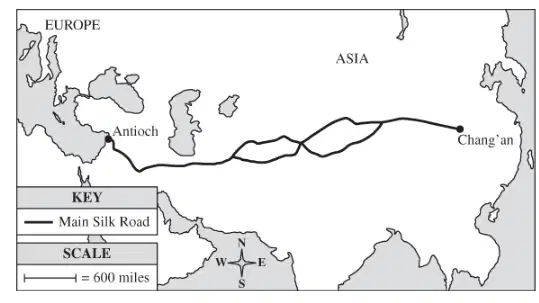
Look at the map of the Silk Road and answer the following question. Based on the map, approximately how many miles long was this trade route?
2,000 miles
3,000 miles
4,000 miles
5,000 miles
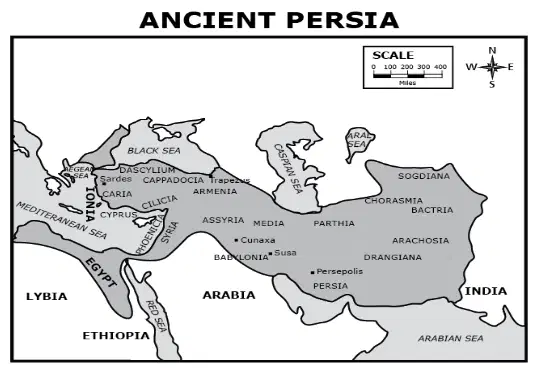
Look at the map and answer the following question. Which intermediate direction would one travel in to go from Ethiopia to the Caspian Sea?
northeast
northwest
southeast
southwest
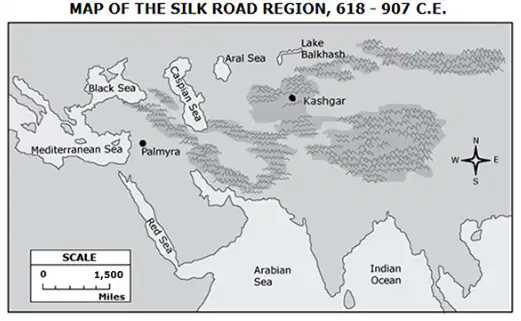
Look at the map and answer the following question. What is the approximate distance between Palmyra and Kashgar?
1.500 miles
3,000 miles
4,500 miles
6,000 miles
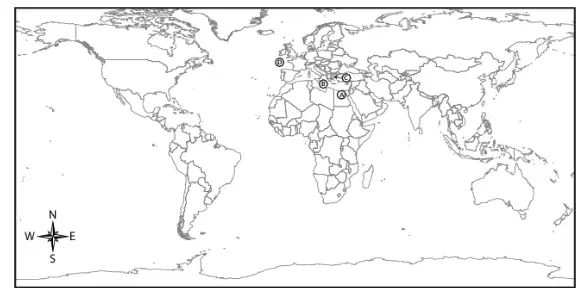
The letter A marks the location of an ancient civilization. This civilization ruled on a major body of water. What is this body of water?
the Nile River
the Tiber River
the Tigris River
the Yellow River
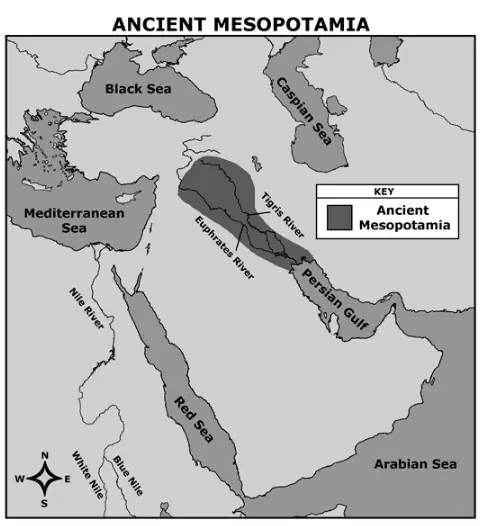
Which two bodies of water shown on the map were most critical to the development of ancient Mesopotamia?
Arabian Sea and Persian Gulf
Tigris River and Euphrates River
Red Sea and Mediterranean Sea
White Nile River and Blue Nile River
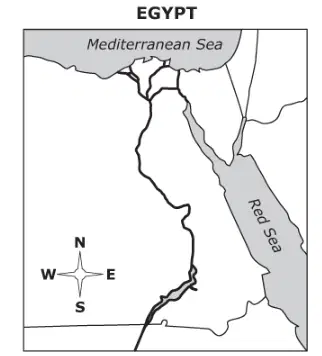
Study the map and answer the question. The river shown on the map was important to an early civilization. Which statement names the river and identifies its importance?
The Nile River provided fertile soil for agriculture.
The Nile River provided a supply of gold for a trade network.
The Indus River provided protection for farms and settlements.
The Indus River provided a means of transportation across a region.
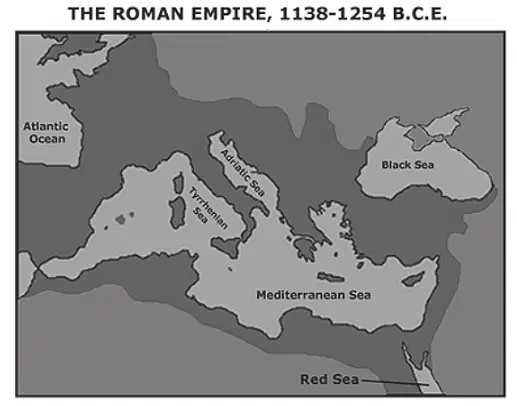
Look at the map and answer the question. Which body of water was most important for Romans to control territory in North Africa?
Black Sea
Caspian Sea
Atlantic Ocean
Mediterranean Sea
Read the following statement and answer the question below.
The Roman aqueducts supplied people throughout ancient Rome with fresh running water and helped move sewage away from homes, farms, and markets.
Which situation most encouraged the Romans to build teh aqueducts?
Wells could not provide adequate water.
Great droughts made water extremely valuable.
Mountains made it difficult to reach nearby rivers and lakes.
The lack of nearby water source was preventing growth.
Why did the Ancient Greeks build the Acropolis on a geographical high point?
to show their architectural skills
to better defend the city
to attract more visitors
to glorify new kings
Why did ancient Indians celebrate the first day of the monsoon rains?
the rains signaled the beginning of a major Hindu festival.
The rains signaled an end to raiding by rival Indian tribes
The rains brought cool air and provided snow to the Himalaya regions
The rains ended the summer heat and watered crops on the Indian subcontinent
What is one way the ancient Greeks adapted to their location?
They build canal systems to prevent flooding in their towns
They planted their crops after the monsoon season
They used boats to travel between settlements
They grew grain on the widespread flat plains
Which reason is NOT a reason ancient civilizations developed near rivers?
rivers allowed for the transportation of goods
rivers allowed for the mining of mineral resources
rivers provided a stable source of water for farming
rivers provided a natural defense from invading forces
Which statement BEST describes why the Nile Valley, Fertile Crescent, Indus Valley, and Huang Valley civilizations flourished?
These civilizations flourished because their warm climate was ideal for raising families
These civilizations flourished because their climate provided steady rainfall for their crops
These civilizations flourished because their river systems provided easy access for their ships
These civilizations flourished because their river systems provided excellent soil conditions for growing crops
Read the information below and answer the question.
In ancient Egypt, the predictable flooding of the Nile River produced surpluses of grain.
What conclusion about ancient Egypt can be drawn most directly from the information?
Flooding protected the ancient Egyptians from invasions
The ancient Egyptians developed ways to control flood water for irrigation
The ancient Egyptians harvested crops from seeds deposited by yearly floods
Ancient Egyptians used predictable flooding to ship more crops seeds to farmland
Which statement best explains how physical geography affected the development of ancient Mesopotamian and Egyptian civilizations?
both civilizations were self-sufficient and did not engage in trade
the river valleys provided fertile land enabling a surplus in agriculture
both civilizations had arid climates and could not keep food in storage
the seaports provided water access enabling each civilization to become empires
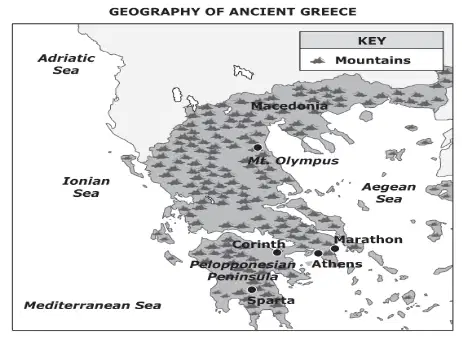
Look at the map and answer the question. Which conclusion can be made about the impact of geography on the development of ancient Greek city-states?
communication was difficult because of the sea currents
wide scale trading was profitable because of the large road system
political unification was difficult because of the mountains
wide scale farming was profitable because of the abundance of arable land
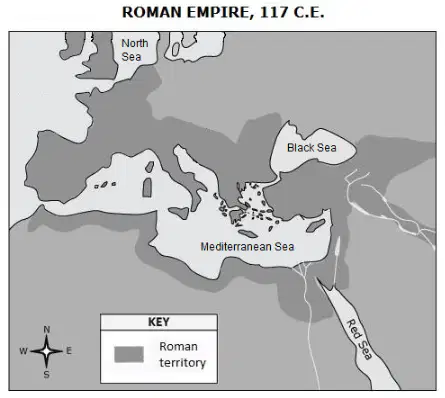
Look at the map and answer the following question. Based on the map, which body of water allowed most Romans to trade with one another?
Red Sea
Black Sea
Atlantic Ocean
Mediterranean Sea
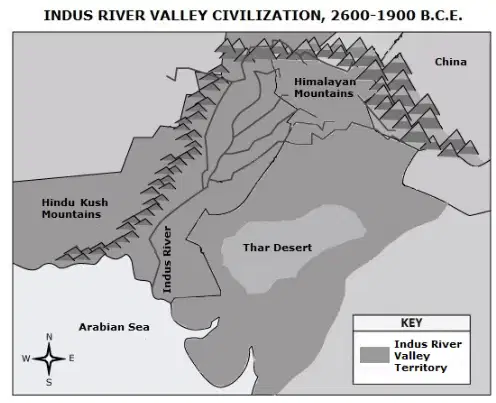
Look at the map and answer the following question. Which geographical feature on the map limited interaction between the ancient Chinese civilization and the Indus River Valley civilization?
Hindu Kush Mountains
Himalayan Mountains
Arabian Sea
Thar Desert
What effect did geography have on the development of ancient Greece?
the landlocked location of Greece limited political and cultural growth
the abundance of fertile land in Greece led to new farming techniques
the lack of seaports in Greece limited contact and trade with other nations
the mountainous terrain in Greece resulted in the growth of independent city-states
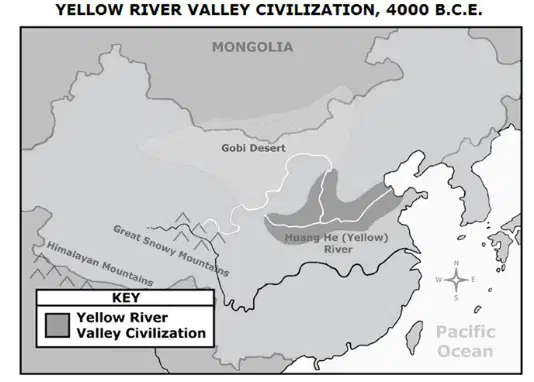
Look at the map and answer the following question. What geographic feature shown on the map limited the interaction of the Yellow River Valley civilization with the cultures to the north?
Great Snowy Mountain
Himalayan Mountain
Pacific Ocean
Gobi Desert
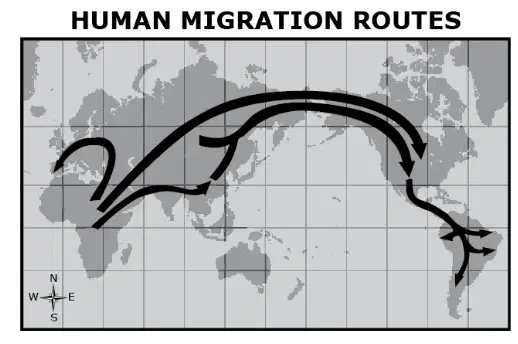
Look at the map and answer the following question. Based on the map, which statement is true?
humans migrated from North America to Asia
humans migrated from North America to Europe
humans migrated from North America to Australia
humans migrated from North America to South America
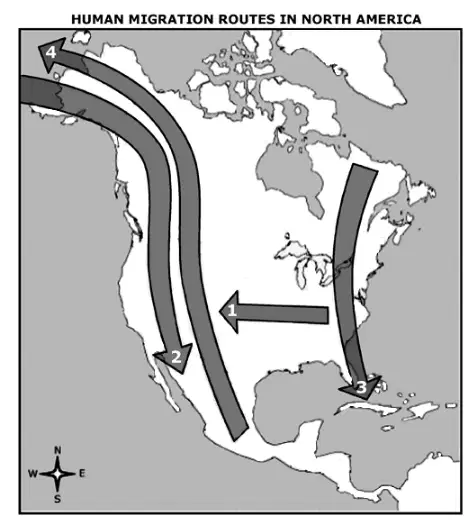
Study the map and answer the following question. Which route on the map represents the migration of prehistoric humans who used a land bridge to get to North America?
1
2
34
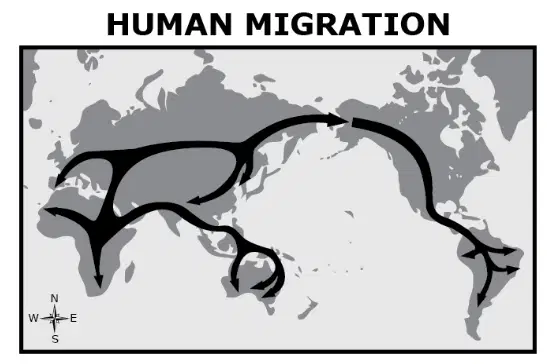
Look at the map and answer the following question. What continent did human migration start on?
Africa
Europe
Asia
Australia
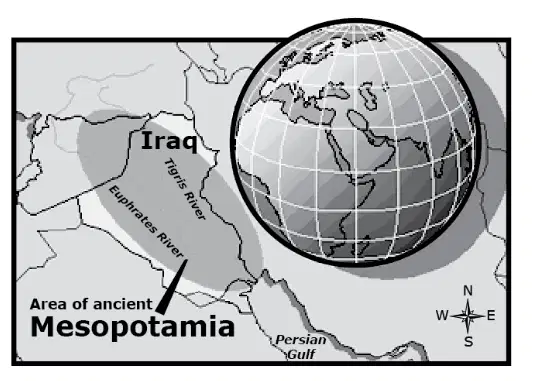
Look at the map and answer the following question. This map shows an area called the "cradle of civilization," where human civilization first took hold. What part of the world did the people living in this area most likely migrate from?
Africa
Asia
Australia
Europe
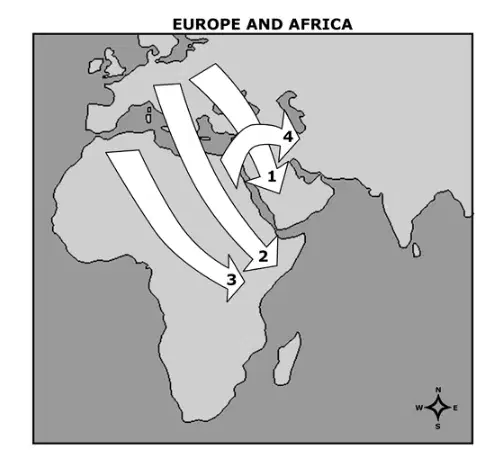
Read the following information, look at the map, and answer the following question.
Around the same time Christianity spread to Northern Europe, Western evangelists also brought Christianity to North Africa. As it became established there, the religion spread east to Ethiopia. In the fourth century C.E., Christianity became the official religion of the kingdom of Ethiopia.
Which numbered route on the map represents the spread of Christianity as described in the text?
1
2
3
4
Which belief or practice of the ancient Egyptians spread to nearby civilizations?
life after death
mummifying the dead
communicating by hieroglyphs
systems of gods and goddesses
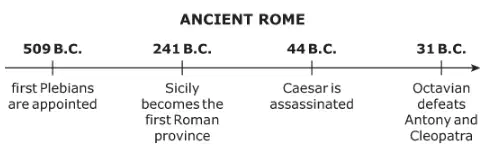
Look at the following timeline and answer the following question. Which event happened at the end of the Roman Republic?
509 B.C. first Plebians are appointed
241 B.C. Sicily becomes the first Roman province
44 B.C. Caesar is assassinated
31 B.C. Octavian defeats Anthony and Cleopatra
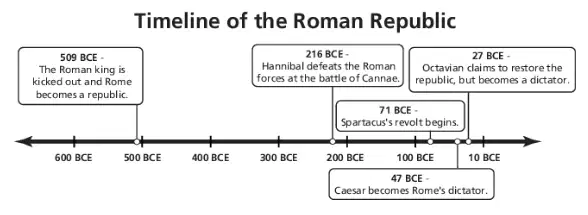
Read the timeline and answer the following question. Which ancient Roman ruled after Caesar?
Cannae
Hannibal
Spartacus
Octavian
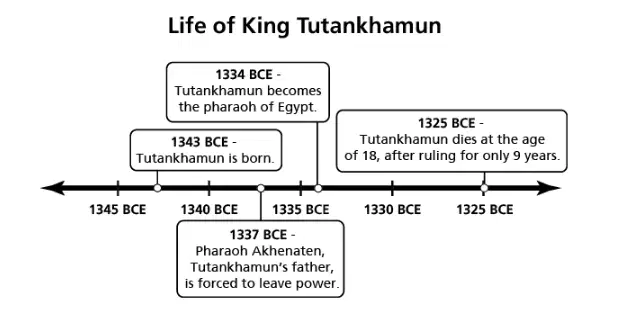
Look at the timeline and answer the following question.
Which two events occurred approximately three years apart?
Tutankhamun was made Pharaoh and Tutankhamun died
Tutankhamun was born and Tutankhamun became Pharaoh
Tutankhamun was born and his father was forced to leave power
Tutankhamun's father was forced to leave power and Tutankhamun became Pharaoh
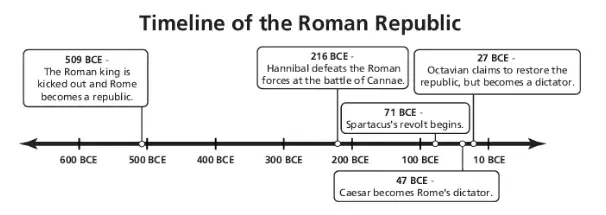
Look at the timeline and answer the following question. Which event happened twenty years after Caesar took power?
Octavian became dictator twenty years after Hannibal fought Roman forces
Octavian became dictator twenty years after Caesar became dictator
Spartacus revolted twenty years after Hannibal attacked Roman forces
Spartacus revolted twenty years after Caesar became dictator

Look at the following timeline and answer the following question. Which term matches the length of time between each mark on the timeline?
year
decade
century
millennium
Which statement describes the Paleolithic Age?
humans had a lifestyle based on farming and raising
humans had a lifestyle based on hunting and gathering
humans made tools and weapons out of bronze
humans made tools and weapons out of iron
Which statement defines the Neolithic Age?
humans made tools and weapons out of iron
humans made tools and weapons out of bronze
humans had a lifestyle based on hunting and gathering
humans had a lifestyle based on farming and raising animals
Which time period represents a millenium?
10 years
100 years
1,000 years
10,000 years
How did agriculture impact early civilizations?
people became more migratory
people formed larger societies
people hunted larger game
people lived farther apart
Why was metallurgy important to the rise of civilization in Mesopotamia?
it enabled people to build walls and fortresses
people were able to create jewelry and figurines
it allowed people to create tools and weapons
trade was expanding and it was used to build ships
From around 8,000 BCE to 4,000 BCE, the population on Earth grew from less than ten million to approximately sixty million. Which of these developments was the MAIN reason for this population growth?
the use of metals
the domestication of plants
the migration of early tribesw
the development of trade routes
Which development in Mesopotamia was an outcome of the advancement of agriculture?
the invention of tools
the invention of weaponry
the beginning of organized religion
the beginning of settlement in cities
What is one characteristic of civilization?
capitalism
colonization
writing systems
monotheistic beliefs
Why did ancient civilizations flourish along river deltas?
because river deltas promote trade
because fertile soil is created along river deltas
because river deltas have large amounts of drinking water
because river deltas are easily defended against invaders
Which characteristics of early civilizations was most helpful to the ancient Egyptians when they were building pyramids?
writing
urbanization
specialized labor
advanced technology
Which custom is a characteristic of civilization?
engaging in hunting and gathering to produce food
using a system of writing to document ideas
engaging in nomadic travel to survive
building tent cities to provide shelter
Which early civilization invented the wheel?
Chinese
Egyptian
Indus
Mesopotamian
Which important contribution to the development of agriculture was made by Mesopotamian civilization?
terraced farming
crop rotation
horse collar
the plow
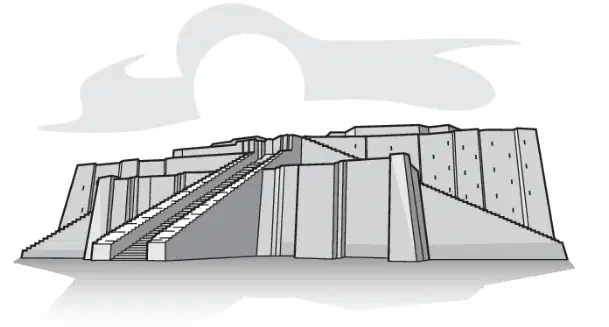
Look at the picture and answer the following question. Why did city-states in ancient Mesopotamia build structures such as this?
to honor the king
to honor the gods
to honor the women
to honor the founders
Why do historians call the Epic of Gilgamesh an "epic" poem?
because it is a very long story
because it is better than ancient Greek stories
because it is one of the world's oldest recorded stories
because it is the story of the adventures of heroes and gods
Which feature describes the religion of the ancient Israelites?
they worshipped the sun
they believed in one god
they practiced mummification
they believed in reincarnation
Who led the Israelites out of Egypt?
Abraham
Isaac
Jacob
Moses
Which figure in Israeli history is known for his extensive building program that included construction of a great temple in the city of Jerusalem?
Alexander the Great
King Solomon
Moses
Saul
Who was the first patriarch of Judaism?
Abraham
Adam
Josephy
Moses
Which statement best describes the phalanx military formation developed by the ancient Greeks?
it stopped the enemy from retreating
it helped the soldiers to work together
it helped soldiers fight on uneven ground
it prevented the enemy from resupplying
Which statement best describes the contribution ancient Greeks made to theater?
they invented traveling plays
they wrote the first musicals
they wrote the first mysteries
they invented plays as an art form
Which statement best describes the contribution the ancient Greeks made to government?
they created the first empire
they created the first legal code
they created the first democracy
they created the first political parties
Which statement describes Homer's style of literature and writing?
he wrote fables that taught people lessons
he wrote epic poems that are still read today
he wrote the histories of wars that are still studied today
he wrote about philosophy that led to ancient religions
Which historical figure had a direct impact on the development of Roman civilization as military leader, politician, and author?
Alexander the Great
Attila the Hun
Julius Caesar
Pericles
Which Roman emperor ended the mistreatment of Christians?
Augustus
Constantine
Diocletian
Nero
Who conquered Gaul and made himself dictator for life of the Roman Republic?
Cicero
Julius Caesar
Scipio Africanus
Tiberius Cracchus
Read the following list of accomplishments and answer the question below.
greatest Roman general of the Punic Wars
conquered New Carthage
helped drive Hannibal out of Italy
Which person is responsible for these accomplishments
Hadrian
Cleopatra
Constantine
Scipio Africanus
Which statement best describes how the Roman Republic influenced the development of democracy in the United States?
it established the principle that citizens should have a way to participate in the writing of laws
it established the principle that citizens should have a way to avoid participating in government
it established the principle that citizens should have a way to direct influence on the judicial branch
it established the principle that citizens should have a way to have their voices heard by government
Which government body existed in the Roman Republic and now exists in the U.S. government as a place for representatives to create laws?
Senate
Supreme Court
Presidential Cabinet
Defense Department
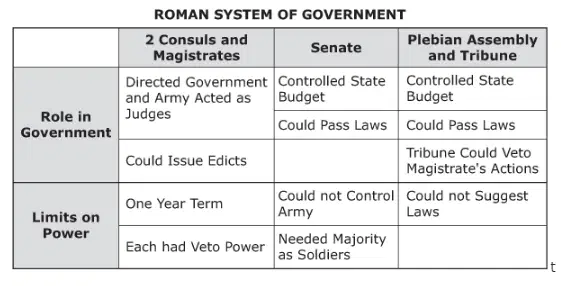
Study the chart and answer the following question. Which principle of Roman government illustrated in the chart was later adopted in the U.S. Constitution?
separation of powers
direct democracy
judicial review
free speech
The Roman Senate is best described as an example of which two democratic principles?
civic duty and rule of law
rule of law and separation of powers
representative government and civic duty
separation of powers and representative government
Which statement BEST explains how aqueducts contributed to the growth of the Roman Empire?
aqueducts provided military protection to towns and villages, which enabled expansion into distant areas
aqueducts provided irrigation water to towns and villages, which enabled expansion into distant areas
aqueducts removed waste water from cities and towns, which enabled populations to increase
aqueducts brought fresh water to cities and towns, which enabled populations to increase
Which statement explains one effect of the Roman Empire's system of roads?
the road system let the empire expand its territory by allowing for the establishment of Roman colonies in neighboring lands
the high cost of the system of roads prevented the empire from developing water and sewage systems leaving to the empire's decline
the road system let the empire maintain its territory by allowing for quick movement of Roman legions to meet military threats
the high cost of the system of roads in the empire resulted from poor construction methods and heavy travel leading to the empire's decline
What was one reason that the Roman Empire lasted for so long?
it had total religious unity
it had powerful local noblemen
it had a centralized government
it had a few powerful enemies nearby
What was one reason that the Roman Empire was able to expand and survive?
the Roman Empire stamped out all foreign religions
the Roman Empire gave political power to local lords
the Roman Empire allowed non-Romans to become citizens
the Roman Empire made marriage allianced with non-Romans
Which statement describes Paul's greatest contribution to Christianity?
he translated the gospel into many languages
he established many fundamental beliefs
he helped to spread the belief in many gods
he spread the religion to many places
Which basic belief began in early Christianity?
the Roman empire must be worshipped
daily offerings must be made to God
there are many goddesses
there is only one God
Which statement best reflects how the Roman Empire's view on Christianity changed over time?
at first Rome was threatened by Christianity, but it later became the official religion
at first Rome was curious about Christianity, and it rapidly became the official religion
Christianity quickly became Rome's official religion, but was later banished by Emperor Nero
Christianity promptly became Rome's official enemy and was later defeated by Emperor Constantine
Read the following list of some of the teachings of Jesus and answer the question below.
* there is only one God
*God cares about every individual
*the poor will receive help for their suffering
*there is a kingdom more powerful than Rome
Which teaching was MOST LIKELY to conflict with Roman values?
there is only one God
God cares about every individual
The poor in Rome will receive help for their suffering
there is a kingdom more powerful than Rome
In which areas did Roman civilization make the MOST lasting contributions?
law and medicine
architecture and law
agriculture and sports
medicine and religion
Which Roman contribution to architecture enabled ancient Roman civilization to construct large buildings?
aqueducts
arches
columns
domes
How did the government of the Roman Empire help spread Christianity?
the government under Emperor Claudius overthrew Muslim religious leaders
the government under Emperor Augustus struck down the terms of the Edict of Milan
the government under Emperor Nero destroyed houses of worship for non-Christian religions
the government under Emperor Constantine declared that Christianity was the official religion of the Roman Empire
The Twelve Tables are an example of the influence of Roman civilization on which aspect of Western culture?
philosophy
religion
law
art
How did the Latin language have a lasting influence on other cultures in the Western world?
as the Romans took control of areas of the Western world, they demanded the newly conquered people begin speaking their Latin language
Latin grew out of ancient Greece and spread into the Roman Empire, then became a widely spoken language as far as the Americans
Latin became the root of Romance languages throughout Europe and many words in law, medicine, and science have Latin roots
Latin spread over time throughout Western society and remains the most widely spoken language in the modern world
How did Latin spread throughout Western civilization?
the merchant class spread Latin as they traveled throughout Europe
Germanic tribes spread Latin as they conquered cities throughout Europe
Latin was the language of the Greece and the Greeks took over all of Europe
Latin became widely spoken in Rome and spread as the Romans conquered Europe
Why are the Italian, French, Spanish, and Portuguese languages so similar?
they all originated from the language of ancient Rome
they all originated from the language of the French Empire
they all originated from the language of the early Spanish Empire
they all originated from the language of nomads from the same Germanic tribe
Why did the Latin language influence so many modern languages?
Latin was used to write all books published in Asia
Latin was spoken by people in many parts of Europe
the Greeks required the use of Latin in their colonies
the Catholic Church required the use of Latin in its services
How did Asoka contribute to the spread of Buddhism from India to others parts of Asia?
he wiped out competing religions
he sent out religious missionaries
he paid people to change religions
he forced people to change religions
Which belief is associated with Buddhism?
people are born into specific caste
people should pray five times each day
people can overcome selfishness by following the Eightfold Path
people who desire enlightenment must have the Mandate of Heaven
Why did the teachings of Buddha appeal to the lower classes of society in India?
he placed a high value on equality among all people
he promised to help the lower classes to become rich
he supported a revolution to overthrow the ruling class
he believed that only the poor could experience nirvana
Which statement best explains Asoka's effect on the spread of Buddhism?
Asoka attempted to stop the spread of Buddhism by persecuting Buddhist missionaries
Asoka attempted to stop the spread of Buddhism by conquering neighboring civilizations
Asoka helped spread Buddhism by ordering people in his empire to convert to Buddhism
Asoka helped spread Buddhism by sending missionaries to neighboring civilizations
How were the Zhou influenced by the Mandate of Heaven?
it justified the Zhou rebellion against the Shang Dynasty
it justified the Zhou construction of the Great Wall
it started an era of cultural advancements
it authorized the system of civil service
Read the following passage and answer the question.
Because the ruler had the Mandate of Heaven, anything good or bad that happened to the people was to his credit or fault. If natural disasters occurred, it might be considered a sign that the leader had done something wrong or immoral, and he may no longer be fit to rule the people.
Which of the four principles of the Mandate of Heaven is reflected in this passage?
the right to rule is given to only one person because there is on heaven
the right to rule is granted by the will of the people being ruled
the right to rule is based on the virtue of the ruler
the right to rule is limited to one dynasty
According to the Mandate of Heaven, what would happen if people rose up in battle against the emperor?
the people fighting the emperor would defeat him as the people have the protection of the gods
if people fighting the emperor defeated him, it would be a sign that he was no longer fit to rule
the people fighting the emperor would be struck down by thunder for daring to go against their ruler
if the people fighting the emperor lost to his army, it would be a sign that the empire would soon fall
Which statement best describes the roles of patricians and plebeians in the Roman Republic?
patricians were in control of the Senate, and plebeians were in control of the lower chamber
patricians were in control of the senate, and plebeians had no direct political power
patricians were often farmers, and plebeians often become politicians
patricians were often slaves, and plebeians often become emperors
What was one difference between the lives of plebeians and patricians?
plebeians lived in the city, while patricians lived in the country
patricians owned slaves while plebeians could not
only patricians could serve in the Roman Senate
only patricians could serve as Roman tribunes
How were the political roles for women and men different in Rome?
men had less political power
men had nearly all the political power
women made all major decisions
women held all high offices
Which statement is true about boys and girls growing up in ancient Rome?
girls were never educated
boys were never educated
girls often went on to learn languages and philosophy
boys often went on to learn langauges and philosophy
What role did women play in Ancient Roman society?
they were influential in politics as advisors
they often owned and ran small businesses
they mainly served as wives and mothers
they regularly held low political offices

