
NEW
Font size
S
M
L
XL
 Worksheets
U5 RNA & Protein Synthesis Corrections
Total questions: 15
Worksheet time: 8mins
Name
Class
Date
1.
What does RNA stand for?
a)
Ribonucleic acid
b)
Reactive-nitrogenous acid
c)
Ribose nucleus acid
d)
Reoxidized nucleic acid
2.
In RNA, what base pairs with adenine?
a)
cytosine
b)
adenine
c)
uracil
d)
guanine
3.
If a DNA strand reads ATT-GGC-CAT, what is the complementary mRNA strand?
a)
UGG-UUA-AGG
b)
UAA-CGA-GGA
c)
UAA-CCG-GUA
d)
UAA-CCG-AAU
4.
What is the role of the enzyme RNA polymerase in the process of transcription?
a)
It creates a different template for new base-pairing.
b)
It transcribes DNA sequences to produce a complementary strand of RNA.
c)
It creates "start" and "stop" sequences in DNA to control transcription.
d)
None of the other answer choices
5.
True or False: Translation happens before transcription.
a)
True
b)
False
6.
What is the role of tRNA in protein synthesis?
a)
To carry a copy of the genetic instructions from the nucleus
b)
To carry amino acids to ribosomes to build the polypeptide
c)
To bind to DNA and separate the DNA strands
d)
All of the answer choices
7.

Translate the following mRNA strand:
AUG-GGG-AUU-AUC.
a)
UAC-CCC-UAA-UAG
b)
methionine - glycine - isoleucine - isoleucine
c)
methionine - glycine - isoleucine - methionine
d)
TAC-CCC-TAA-TAG
8.
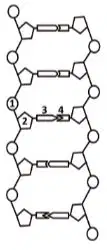
Based on the diagram shown to the right AND on your knowledge of DNA structure, structures 3 and 4 are held together by...
a)
a. weak peptide bonds
b)
b. weak hydrogen bonds
c)
c. strong covalent bonds
d)
d. strong peptide bonds
9.
Which is Not a function of proteins?
a)
Help protect the body
b)
Contain the recipe to make proteins
c)
They are key to cell structure and function
d)
Catalyze chemical reactions
10.
What is the role of mRNA?
a)
Carry an amino acid to the ribosome
b)
Copy the instructions from DNA and carry it out of the nucleus
c)
Make up the ribosomes
11.
Where does Transcription occur?
a)
Nucleus
b)
Ribosome
c)
ER
d)
Mitochondria
12.
Where does Translation occur?
a)
Nucleus
b)
Ribosome
c)
Chloroplast
13.
What is the end product of translation?
a)
mRNA that can leave the nucleus
b)
Amino acid chain
c)
monosaccharide chain
d)
Anticodon
14.
What is an anticodon?
a)
rRNA
b)
an amino acid
c)
Three nucleotide sequence found on mRNA
d)
Three nucleotide sequence found on tRNA
15.
Which statement is true about macromolecules?
a)
Simple sugars are made of polysaccharides.
b)
Glycerol is made of fatty acids.
c)
Proteins are made of amino acids.
d)
Nucleotides are made of nucleic acids.
Reset

