
 Worksheets
CHAPTER 28
Total questions: 105
Worksheet time: 3hrs 38mins
To maintain their standard of living, most people rely on
A. government assistance.
B. their personal savings.
C. their labor earnings.
D. rental income.
A
B
C
D
To maintain their standard of living, most people rely on
A. government assistance.
B. their labor earnings.
C. their personal savings.
D. All of the above are correct.
A
B
C
D
Which of the following is correct?
The amount of unemployment that a country typically experiences is a determinant of that country's standard of living, and some degree of unemployment is inevitable in a complex economy.
The amount of unemployment that a country typically experiences is a determinant of that country's standard of living, and a complex economy can achieve zero unemployment.
The amount of unemployment that a country typically experiences is not a determinant of that country's standard of living, and a complex economy can achieve zero unemployment.
The amount of unemployment that a country typically experiences is not a determinant of that country's standard of living, and some degree of unemployment is inevitable in a complex economy.
The amount of unemployment varies
A. little over time and across countries.
B. little over time but substantially across countries.
C. substantially over time but little across countries.
D. substantially over time and across countries.
A
B
C
D
The amount of unemployment that an economy normally experiences is called the
A. average rate of unemployment.
B. natural rate of unemployment.
C. cyclical rate of unemployment.
D. typical rate of unemployment.
A
B
C
D
The natural rate of unemployment is the
unemployment rate that would prevail with zero inflation.
rate associated with the highest possible level of GDP.
difference between the long-run and short-run unemployment rates.
amount of unemployment that the economy normally experiences.
In the long run the unemployment rate equals
zero.
the cyclical rate of unemployment.
the natural rate of unemployment.
the sum of the cyclical and natural rate of unemployment.
Cyclical unemployment refers to
the portion of unemployment created by job search.
short-run fluctuations around the natural rate of unemployment.
changes in unemployment due to changes in the natural rate of unemployment.
the portion of unemployment created by wages set above the equilibrium level.
Cyclical unemployment is closely associated with
long-term economic growth.
short-run ups and downs of the economy.
fluctuations in the natural rate of unemployment.
changes in the minimum wage.
The designation "natural" implies that the natural rate of unemployment
is desirable.
is constant over time.
is impervious to economic policy.
does not go away on its own even in the long run.
The natural rate of unemployment
(i) is the economy’s desirable level of unemployment.
(ii) cannot be affected by economic policy.
(iii) is typically constant over time.
(i) and (ii) only
(iii) only
(i), (ii), and (iii)
None of the above is correct.
The Bureau of Labor Statistics is part of the U.S. Department of
the Treasury.
Commerce.
Labor.
the Interior.
Measuring unemployment is the job of the
Congressional Budget Office.
Department of Commerce.
Council of Economic Advisers.
Bureau of Labor Statistics.
Unemployment data are collected
from unemployment insurance claims.
through a regular survey of about 60,000 households.
through a regular survey of about 200,000 firms.
All of the above are correct.
The Bureau of Labor Statistics produces data on unemployment
weekly.
monthly.
quarterly.
yearly.
The Bureau of Labor Statistics counts a member of a surveyed household as an adult if that person is at least
a. 14 years old.
b. 16 years old.
c. 18 years old.
d. 21 years old.
a
b
c
d
The Bureau of Labor Statistics places people in the “employed” category if they
are temporarily absent from their jobs.
are self-employed.
work without pay in a family member’s business.
All of the above are correct.
Who of the following are included in the Bureau of Labor Statistics’ “employed” category?
certain unpaid workers
part-time workers
workers on vacation
All of the above are correct.
Amy is working part-time. Tavaris is on temporary layoff. Who is included in the Bureau of Labor Statistics’ “employed” category?
only Amy
only Tavaris
both Amy and Tavaris
neither Amy nor Tavaris
Who of the following is counted as “unemployed” by the Bureau of Labor Statistics?
someone working without pay for a family member’s business
someone who is absent from their job due to illness
someone on temporary layoff
All of the above are correct.
Who among the following would be counted as “unemployed”?
Shasta, who is waiting to be recalled to a job from which she has been laid off.
Karen, who neither has a job nor is looking for one.
Mary, who worked only 35 hours last week.
None of the above is correct.
Gwen is an unpaid worker in her family’s restaurant. The Bureau of Labor Statistics counts Gwen as
unemployed and in the labor force.
unemployed and not in the labor force.
employed and in the labor force.
employed and not in the labor force.
The labor force equals the
number of people employed.
number of people employed plus the number of people unemployed.
number of people employed plus the number of people unemployed plus teenagers between ages 14 and 16 who work at least 10 hours a week.
adult population.
Who is not included in the labor force by the Bureau of Labor Statistics?
Anita, who is on temporary layoff
Lauren, who has retired and is not looking for work
Raymond, who does not have a job but has applied for several in the last week
None of the above is correct.
Suppose that the adult population in the country of Atlantis is 115 million. If 80 million people are employed and 5 million are unemployed, then
30 million are not in the labor force.
35 million are in the labor force.
75 million are in the labor force.
35 million are not in the labor force.

How many in the sample are unemployed?
5
4
3
2

How many in the sample are in the labor force?
11
10
9
8
The labor-force participation rate measures the percentage of the
total adult population that is in the labor force.
total adult population that is employed.
labor force that is employed.
labor force that is either employed or unemployed.
Which of the following is correct?
Labor force = number of employed.
Labor force = population - number of unemployed.
Unemployment Rate = number of unemployed ÷ (number of employed + number of unemployed) × 100.
Unemployment Rate = number of unemployed ÷ adult population × 100.
The unemployment rate is computed as the number of unemployed
divided by the labor force, all times 100.
divided by the number of employed, all times 100.
divided by the adult population, all times 100.
times the labor-force participation rate, all times 100.
The labor-force participation rate is computed as
(Employed ÷ Adult Population) × 100.
(Employed ÷ Labor Force) × 100.
(Labor Force ÷ Adult Population) × 100.
(Adult Population ÷ Labor Force) × 100.
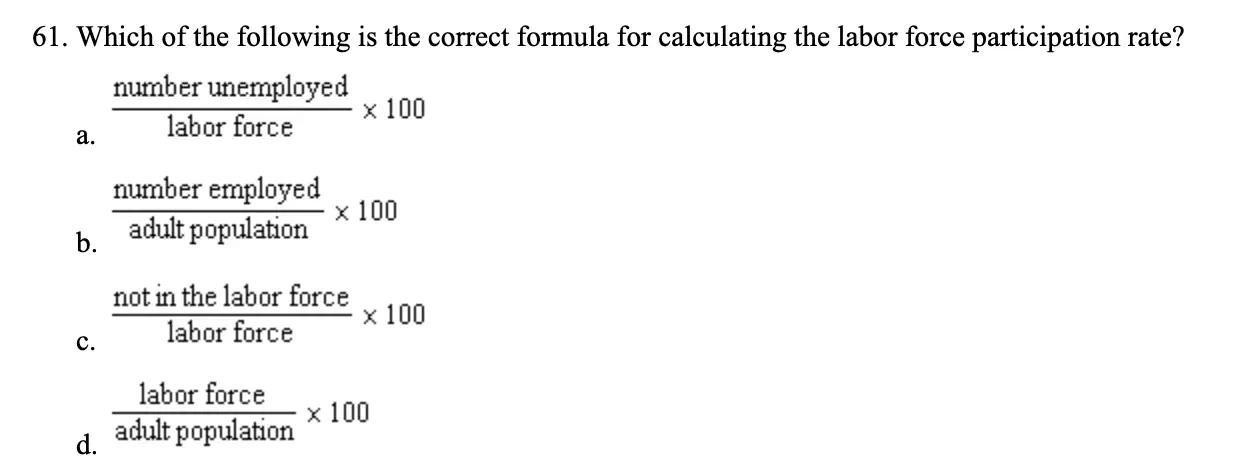
a
b
c
d
Sheamous loses his job and decides to sit on the beach rather than look for work during the next few months. Other things the same, the unemployment rate
increases, and the labor-force participation rate decreases.
increases, and the labor-force participation rate is unaffected.
is unaffected, and the labor-force participation rate decreases.
and the labor-force participation rate are both unaffected.
Data on the unemployment rate in the U.S. since 1960 show that the unemployment rate is
always zero.
sometimes zero.
rarely zero.
never zero.
In June 2009 the Bureau of Labor Statistics reported an adult population of 234.9 million, a labor force of 154 million and employment of 141.6 million. Based on these numbers the unemployment rate was
93.3/234.9.
12.4/234.9.
93.3/154.
12.4/154.
The adult population in the town of Shelbyville is 150 thousand. If 100 thousand people are employed and 20 thousand are unemployed, then the labor force participation rate is approximately
67%.
80%.
16%.
13%.
Suppose that some country had an adult population of about 25 million, a labor-force participation rate of 60 percent, and an unemployment rate of 6 percent. How many people were unemployed?
0.846 million
0.9 million
1.5 million
6 million
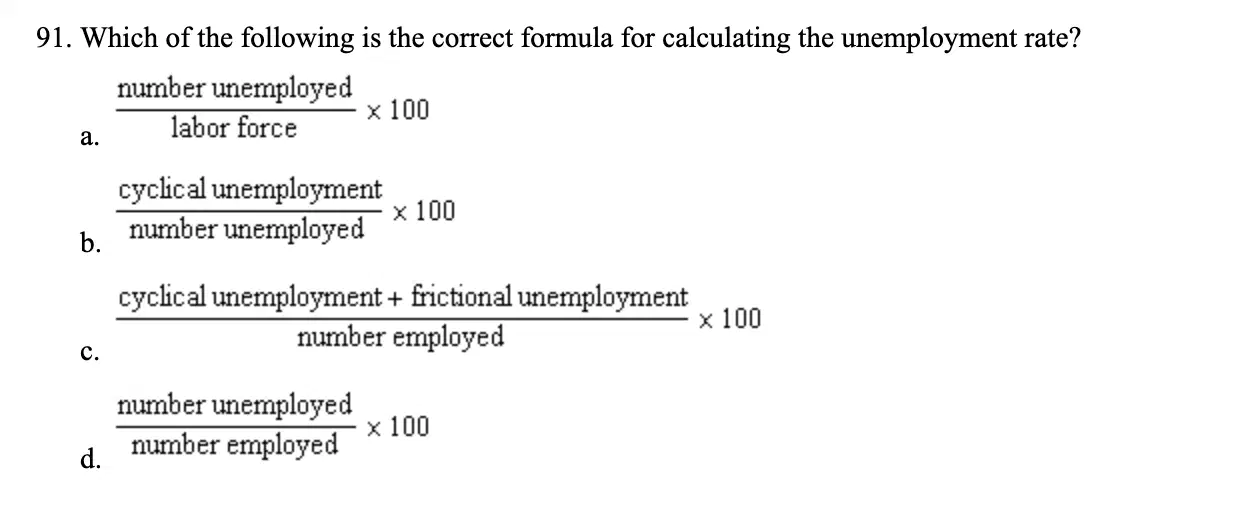
a
b
c
d
Suppose that the adult population in the town of Springfield is 225 million. If 40 million are unemployed and 100 million are employed, then the unemployment rate is approximately
29%.
18%.
24%.
6%.
Scenario 28-1
Suppose that the Bureau of Labor Statistics reports that the entire adult population of Mankiwland can be categorized as follows: 25 million people employed, 3 million people unemployed, 1 million discouraged workers, and 1 million people who are either students, homemakers, retirees, or other people not seeking employment. What is the total labor force?
25 million
28 million
29 million
30 million
Suppose that the Bureau of Labor Statistics reports that the entire adult population of Mankiwland can be categorized as follows: 25 million people employed, 3 million people unemployed, 1 million discouraged workers, and 1 million people who are either students, homemakers, retirees, or other people not seeking employment. What is the labor-force participation rate?
83.3%
86.7%
93.3%
96.7%
Suppose that the Bureau of Labor Statistics reports that the entire adult population of Mankiwland can be categorized as follows: 25 million people employed, 3 million people unemployed, 1 million discouraged workers, and 1 million people who are either students, homemakers, retirees, or other people not seeking employment. How many people are unemployed?
1 million
3 million
4 million
5 million
Suppose that the Bureau of Labor Statistics reports that the entire adult population of Mankiwland can be categorized as follows: 25 million people employed, 3 million people unemployed, 1 million discouraged workers, and 1 million people who are either students, homemakers, retirees, or other people not seeking employment. What is the unemployment rate?
3.3%
6.7%
10.7%
12%
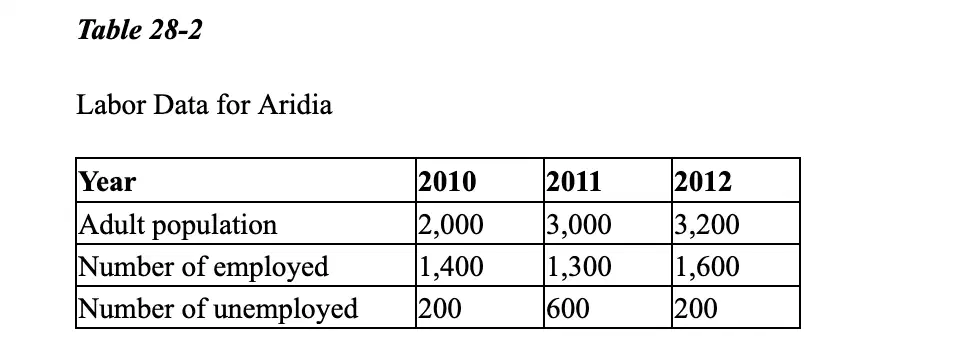
Refer to Table 28-2. The labor force of Aridia in 2010 was
1,400.
1,600.
1,800.
2,000.
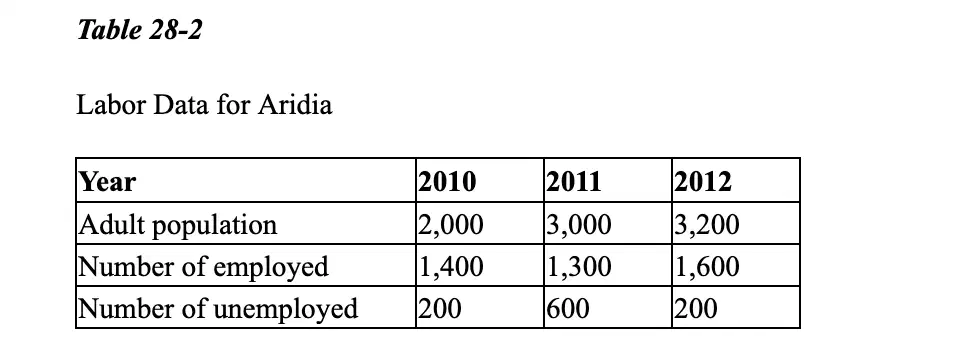
The unemployment rate of Aridia in 2010 was
10%.
12.5%.
14.3%.
80%.
According to 2012 data on the U.S. population, which of the following was correct for the adult population of prime working age, ages 25-54?
Black females had higher labor-force participation rates and lower unemployment rates compared to white females.
Black females had similar labor-force participation rates and higher unemployment rates compared to white females.
Black females had both lower labor-force participation rates and lower unemployment rates compared to white females.
Black females had lower labor-force participation rates and higher unemployment rates compared to white females.
Just after World War II, the labor-force participation rate of men was
about 33 percent, and in 2012, it was about 50 percent.
about 50 percent, and in 2012, it was about 60 percent.
about 60 percent, and in 2012, it was about 60 percent.
about 90 percent, and in 2012, it was about 70 percent.
Spells of unemployment end about
1/5 of the time with the person leaving the labor force.
1/4 of the time with the person leaving the labor force.
1/3 of the time with the person leaving the labor force.
1/2 of the time with the person leaving the labor force.
Discouraged workers are included in
the number of unemployed.
frictional unemployment.
the labor force.
None of the above is correct.
The reported unemployment rate should be viewed as
a. a useful but imperfect measure of joblessness.
b. clearly smaller than the true unemployment rate.
c. clearly larger than the true unemployment rate.
d. being very close to the true unemployment rate.
a
b
c
d
Evidence indicates that the typical person who becomes unemployed will
soon find a job.
find a job but not before a year or more has gone by.
leave the labor force and never return.leave the labor force and never return.
retire soon after
People who are unemployed because of job search are best classified as
cyclically unemployed.
structurally unemployed.
frictionally unemployed.
discouraged workers.
Which of the following is an explanation for the existence of frictional unemployment?
efficiency wages
minimum-wage laws
unions
job search
Frictional unemployment results from
job searching. It is often thought to explain relatively short spells of unemployment.
job searching. It is often thought to explain relatively long spells of unemployment
a surplus in the some labor markets. It is often thought to explain relatively short spells of unemployment.
a surplus in some labor markets. It is often thought to explain relatively long spells of unemployment.
Unemployment that results because the number of jobs available in some labor markets may be insufficient to give a job to everyone who wants one is called
the natural rate of unemployment.
cyclical unemployment.
structural unemployment.
frictional unemployment.
The natural unemployment rate includes
both frictional and structural unemployment.
neither frictional nor structural unemployment.
structural but not frictional unemployment.
frictional but not structural unemployment.
Cyclical unemployment is caused by
frictional and structural unemployment
frictional but not structural unemployment
structural but not frictional unemployment
neither frictional nor structural unemployment
Job search
is one reason economies always experience some unemployment.
is the process of matching workers with appropriate jobs.
would not be a problem if all workers and all jobs were the same.
All of the above are correct.
Sectoral shifts in demand for output
create structural unemployment.
immediately reduce unemployment.
increase unemployment due to job search.
do not affect demand for labor.
Suppose that because of the popularity of the low-carb diet, bakeries need fewer workers and steak houses need more workers. The unemployment created by this change is
a. frictional unemployment created by efficiency wages.
b. frictional unemployment created by sectoral shifts.
c. structural unemployment created by efficiency wages.
d. astructural unemployment created by sectoral shifts.
a
b
c
d
Frictional unemployment is inevitable because
a. sectoral shifts are always happening.
b. there is a federal minimum-wage law in the U.S.
c. some people do not want to be employed.
d. unions are very popular in the U.S.
a
b
c
d
Which of the following was not among the four industries with the largest employment in the United States a century ago?
cotton goods
men’s clothing
meat packing
lumber
Policies that reduce the time it takes unemployed workers to find new jobs
can reduce both frictional unemployment and the natural rate of unemployment.
can reduce frictional unemployment, but they cannot reduce the natural rate of unemployment.
cannot reduce frictional unemployment, but they can reduce the natural rate of unemployment.
cannot reduce either frictional unemployment or the natural rate of unemployment.
Which of the following helps to reduce frictional unemployment?
a. government-run employment agencies
b. public training programs
c. the Internet
d. All of the above are correct.
a
b
c
d
Unemployment insurance
a. reduces search effort which raises unemployment.
b. reduces search effort which lowers unemployment.
c. increases search effort which raises unemployment.
d. increases search effort which decreases unemployment.
a
b
c
d
More generous unemployment insurance would
a. raise structural unemployment.
b. raise frictional unemployment.
c. lower structural unemployment.
d. lower frictional unemployment.
a
b
c
d
Frictional unemployment is
not inevitable; rather, it can be reduced to zero by well-designed public policies.
not inevitable; rather, it could be reduced to zero if by the elimination of unemployment insurance.
inevitable, because at any given time, jobs are being created in some firms and destroyed in other firms.
inevitable, because in some industries, wages are always set above the level that brings supply and demand into equilibrium.
The growth rate for the American economy is
lower in the 21st century than for the previous 250 years.
higher in the 21st century than for the previous 250 years and increasing rapidly.
higher in the 21st century than for the previous 250 years but increasing slowly.
approximately equal in the 21st century and in the previous 250 years.
Minimum-wage laws
create unemployment.
do not apply in states with right-to-work laws.
affect highly-educated workers more than high school dropouts.
cause labor shortages, which further raise wages above equilibrium.
An increase in the minimum wage
A. reduces structural unemployment.
B. reduces frictional unemployment,
C. increases structural unemployment.
D. increases frictional unemployment.
A
B
C
D
Workers waiting for jobs to open up is most closely associated with
cyclical unemployment.
frictional unemployment.
seasonal unemployment.
structural unemployment.
Which of the following is not correct?
A union is a worker association that bargains with employers over wages, benefits, and working conditions.
Unions play a much larger role in the U.S. labor market now than they did in the past.
Unions play a large role in many European countries.
A union is a type of cartel.
In Belgium, Norway, and Sweden, the percentage of workers who belong to unions is
almost zero.
less than it is in the United States.
about the same as it is in the United States.
greater than it is in the United States.
Labor unions
raise wages in unionized industries.
create labor shortages in non-unionized industries.
play a larger role in the current U.S. economy than in European countries such as Norway and Sweden.
prefer to operate in states with right-to-work laws.
When a union raises the wage above the equilibrium level,
A. both the quantity of labor supplied and unemployment rise.
B. both the quantity of labor supplied and unemployment fall.
C. the quantity of labor supplied rises and unemployment falls.
D. the quantity of labor supplied falls and unemployment rises.
A
B
C
D
When a union bargains successfully with employers, in that industry,
A. both wages and unemployment increase.
B. wages increase and unemployment decreases.
C. wages decrease and unemployment increases.
D. both wages and unemployment decrease.
A
B
C
D
The introduction of a union into an industry
A. raises wages and employment in that industry.
B. lowers wages and employment in that industry.
C. lowers wages and raises employment in that industry.
D. raises wages and lowers employment in that industry.
A
B
C
D
Unions contribute to
A. frictional but not structural unemployment.
B. structural but not frictional unemployment.
C. both frictional and structural unemployment.
D. neither frictional nor structural unemployment.
A
B
C
D
Suppose that garbage collectors and landscaping workers have no unions. Now suppose that garbage collectors form unions. What does this do the labor supply and wages of landscaping workers?
Both labor supply and wages increase.
Labor supply increases, and wages decrease.
Labor supply decreases, and wages increase.
Both labor supply and wages increase.
The National Labor Relations Board
A/enforces antitrust laws against unions.
B/enforces workers' rights to unionize.
C/acts as a union's representative in collective bargaining.
D/is required to approve all collective bargaining agreements before they can be enforced.
A
B
C
D
Right-to-work laws
guarantee workers the right to form unions.
give workers in a unionized firm the right to choose whether to join the union.
prevent employers from hiring permanent replacements for workers who are on strike.
prevent workers from being fired because of increases in wages brought about by collective bargaining.
The theory of efficiency wages explains why
setting wages at the equilibrium level may increase unemployment.
it may be in the best interest of firms to offer wages that are above the equilibrium level.
the most efficient way to pay workers is to pay them according to their skills.
Wages set above the equilibrium wage by
firms to increase morale are called collective bargaining wages.
lawmakers to decrease cyclical unemployment are called minimum wages laws.
firms to increase productivity are called efficiency wages.
lawmakers to decrease the length of a job search are called efficiency wages.
Efficiency wages
A. increase productivity and reduce unemployment.
B. increase productivity but increase unemployment.
C. decrease productivity but reduce unemployment.
D. decrease productivity and increase unemployment.
A
B
C
D
Efficiency wages create a labor
A. surplus and so increase unemployment.
B. surplus and so decrease unemployment.
C. shortage and so increase unemployment.
D. shortage and so decrease unemployment.
A
B
C
D
A firm may pay efficiency wages in an attempt to
entice workers to work the night shift rather than the day shift.
improve productivity by reducing turnover.
reduce costs by attracting the least-skilled workers to apply for job vacancies.
All of the above are correct.
Job search
and firms paying wages above equilibrium to improve worker health both create frictional unemployment.
creates frictional unemployment, while firms paying wages above equilibrium to improve worker health creates structural unemployment.
creates structural unemployment, while firms paying wages above equilibrium to improve worker health creates frictional unemployment.
and firms paying wages above equilibrium to improve worker health both create structural unemployment.
Minimum-wage laws, unions, and efficiency wages contribute to
both structural unemployment and the natural rate of unemployment.
neither structural unemployment nor the natural rate of unemployment.
structural unemployment, but not the natural rate of unemployment.
the natural rate of unemployment, but not structural unemployment.
Which famous company executive introduced an innovative pay system that is consistent with the theory of efficiency wages?
Lee Iococca
Steve Jobs
Mark Zuckerberg
Henry Ford
In the early 1900s, Henry Ford introduced a
high-wage policy, and this policy produced many of the effects predicted by efficiency-wage theory.
high-wage policy, and this policy produced none of the effects predicted by efficiency-wage theory.
low-wage policy, and this policy produced many of the effects predicted by efficiency-wage theory.
low-wage policy, and this policy produced none of the effects predicted by efficiency-wage theory.
Most people rely primarily on income other than their labor earnings to maintain their standard of living.
T
F
When a country keeps its workers as fully employed as possible, it achieves a higher level of GDP than if many of its workers were idle.
T
F
Cyclical unemployment refers to the year-to-year fluctuations in unemployment around its natural rate.
T
F
The natural rate of unemployment is closely associated with the short-run ups and downs of economic activity.
T
F
Government policy can do nothing about the natural rate of unemployment.
T
F
Every week, the Bureau of Labor Statistics produces data on unemployment.
T
F
The Bureau of Labor Statistics produces data on unemployment and other aspects of the labor market from a regular survey of about 600 households, called the Current Population Survey.
T
F
The normal rate of unemployment around which the unemployment rate fluctuates is called the natural rate of unemployment.
T
F
Over the past several decades in the United States, the labor-force participation rate of women has increased and the labor-force participation rate of men had remained steady.
T
F
The Bureau of Labor Statistics’ U1 measure of joblessness is larger than its U6 measure of joblessness.
T
F
A typical American worker covered by unemployment insurance receives 50 percent of his former wages for 52 weeks.
T
F
Most economists agree that eliminating unemployment insurance would increase the nation’s overall level of wellbeing.
T
F
When a minimum-wage law forces the wage to remain above the level that balances supply and demand, there are more workers willing to work than there are jobs, so some workers are unemployed.
T
F
When a union raises the wage above the equilibrium level, it reduces the quantity of labor supplied and raises the quantity of labor demanded, resulting in unemployment.
T
F
Workers in unions reap the benefit of collective bargaining, while workers not in unions bear some of the cost.
T
F

