
 Worksheets
Unit 04 7th Science Review
Total questions: 56
Worksheet time: 2hrs 7mins


Match the following:
Producer/Autotroph
Plant
Secondary Consumer
Bird
Tertiary Consumer
Snake
Apex Predator
Owl
Herbivore
Grasshopper

Which of the following would be the Apex Predator?
Hammerhead Shark
Octopus
Phytoplankton
Orca

The Mayfly is a food source for which 3 organisms?
respiration and decomposition
respiration and photosynthesis
death
burning
Humans burn fossil fuels and wood, releasing carbon dioxide into the atmosphere. This carbon dioxide is then absorbed by trees for photosynthesis. These processes are contributory to which chemical cycle?
The carbon cycle
The water cycle
The nitrogen cycle
The phosphorous cycle
How does the human body return carbon to the atmosphere in the carbon cycle?
Waste products
Photosynthesis
Cellular respiration
Formation of glucose
In the carbon cycle, animals can release carbon back into the cycle through __________ or through __________.
burning . . . photosynthesis
fixation . . . decomposition
decomposition . . . photosynthesis
respiration . . . decomposition
respiration . . . photosynthesis
Where does all the carbon in organisms (living things) originate from?
Earth's atmosphere
Rocks
Water
Soil
Which of the following are some of the major carbon stores on Earth? Select ALL that apply!
The ocean
The lithosphere (upper part of Earth's crust)
The atmosphere

The step of the nitrogen cycle that is in red is called...
Denitrification
Nitrification
Nitrogen Fixation
Ammonification

The step of the nitrogen cycle that is in red is called...
Denitrification
Nitrification
Nitrogen Fixation
Ammonification

The step of the nitrogen cycle that is in red is called...
Denitrification
Nitrification
Nitrogen Fixation
Ammonification
Nitrogen fixation...
animals eat the plants and other animals that contain nitrogen and release it through their waste
Bacteria in the soil and lightning in the atmosphere “fix” the nitrogen
Once in the ground, bacteria in the soil also nitrify the nitrogen
plants absorb nitrogen through their roots and return it back to the atmosphere
Denitrification...
animals eat the plants and other animals that contain nitrogen and release it through their waste
Bacteria in the soil and lightning in the atmosphere “fix” the nitrogen
nitrogen is released back into the atmosphere from the animal’s waste or decomposers
plants absorb nitrogen through their roots and return it back to the atmosphere
Organisms need nitrogen in order to...
To breathe
To obtain water for growth
To build proteins & DNA
To regulate temperature
Which of these nitrogen cycle processes converts atmospheric nitrogen to a soil form of nitrogen that is usable by plants?
nitrogen fixation
nitrification
denitrification
ammonification
Bacteria fix nitrogen from the atmosphere into a form plants can use.
True
False
How do animals get the nitrogen they need?
From the air they breathe
From the water they drink
From the food they eat
From the sun
Which of the following is an disadvantage of asexual reproduction?
lacks variation
quick
many offspring with little energy
Involves only one parent
Asexual Reproduction
Sexual Reproduction
Diverse
Uniform
Which is NOT a Sexual reproduction DISADVANTAGE
High genetic variation
Can be complicated
smaller population
requires courtship or mating
Which is NOT an Asexual reproduction DISADVANTAGE
No genetic variation
Only need one parent
Bad characteristics are passed on
difficult for organisms to adapt
What is the difference between sexual and asexual reproduction?
Asexual produces genetically different offspring. Sexual produces genetically identical.
Sexual produces offspring with fewer chromosomes. Asexual produces more.
Sexual produces genetically different offspring. Asexual produces genetically identical.
Sexual reproduction is quicker than asexual.
Evolution is the result of a process called ____________
Natural Selection
Artificial Selection
Survival of the Weakest
Supernatural Selection
According to natural selection, organisms more suited to their environment are better able to
Sleep
Survive
Perish
Migrate
Natural selection happens when an individual's genes ______________ from the genes of other members of its species.
Become different
Stay the same
Become separated
Changes in genetic material are called _____________
Mutations
RNA
Genes
Some changes in genes can help organisms _____
Survive
Mutate
Rest
1. The process of choosing parent organisms for desired characteristics is called
natural selection
Artificial selection
random selection
genetic manipulation
What is an example of artificial selection?
Letting dogs choose their own mate
Letting plants pollinate on their own
Crossing a labrador and a poodle to create a labradoodle
Which statement is true comparing natural selection and artificial selection?
In natural selection, traits benefit humans and in artificial selection, the traits benefit the species
In natural selection, traits benefit the species and in artificial selection, the traits benefit humans
In natural and artificial selection, the process takes hundreds of years to occur
In natural and artificial selection, nature determines what traits will be passed down to offspring.

Which leaf is shown in the drawing?
Magnolia
Redbud
Sweetgum
None of the above
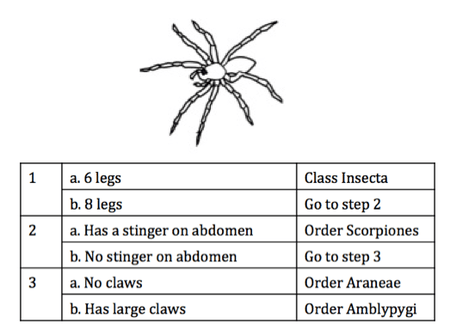
A student discovers an arachnid with a segmented abdomen, long legs, and a tail with no stinger.
The student uses the dichotomous key below to identify it.
1. a) Abdomen segmented.............go to 2
b) Abdomen not segmented ......go to 4
2. a) Abdomen with tail....................go to 3
b) Abdomen without tail...............go to 5
3. a) Tail with stinger..........................Scorpion
b) Tail without stinger.....................Whip scorpion
4. a) Legs longer than body.............Daddy Long Legs
b) Legs not longer than body……….Wind scorpion
5. a) Covered with spines .......................Mite
b) Few spines.....................................Tick
Whip Scorpion
Daddy Long Legs
Mite
Tick

Identify the plant shown
A
B
C
D
How many options should every branch in a dichotomous key have?
1
2
3
4
When using a dichotomous key to identify organisms, what do we look at?
physical features
weather patterns
environment
diet
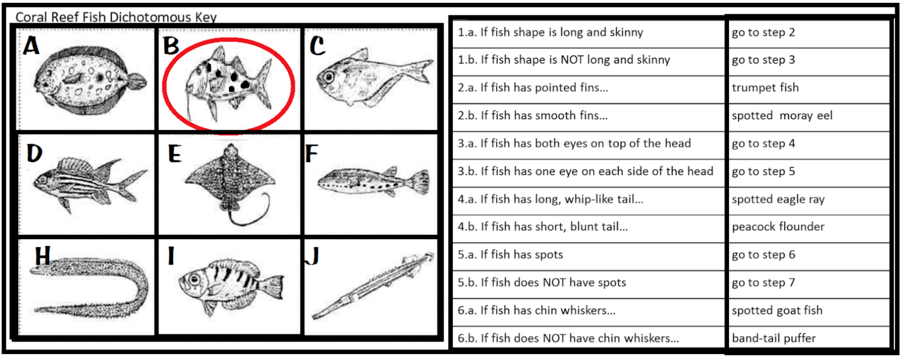
All cells in the Eukarya domain will have a __________.
Nucleus
Cytoplasm
Cell Wall
Flagella
The study of naming and classifying organisms
(a)

F
G
H
J

A
B
C
D
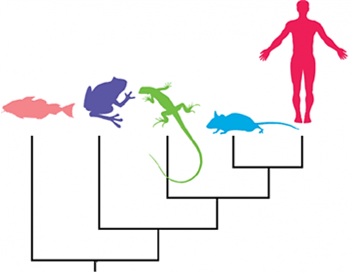
According to this phylogenetic tree, which creature is the least related out of all pictured?
Fish
Frog
Salamander
Human

