
 Worksheets
AZ204 quiz1 bootcamp
Total questions: 25
Worksheet time: 38mins
Your company has a web app named WebApp1.You use the WebJobs SDK to design a triggered App Service background task that automatically invokes a function in the code every time new data is received in a queue.You are preparing to configure the service processes a queue data item.Which of the following is the service you should use?
Logic Apps
WebJobs
Flow
Functions
You develop a Web App on a tier D1 app service plan.You notice that page load times increase during periods of peak traffic.You want to implement automatic scaling when CPU load is above 80 percent. Your solution must minimize costs.What should you do first?
A. Enable autoscaling on the Web App.
B. Switch to the Premium App Service tier plan.
C. Switch to the Standard App Service tier plan.
D. Switch to the Azure App Services consumption plan.
You are a developer at your company.You need to edit the workflows for an existing Logic App.What should you use?
A. the Enterprise Integration Pack (EIP)
B. the Logic App Code View
C. the API Connections
D. the Logic Apps Designer
You develop a software as a service (SaaS) offering to manage photographs. Users upload photos to a web service which then stores the photos in AzureStorage Blob storage. The storage account type is General-purpose V2.When photos are uploaded, they must be processed to produce and save a mobile-friendly version of the image. The process to produce a mobile-friendly version of the image must start in less than one minute.You need to design the process that starts the photo processing.Solution: Trigger the photo processing from Blob storage events.Does the solution meet the goal?
Yes
No
You develop and deploy an Azure App Service API app to a Windows-hosted deployment slot named Development. You create additional deployment slots named Testing and Production. You enable auto swap on the Production deployment slot.You need to ensure that scripts run and resources are available before a swap operation occurs.Solution: Update the web.config file to include the applicationInitialization configuration element. Specify custom initialization actions to run the scripts.Does the solution meet the goal?
Yes
No
You develop and deploy an Azure App Service API app to a Windows-hosted deployment slot named Development. You create additional deployment slots named Testing and Production. You enable auto swap on the Production deployment slot.You need to ensure that scripts run and resources are available before a swap operation occurs.Solution: Enable auto swap for the Testing slot. Deploy the app to the Testing slot.Does the solution meet the goal?
Yes
No
You develop a website. You plan to host the website in Azure. You expect the website to experience high traffic volumes after it is published.You must ensure that the website remains available and responsive while minimizing cost.You need to deploy the website.What should you do?
A. Deploy the website to a virtual machine. Configure the virtual machine to automatically scale when the CPU load is high.
B. Deploy the website to an App Service that uses the Shared service tier. Configure the App Service plan to automatically scale when the CPU load is high.
C. Deploy the website to a virtual machine. Configure a Scale Set to increase the virtual machine instance count when the CPU load is high.
D. Deploy the website to an App Service that uses the Standard service tier. Configure the App Service plan to automatically scale when the CPU load is high.
You are developing an Azure Function App that processes images that are uploaded to an Azure Blob container.Images must be processed as quickly as possible after they are uploaded, and the solution must minimize latency. You create code to process images when theFunction App is triggered.You need to configure the Function App.What should you do?
A. Use an App Service plan. Configure the Function App to use an Azure Blob Storage input trigger.
B. Use a Consumption plan. Configure the Function App to use an Azure Blob Storage trigger.
C. Use a Consumption plan. Configure the Function App to use a Timer trigger.
D. Use an App Service plan. Configure the Function App to use an Azure Blob Storage trigger.
E. Use a Consumption plan. Configure the Function App to use an Azure Blob Storage input trigger.
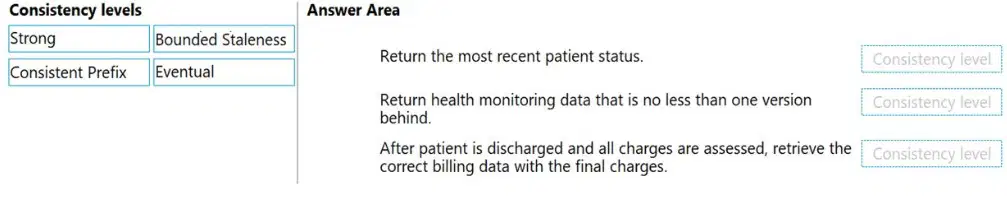
You are developing a solution for a hospital to support the following use cases:✑ The most recent patient status details must be retrieved even if multiple users in different locations have updated the patient record.✑ Patient health monitoring data retrieved must be the current version or the prior version.✑ After a patient is discharged and all charges have been assessed, the patient billing record contains the final charges.You provision a Cosmos DB NoSQL database and set the default consistency level for the database account to Strong. You set the value for Indexing Mode toConsistent.You need to minimize latency and any impact to the availability of the solution. You must override the default consistency level at the query level to meet the required consistency guarantees for the scenarios.Which consistency levels should you implement? To answer, drag the appropriate consistency levels to the correct requirements. Each consistency level may be used once, more than once, or not at all. You may need to drag the split bar between panes or scroll to view content.NOTE: Each correct selection is worth one point.Select and Place:
box 1:Strong
box 2:Eventual
box 3:Bounded Staleness
box 1:Consistent Prefix
box 2:Eventual
box 3:Strong
box 1:Strong
box 2:Bounded staleness
box 3:Eventual
box 1:Eventual
box 2:Bounded staleness
box 3:Strong
You are preparing to deploy a website to an Azure Web App from a GitHub repository. The website includes static content generated by a script.You plan to use the Azure Web App continuous deployment feature.You need to run the static generation script before the website starts serving traffic.What are two possible ways to achieve this goal? Each correct answer presents a complete solution.NOTE: Each correct selection is worth one point.
A. Add the path to the static content generation tool to WEBSITE_RUN_FROM_PACKAGE setting in the host.json file.
B. Add a PreBuild target in the websites csproj project file that runs the static content generation script.
C. Create a file named run.cmd in the folder /run that calls a script which generates the static content and deploys the website.
D. Create a file named .deployment in the root of the repository that calls a script which generates the static content and deploys the website.
You have two Hyper-V hosts named Host1 and Host2. Host1 has an Azure virtual machine named VM1 that was deployed by using a custom Azure Resource
Manager template.
You need to move VM1 to Host2.
What should you do?
From the Update management blade, click Enable.
From the Overview blade, move VM1 to a different subscription.
From the Redeploy blade, click Redeploy.
From the Profile blade, modify the usage location.
You are a developer at your company.
You need to edit the workflows for an existing Logic App.
What should you use?
the Enterprise Integration Pack (EIP)
the Logic App Code View
the API Connections
the Logic Apps Designer
You develop and deploy an Azure App Service API app to a Windows-hosted deployment slot named Development. You create additional deployment slots named Testing and Production. You enable auto swap on the Production deployment slot.
You need to ensure that scripts run and resources are available before a swap operation occurs.
Solution: Disable auto swap. Update the app with a method named statuscheck to run the scripts. Re-enable auto swap and deploy the app to the Production slot.
Does the solution meet the goal?
Yes
No
You develop a software as a service (SaaS) offering to manage photographs. Users upload photos to a web service which then stores the photos in Azure
Storage Blob storage. The storage account type is General-purpose V2.
When photos are uploaded, they must be processed to produce and save a mobile-friendly version of the image. The process to produce a mobile-friendly version of the image must start in less than one minute.
You need to design the process that starts the photo processing.
Solution: Convert the Azure Storage account to a BlockBlobStorage storage account.
Does the solution meet the goal?
Yes
No
You develop a website. You plan to host the website in Azure. You expect the website to experience high traffic volumes after it is published.
You must ensure that the website remains available and responsive while minimizing cost.
You need to deploy the website.
What should you do?
Deploy the website to a virtual machine. Configure the virtual machine to automatically scale when the CPU load is high.
Deploy the website to an App Service that uses the Shared service tier. Configure the App Service plan to automatically scale when the CPU load is high.
Deploy the website to a virtual machine. Configure a Scale Set to increase the virtual machine instance count when the CPU load is high.
Deploy the website to an App Service that uses the Standard service tier. Configure the App Service plan to automatically scale when the CPU load is high.
You develop an HTTP triggered Azure Function app to process Azure Storage blob data. The app is triggered using an output binding on the blob.
The app continues to time out after four minutes. The app must process the blob data.
You need to ensure the app does not time out and processes the blob data.
Solution: Use the Durable Function async pattern to process the blob data.
Does the solution meet the goal?
Yes
No
You develop an HTTP triggered Azure Function app to process Azure Storage blob data. The app is triggered using an output binding on the blob.
The app continues to time out after four minutes. The app must process the blob data.
You need to ensure the app does not time out and processes the blob data.
Solution: Pass the HTTP trigger payload into an Azure Service Bus queue to be processed by a queue trigger function and return an immediate HTTP success response.
Does the solution meet the goal?
Yes
No
You develop an HTTP triggered Azure Function app to process Azure Storage blob data. The app is triggered using an output binding on the blob.
The app continues to time out after four minutes. The app must process the blob data.
You need to ensure the app does not time out and processes the blob data.
Solution: Configure the app to use an App Service hosting plan and enable the Always On setting.
Does the solution meet the goal?
Yes
No
You develop a software as a service (SaaS) offering to manage photographs. Users upload photos to a web service which then stores the photos in Azure
Storage Blob storage. The storage account type is General-purpose V2.
When photos are uploaded, they must be processed to produce and save a mobile-friendly version of the image. The process to produce a mobile-friendly version of the image must start in less than one minute.
You need to design the process that starts the photo processing.
Solution: Move photo processing to an Azure Function triggered from the blob upload.
Does the solution meet the goal?
Yes
No
You are developing an application that uses Azure Blob storage.
The application must read the transaction logs of all the changes that occur to the blobs and the blob metadata in the storage account for auditing purposes. The changes must be in the order in which they occurred, include only create, update, delete, and copy operations and be retained for compliance reasons.
You need to process the transaction logs asynchronously.
What should you do?
Process all Azure Blob storage events by using Azure Event Grid with a subscriber Azure Function app.
Enable the change feed on the storage account and process all changes for available events.
Process all Azure Storage Analytics logs for successful blob events.
Use the Azure Monitor HTTP Data Collector API and scan the request body for successful blob events
You are developing an Azure Function App that processes images that are uploaded to an Azure Blob container.
Images must be processed as quickly as possible after they are uploaded, and the solution must minimize latency. You create code to process images when the
Function App is triggered.
You need to configure the Function App.
What should you do?
Use an App Service plan. Configure the Function App to use an Azure Blob Storage input trigger.
Use a Consumption plan. Configure the Function App to use an Azure Blob Storage trigger.
Use a Consumption plan. Configure the Function App to use a Timer trigger.
Use an App Service plan. Configure the Function App to use an Azure Blob Storage trigger.
Use a Consumption plan. Configure the Function App to use an Azure Blob Storage input trigger.
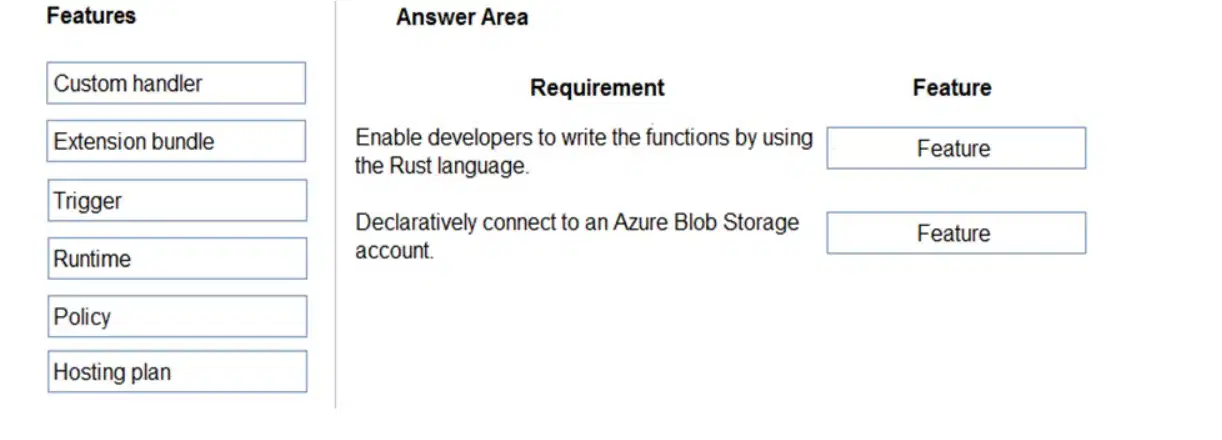
You are developing an Azure Function app.
The app must meet the following requirements:
✑ Enable developers to write the functions by using the Rust language.
✑ Declaratively connect to an Azure Blob Storage account.
You need to implement the app.
Which Azure Function app features should you use? To answer, drag the appropriate features to the correct requirements. Each feature may be used once, more than once, or not at all. You may need to drag the split bar between panes or scroll to view content.
NOTE: Each correct selection is worth one point.
Box 1: Hosting plan
Box 2: Policy
Box 1: Custom handler
Box 2: Trigger
Box 1: Extension bundle
Box 2: Runtime
Box 1: Runtime
Box 2: Trigger
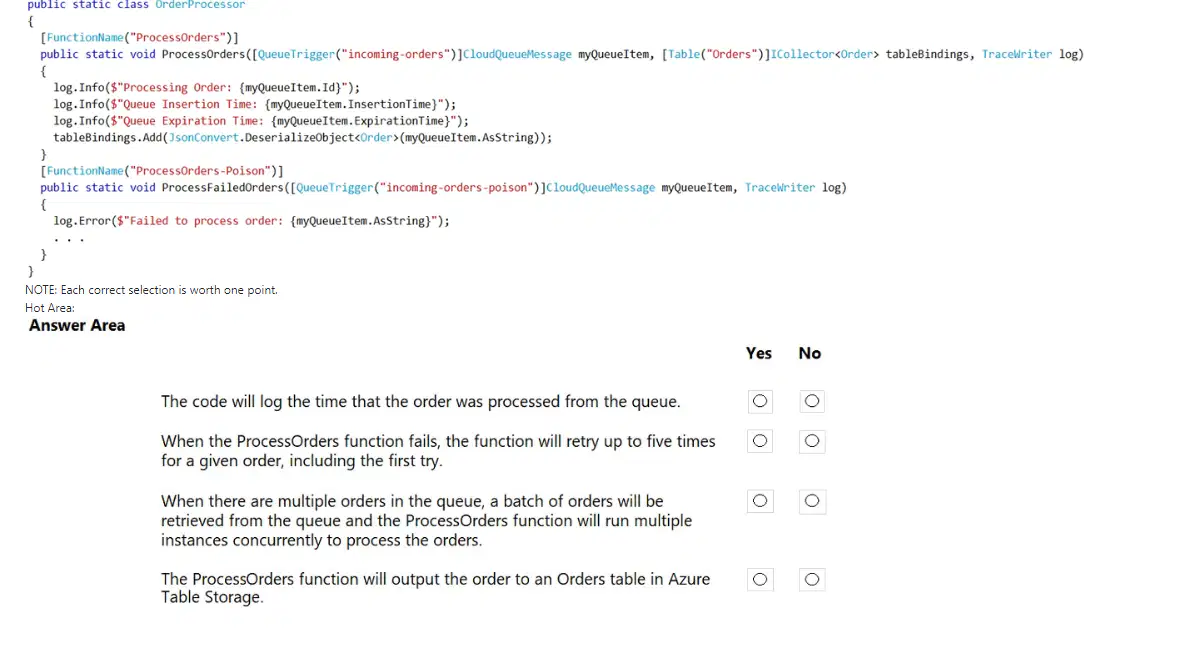
You are developing an Azure Function App by using Visual Studio. The app will process orders input by an Azure Web App. The web app places the order information into Azure Queue Storage.
You need to review the Azure Function App code shown below.
Box 1: Yes
Box 2: Yes
Box 3: Yes
Box 4: Yes
Box 1: No
Box 2: No
Box 3: No
Box 4: Yes
Box 1: No
Box 2: Yes
Box 3: Yes
Box 4: Yes
Box 1: No
Box 2: Yes
Box 3: Yes
Box 4: No

You are configuring a development environment for your team. You deploy the latest Visual Studio image from the Azure Marketplace to your Azure subscription.
The development environment requires several software development kits (SDKs) and third-party components to support application development across the organization. You install and customize the deployed virtual machine (VM) for your development team. The customized VM must be saved to allow provisioning of a new team member development environment.
You need to save the customized VM for future provisioning.
Which tools or services should you use? To answer, select the appropriate options in the answer area.
NOTE: Each correct selection is worth one point.
Box 1: Azure Powershell
Box 2: Azure Blob Storage
Box 1: Azure Backup
Box 2: Azure File Storage
Box 1: Azure Data Lake Storage
Box 2: Azure Table Storage
Box 1: Azure Migrate
Box 2: Azure Blob Storage
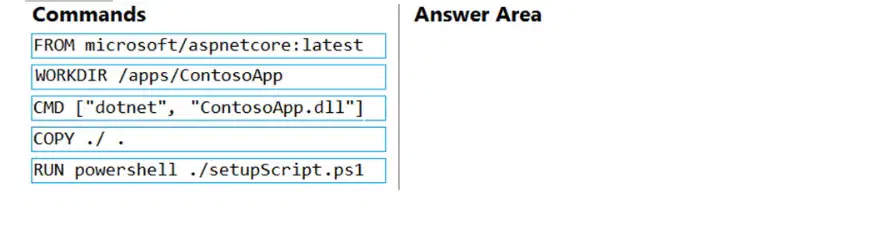
You plan to create a Docker image that runs an ASP.NET Core application named ContosoApp. You have a setup script named setupScript.ps1 and a series of application files including ContosoApp.dll.
You need to create a Dockerfile document that meets the following requirements:
✑ Call setupScripts.ps1 when the container is built.
✑ Run ContosoApp.dll when the container starts.
The Dockerfile document must be created in the same folder where ContosoApp.dll and setupScript.ps1 are stored.
Which five commands should you use to develop the solution? To answer, move the appropriate commands from the list of commands to the answer area and arrange them in the correct order.
Select and Place:
Box 1:
FROM microsoft/aspnetcore-build:latest
Box 2:
CMD [..]
Box 3: WORKDIR /apps/ContosoApp -
Bxo 4: COPY ./ .
Box 5: RUN powershell ./setupScript.ps1
Box 1: CMD [..]
Box 2: FROM microsoft/aspnetcore-build:latest
Box 3: WORKDIR /apps/ContosoApp -
Bxo 4: COPY ./ .
Box 5: RUN powershell ./setupScript.ps1

