Worksheets
Unit 7- Motion Review
Total questions: 71
Worksheet time: 44mins

Object is...
constant speed
speeding up
slowing down
stopped
What is the metric unit for speed?
h/km
m/s
km
cm3
A negative acceleration means that your object is
constant
speeding up
at rest
slowing down

Which graph shows an object at rest?
A
B
C
D
Sadie jumps rope during gym class. What object pushes against Sadie so she can jump?
the jump rope
the gym teacher
the floor
gravity
As you run, your feet push against the ground. At the same time, the ground pushes against your feet. Which of the following explains this.
Newton's 1st Law
Newton's 2nd Law
Newton's 3rd Law
momentum
Which law states: An object in motion will stay in motion unless acted upon by an unbalanced force, and object at rest will stay at rest unless acted upon by an unbalanced force?
Newton's First Law
Newton's Second Law
Newton's Third Law
Mrs. Buckley's Law
Force = mass X acceleration
Newton's First Law
Newton's Second Law
Newton's Third Law
For every action there is an equal and opposite reaction.
Newton's First Law
Newton's Second Law
Newton's Third Law

How would you walk to create the graph shown?
stand still
walk away from the detector at constant speed
walk toward the detector at constant speed
walk away with increasing speed

How would you walk to create the graph shown?
stand still
walk away from the detector at constant speed
walk toward from the detector at constant speed
walk toward from the detector with decreasing speed

How would you walk to produce this graph?
walk away slow for 4 minutes, stand still for 4 minutes, walk away fast for 2 minutes
walk away slow for 2 minutes, stand still for 2 minutes, walk away fast for 6 minutes
walk toward slow for 4 minutes, stand still for 4 minutes, walk toward fast for 2 minutes
walk away at increasing speed for 4 minutes, stand still for 4 minutes, walk away with increasing speed for for 2 minutes

Which line segment shows increasing speed?
A
B
C
D

Which line segment show your speed is zero?
A
B
C
D

Which line segment show you walking away from the starting point at a fast constant speed?
A
B
C
D

1st
Law of Motion
2nd
Law of Motion
3rd
Law of Motion


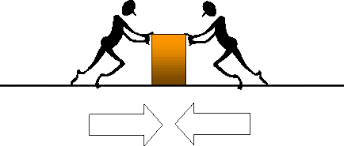
If there are two forces going in opposite directions how would you find the net force?
Subtract
Add
Neither
Multiply


What does the solid line on this graph represent?
Constant speed
Acceleration
Not moving
deceleration
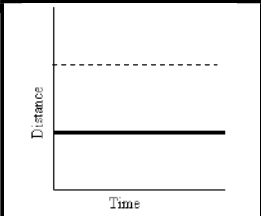
What does the solid line on this graph represent?
Constant speed
Acceleration
At rest
deceleration
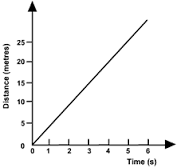
What is the line on this graph showing?
moving away from starting point at a constant speed
moving back towards the starting point at a constant speed
acceleration (getting faster)
deceleration (getting slower)

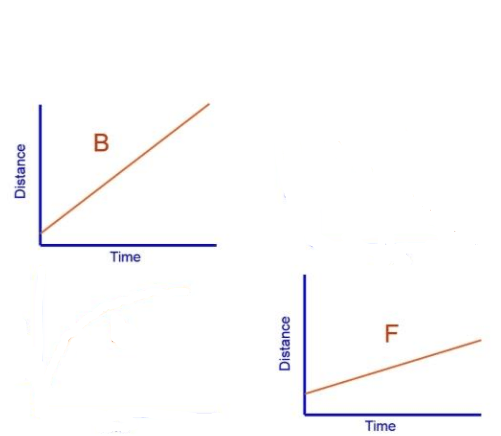


I saw a pothole, so I slowed down so my car wouldn’t be damaged
Speed
Velocity
Acceleration
Force
A gray whale can travel an average of 120 km per day as it migrates
Speed
Velocity
Acceleration
Force
The Train traveled northwest at 50 km/s
Speed
Velocity
Acceleration
Force
How would you walk to produce this graph?
walk away slow for 4 minutes, stand still for 4 minutes, walk away fast for 2 minutes
walk away slow for 2 minutes, stand still for 2 minutes, walk away fast for 6 minutes
walk toward slow for 4 minutes, stand still for 4 minutes, walk toward fast for 2 minutes
walk away at increasing speed for 4 minutes, stand still for 4 minutes, walk away with increasing speed for for 2 minutes

What is your velocity in segment B of the graph?
0 m/s
10 m/s
2 m/s
6 m/s
Which line segment shows increasing speed?
A
B
C
D
In science, __________________________ is defined as a change in position.
motion
potential energy
evaporation
sublimation
_____________________________________is a measure of the change in velocity of a moving object
acceleration
speed
distance
displacement
The measure of both speed and direction is called _________________________
distance
velocity
acceleration
gravity

During which interval is the object speeding up?
A to B
B to C
D to E
E to F


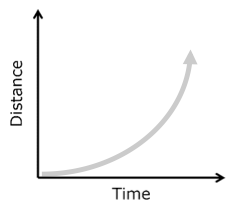


Horizontal lines on a distance vs. time graph would best describe what type of motion?
constant acceleration
no motion
positive acceleration
negative acceleration
A line on a distance‐time graph becomes steeper as an object's speed _____________.
Decreases
Stays constant
Stops moving
Increases
Antone is pulling on the rope with a force of 300 newtons, how much force will Bryan need to pull with in order to win the game of tug of war?
300 newtons
Less than 300 newtons
More than 300 newton
Bryan will never win the game of tug of war
A ball sits in the middle of a table without moving. Suddenly, the ball moves and falls off the table. What must have happened?
The ball popped, which made it fall off the table
The ball moved by itself as objects sometimes do and fell.
A force exerted by moving air must have acted on the ball
The table was not flat and the ball was balanced on it, but then it fell
You can increase the friction by…
making the surfaces rougher
using oil or another lubricant
putting the object on wheels
asking a friend to help push or pull
A girl on a bike rides down a hill 500 meters long in 50 seconds. What is her speed?
100 m/s
10 m/s
1,000 m/s
10 mph
What is the speed of a jet plane that travels 528 meters in 4 seconds ?
140 m/s
132 mph
142 mph
132 m/s