
 Worksheets
Review Chapter 31
Total questions: 17
Worksheet time: 9mins
When prices are falling, economists say that there is
disinflation
deflation
a contraction
an inverted inflation
The term hyperinflation refers to
the spread of inflation from one country to others.
a decrease in the inflation rate.
a period of very high inflation.
inflation accompanied by a recession.
The value of money falls as the price level
rises, because the number of dollars needed to buy a representative basket of goods rises
rises, because the number of dollars needed to buy a representative basket of goods falls.
falls, because the number of dollars needed to buy a representative basket of goods rises.
falls, because the number of dollars needed to buy a representative basket of goods falls.
If P denotes the price of goods and services measured in terms of money, then
1/P represents the value of money measured in terms of goods and services
P can be regarded as the “overall price level.”
an increase in the value of money is associated with a decrease in P.
All of the above are correct.
With the value of money on the vertical axis, the money supply curve is
upward-sloping.
downward-sloping.
horizontal.
vertical.
If M = 3,000, P = 2, and Y = 12,000, what is velocity?
1/2
2
4
8
If velocity = 3.5, the quantity of money = 15,000, and the price level = 1.2, then the real value of output is
3,571.43
4,285.71
5,142.86
43,750.00.
Other things the same, an increase in velocity means that
the rate at which money changes hands falls, so the price level rises.
the rate at which money changes hands falls, so the price level falls.
the rate at which money changes hands rises, so the price level rises.
the rate at which money changes hands rises, so the price level falls
If the nominal interest rate is 8 percent and expected inflation is 3.5 percent, then what is the real interest rate?
11.5 percent
7.5 percent
4.5 percent
2.5 percent
The supply of money is determined by
the price level.
the Treasury and Congressional Budget Office
the Central Bank.
the demand for money
When the money market is drawn with the value of money on the vertical axis, if the Central Bank sells bonds then
the money supply and the price level increase
the money supply and the price level decrease.
the money supply increases and the price level decreases.
the money supply increases and the price level increases
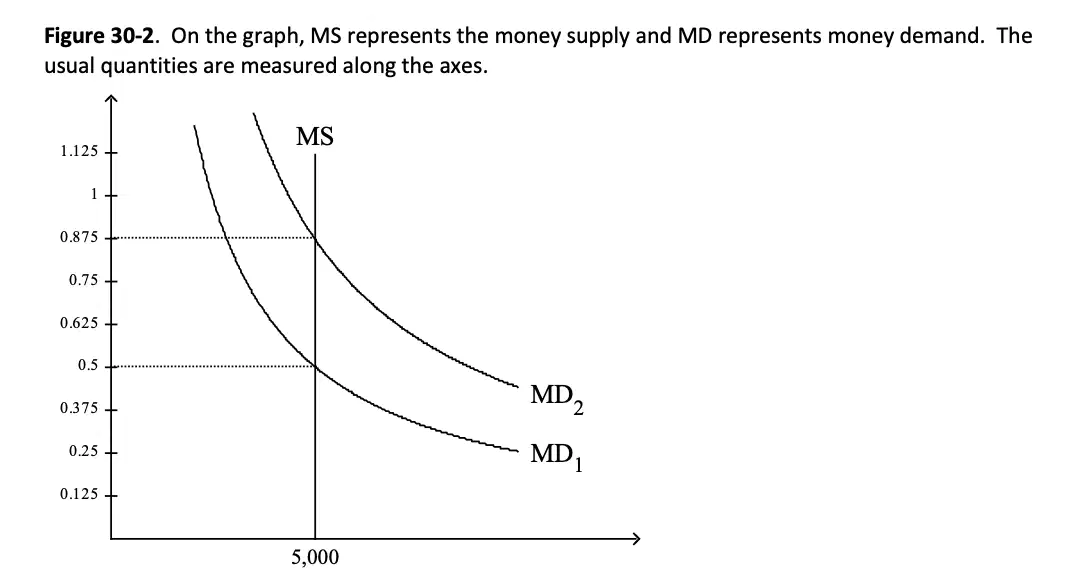
Refer to Figure 30-2. What quantity is measured along the horizontal axis?
the price level
the real interest rate
the value of money
the quantity of money
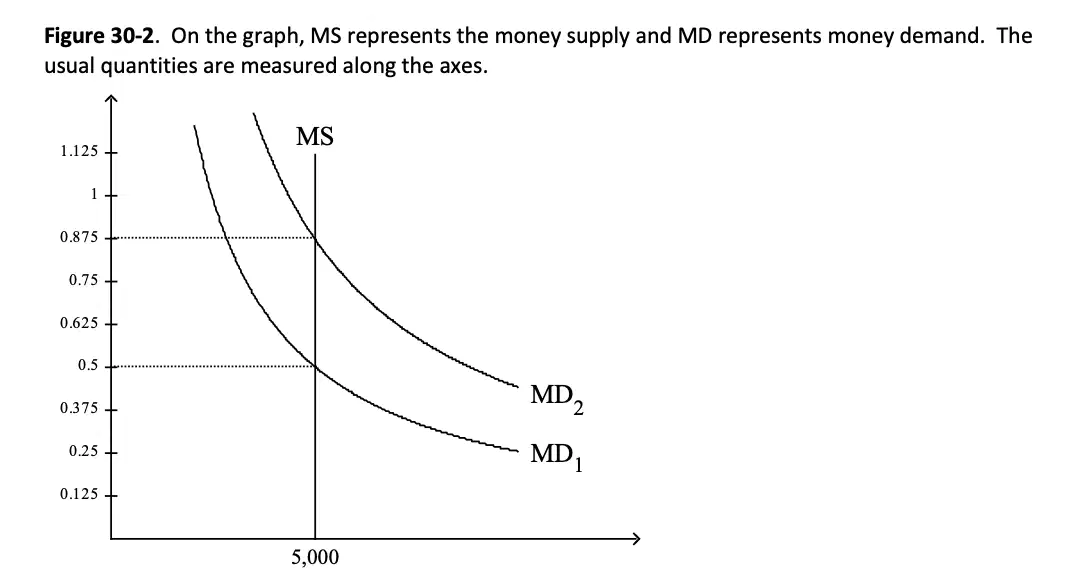
Refer to Figure 30-2. If the relevant money-demand curve is the one labeled MD1, then the equilibrium value of money is
0.5 and the equilibrium price level is 2
2 and the equilibrium price level is 0.5
0.5 and the equilibrium price level cannot be determined from the graph
2 and the equilibrium price level cannot be determined from the graph
Economic variables whose values are measured in monetary units are called
dichotomous variables
nominal variables
classical variables
real variables
Monetary neutrality implies that an increase in the quantity of money will
increase employment
increase the price level
increase the incentive to save
not increase any of the above
Most economists believe that monetary neutrality provides
a good description of both the long run and the short
a good description of neither the long run nor the short run.
a good description of the short run, but not the long run.
a good description of the long run, but not the short run.
Menu costs refers to
resources used by people to maintain lower money holdings when inflation is high.
resources used to price shop during times of high inflation.
the distortion in incentives created by inflation when taxes do not adjust for inflation.
the cost of more frequent price changes induced by higher inflation.

