
 Worksheets
NET1L - Lesson 7 (Ethernet Switching)
Total questions: 75
Worksheet time: 40mins
Also called CAM Table (Content Addressable Memory) Table.
MAC Address Table
Routing Table
IP Address Table

Ethernet operates in the ___________ and the physical layer.
data link layer
network layer
transport layer

It is a family of networking technologies defined in the IEEE 802.2 and 802.3 standards.
Ethernet
WLAN
Wi-Fi
Bluetooth
The 802 LAN/MAN standards, including Ethernet, use two separate sublayers of the data link layer to operate:
LLC Sublayer
MAC Sublayer
IP Sublayer
Places information in the frame to identify which network layer protocol is used for the frame.
(IEEE 802.2)
LLC Sublayer
MAC Sublayer
Responsible for data encapsulation and media access control, and provides data link layer addressing.
(IEEE 802.3, 802.11, or 802.15)
LLC Sublayer
MAC Sublayer
IEEE 802.3 data encapsulation includes the following:
Ethernet frame
Ethernet Addressing
Ethernet Error detection
Ethernet Forwarding
This is the internal structure of the Ethernet frame.
Ethernet frame
Ethernet Addressing
Ethernet Error detection
The Ethernet frame includes both a source and destination MAC address to deliver the Ethernet frame from Ethernet NIC to Ethernet NIC on the same LAN.
Ethernet frame
Ethernet Addressing
Ethernet Error detection
The Ethernet frame includes a frame check sequence (FCS) trailer.
Ethernet frame
Ethernet Addressing
Ethernet Error detection
What is used for error detection in the Ethernet Frame?
- It checks the size of the frame.
FCS (Frame Check Sequence)
(MTU) maximum transmission unit
ECS (Ethernet Check Sequence)
Switches are recommended instead of Hub (they are Dumb Hubs)
True
False
Includes the specifications for different Ethernet communications standards over various types of media including copper and fiber.
IEEE 802.3 MAC sublayer
IEEE 802.3 LLC sublayer
IEEE 802.11 WLAN sublayer
Legacy Ethernet using a bus topology or hubs is a shared, _________ medium.
half-duplex
full-duplex
Ethernet over a half-duplex medium uses a contention-based access method:
Carrier sense multiple access/collision detection (CSMA/CD)
Carrier sense multiple access/collision avoidance (CSMA/CA)
Ethernet LANs of today use switches that operate in full-duplex.
True
False
Full-duplex communications with Ethernet switches require access control through CSMA/CD.
True
False
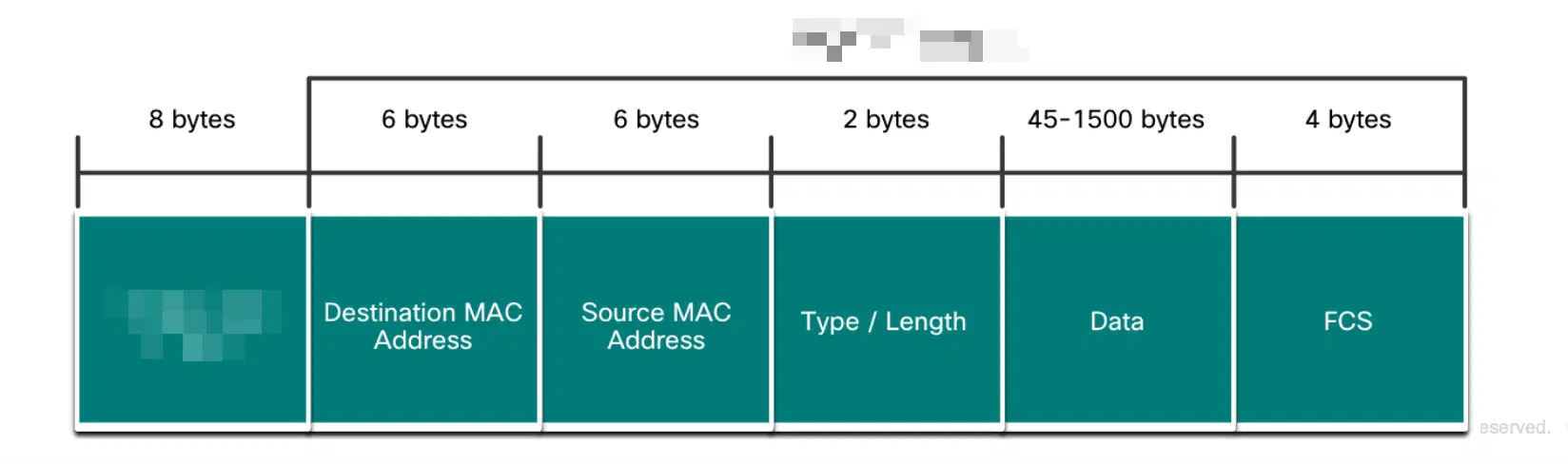
The minimum Ethernet frame size is ____ bytes and the maximum is _____ bytes.
64, 1518
54, 1618
74, 1519
84, 1518
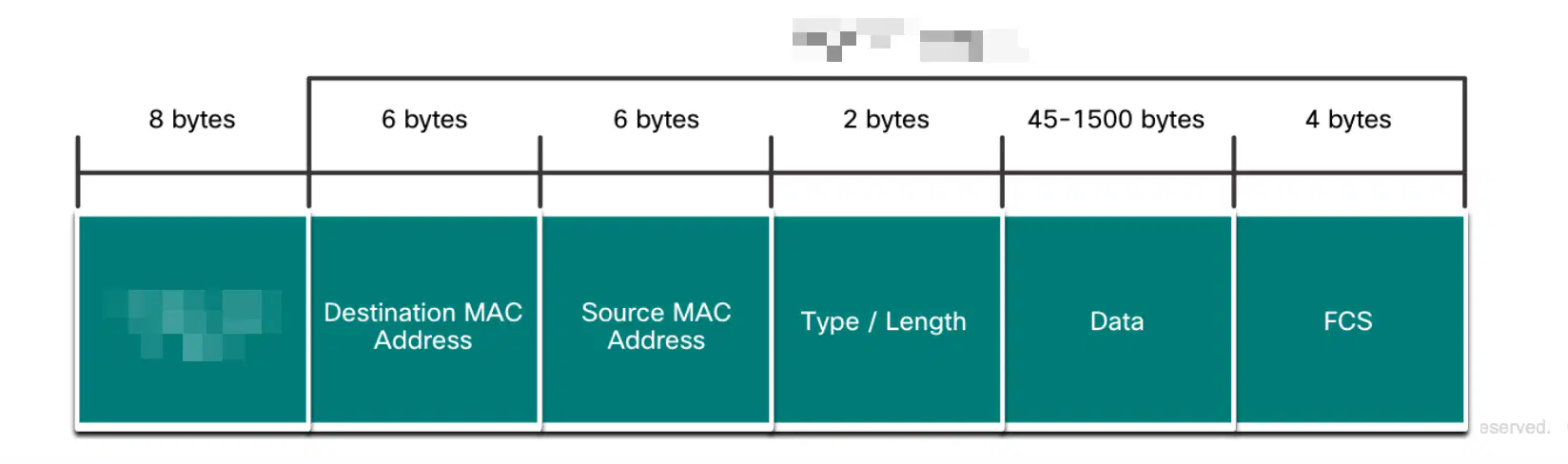
The preamble field is included when describing the size of the frame.
True
False
Any frame less than 64 bytes in length is considered a “_____________” or “_________” and is automatically discarded.
collision fragment
runt frame
jumbo
baby giant frames
Frames with more than 1500 bytes of data are considered “____________” or “________________”.
collision fragment
runt frame
jumbo
baby giant frames
Dropped frames are not likely to be the result of collisions or other unwanted signals.
They are considered valid.
True
False
Jumbo frames are usually supported by most Fast Ethernet and Gigabit Ethernet switches and NICs.
True
False
An Ethernet MAC address consists of a ______ binary value, expressed using ____ hexadecimal values.
48-bit binary
12 hexadecimal
24-bit binary
10 hexadecimal
Given that 8 bytes (one bit) is a common binary grouping, binary 00000000 to 11111111 can be represented in hexadecimal as the range 00 to FF.
11111111 - 255
True
False
When using hexadecimal, leading zeroes are not always displayed to complete the 8-bit representation.
Ex: the binary value 0000 1010 is represented in hexadecimal as 0A.
(1010 is just A, you need to add 0000 1010)
True
False
Hexadecimal numbers are often represented by the value preceded by _______ to distinguish between decimal and hexadecimal values in documentation.
32 - decimal
____32 - hexadecimal
0x
1x
x
Hexadecimal may also be represented by a _______ 16, or the hex number followed by an __ (e.g., 73H - since it is not included in hex values anymore).
subscript
H
superscript
F
In an Ethernet LAN, every network device is connected to the same, shared media.
True
False
MAC addressing provides a method for device identification at the ____________ of the OSI model.
data link layer
network layer
physical layer
An Ethernet MAC address is a 48-bit address expressed using 12 hexadecimal digits. Because a byte equals 8 bits, we can also say that a MAC address is _________ in length.
6 bytes
5 bytes
4 bytes
All MAC addresses must be unique to the Ethernet device or Ethernet interface.
True
False

All MAC addresses must be unique to the Ethernet device or Ethernet interface. To ensure this, all vendors that sell Ethernet devices must register with the IEEE to obtain a unique 6 hexadecimal (i.e., 24-bit or 3-byte) code called the ______________________.
organizationally unique identifier (OUI)
organizationally universal identifier (OUI)
organization unique identity (OUI)
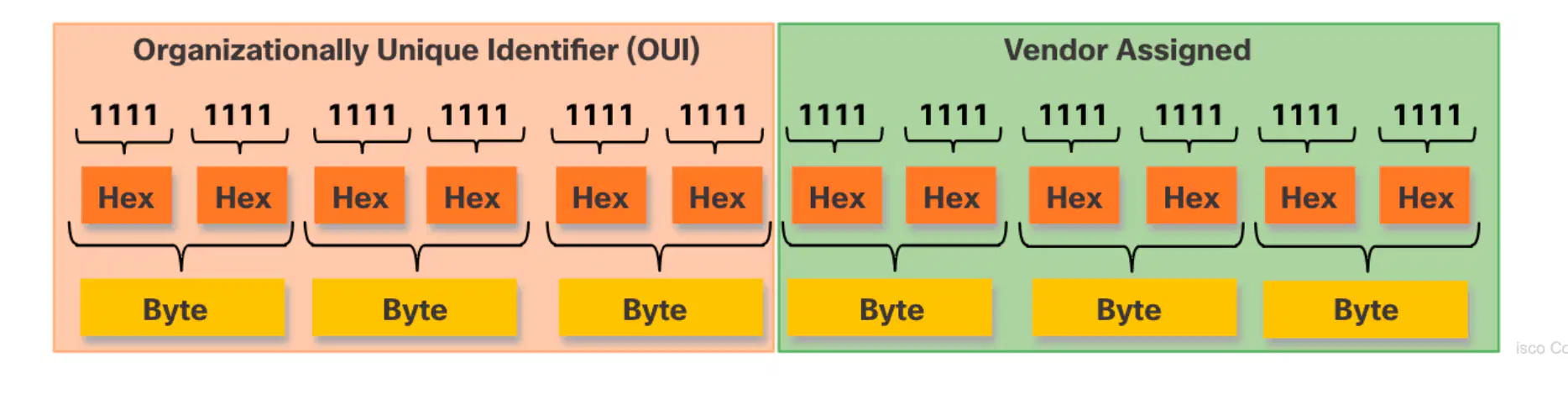
An Ethernet MAC address consists of a ___ hexadecimal vendor OUI code followed by a ____ hexadecimal vendor-assigned value.
6, 6
6, 12
5, 6
6, 7
When a device is forwarding a message to an Ethernet network, the Ethernet header include a __________ address and a __________address.
Source MAC, Destination MAC
Source IP, Destination IP
When a NIC receives an Ethernet frame, it examines the destination MAC address to see if it matches the physical MAC address that is stored in RAM.
If there is a match, the device discards the frame.
If there is no match, it passes the frame up the OSI layers, where the de-encapsulation process takes place.
True
False
Ethernet NICs will also accept frames if the destination MAC address is a broadcast or a multicast group of which the host is a member.
True
False
Any device that is the source or destination of an Ethernet frame, will have an Ethernet NIC and therefore, a ________.
This includes workstations, servers, printers, mobile devices, and routers.
IP Address
MAC Address
__________ - last address in the addressing scheme.
___________ - first address in the addressing scheme.
Broadcast, Default Gateway
Default Gateway, Broadcast
FF:FF:FF:FF:FF:FF (11111111) - Broadcast since its the last address
True
False
There are instances that the Switch doesn’t have any record of a destination MAC address.
What the switch will do is broadcast the frame to all and ask who has this destination MAC Address.
True
False
Is the unique address that is used when a frame is sent from a single transmitting device to a single destination device.
Unicast MAC Address
Multicast MAC Address
Broadcast MAC Address
The process that a source host uses to determine the destination MAC address associated with an IPv4 address.
Address Resolution Protocol (ARP)
Neighbor Discovery (ND)
Internet Protocol (IP)
Transmission Control Protocol (TCP)
The process that a source host uses to determine the destination MAC address associated with an IPv6 address.
Address Resolution Protocol (ARP)
Neighbor Discovery (ND)
Internet Protocol (IP)
Transmission Control Protocol (TCP)
The source MAC address must always be a unicast.
True
False
A Layer 2 Ethernet switch is completely aware of the data (protocol) being carried in the data portion of the frame, such as an IPv4 packet, an ARP message, or an IPv6 ND packet.
The switch makes its forwarding decisions based solely on the Layer 2 Ethernet MAC addresses.
True
False
An Ethernet switch examines its MAC address table to make a forwarding decision for each frame, unlike legacy Ethernet hubs that repeat bits out all ports except the incoming port.
True
False
When a switch is turned on, the MAC address table is empty.
True
False
[MAC Address Population]
If the source MAC address does not exist, it is not added to the table along with the incoming port number.
If the source MAC address does exist, the switch updates the refresh timer for that entry.
True
False
By default, most Ethernet switches keep an entry in the table for 5 minutes.
True
False
[MAC Address Population]
If the destination MAC address is in the table, it will forward the frame out the specified port.
If the destination MAC address is not in the table, the switch will forward the frame out all ports except the incoming port. This is called an unknown unicast.
True
False
As a switch receives frames from different devices, it is able to populate its MAC address table by examining the source MAC address of every frame.
True
False
What are the 2 Frame Forwarding methods (for switching data between network ports)?
Store-and-forward switching
Cut-through switching
Fast-forward switching
Fragment-free
This frame forwarding method receives the entire frame and computes the CRC.
Store-and-forward switching
Cut-through switching
Fast-forward switching
Fragment-free
This frame forwarding method forwards the frame before it is entirely received.
- At a minimum, the destination address of the frame must be read before the frame can be forwarded.
Store-and-forward switching
Cut-through switching
Fast-forward switching
Fragment-free
A big advantage of ____________ is that it determines if a frame has errors before propagating the frame.
- When an error is detected in a frame, the switch discards the frame. Discarding frames with errors reduces the amount of bandwidth consumed by corrupt data.
Store-and-forward switching
Cut-through switching
Fast-forward switching
Fragment-free
__________________ is required for quality of service (QoS) analysis on converged networks where frame classification for traffic prioritization is necessary.
For example, voice over IP (VoIP) data streams need to have priority over web-browsing traffic.
Store-and-forward switching
Cut-through switching
Fast-forward switching
Fragment-free
In _________________, the switch acts upon the data as soon as it is received, even if the transmission is not complete.
Store-and-forward switching
Cut-through switching
Fast-forward switching
Fragment-free
-The switch buffers just enough of the frame to read the destination MAC address so that it can determine to which port it should forward out the data.
- The switch does not perform any error checking on the frame.
Store-and-forward switching
Cut-through switching
Fast-forward switching
Fragment-free
2 variants of cut-through switching:
Store-and-forward switching
Cut-through switching
Fast-forward switching
Fragment-free
Offers the lowest level of latency by immediately forwarding a packet after reading the destination address.
- It is the typical cut-through method of switching.
Store-and-forward switching
Cut-through switching
Fast-forward switching
Fragment-free
Because ________________ starts forwarding before the entire packet has been received, there may be times when packets are relayed with errors.
Store-and-forward switching
Cut-through switching
Fast-forward switching
Fragment-free
A compromise between the high latency and high integrity of store-and-forward switching and the low latency and reduced integrity of fast-forward switching.
Store-and-forward switching
Cut-through switching
Fast-forward switching
Fragment-free
The switch stores and performs an error check on the first 64 bytes of the frame before forwarding.
- Because most network errors and collisions occur during the first 64 bytes, this ensures that a collision has not occurred before forwarding the frame.
Store-and-forward switching
Cut-through switching
Fast-forward switching
Fragment-free
In fragment-free switching, the switch stores and performs an error check on the first _____ bytes of the frame before forwarding
64
32
24
16
2 of the most basic settings on a switch:
bandwidth (speed)
duplex settings
throughput
latency
It is critical that the duplex and bandwidth settings do not match between the switch port and the connected devices.
True
False
There are two types of duplex settings used for communications on an Ethernet network:
Full-duplex
Complete-duplex
Half-duplex
Partial duplex
Both ends of the connection can send and receive simultaneously.
Full-duplex
Complete-duplex
Half-duplex
Partial duplex
Only one end of the connection can send at a time.
Full-duplex
Complete-duplex
Half-duplex
Partial duplex
Is an optional function found on most Ethernet switches and NICs.
It enables two devices to automatically negotiate the best speed and duplex capabilities.
Autonegotiation
Auto-MDIX
In Autonegotiation, the link follows the lowest link speed.
Ex: One switch has 100mbps but the other has 10mbps. (It will follow the 10mbps speed, because the other can adjust)
True
False
Is one of the most common causes of performance issues on 10/100 Mbps Ethernet links.
- It occurs when one port on the link operates at half- duplex while the other port operates at full-duplex.
Duplex mismatch
Duplex lag
Duplex performance
This can occur when one or both ports on a link are reset, and the autonegotiation process does not result in both link partners having the same configuration.
Duplex mismatch
Duplex misconfiguration
Duplex reset
When enabled, the switch automatically detects the type of cable attached to the port and configures the interfaces accordingly.
(Either a crossover or straight-through cable)
Autonegotiation
Auto-MDIX

