wayground logo

Free Printable Worksheets

NEW

Font size

S
M
L
XL
Worksheets

7th Grade Science LEAP Olympics

Total questions: 60

Worksheet time: 1hrs 22mins

Name
Class
Date
1.
When you leave your cold drink outside, the glass may have water drops on it.  This is an example of...
a)
condensation
b)
evaporation
c)
precipitation
d)
estuary
2.
Which form of energy causes water to boil?
a)
sound energy
b)
mechanical energy
c)
thermal energy
d)
light energy
3.
Which change is happening to the water?
a)
it is changing from a liquid to a gas
b)
it is changing from a liquid to a solid
c)
it is changing from a solid to a gas
d)
it is changing from a gas to a liquid
4.
Which process does the diagram show?
a)
freezing
b)
boiling
c)
evaporation
d)
melting
5.

Hot things have ____________ thermal energy than cold things

a)

more

b)

less

c)

same

d)

potato

6.

Cold things often have a _________ kinetic energy because_______

a)

lower; particles are moving around less

b)

lower; particles are moving around more

c)

higher; particles are moving around the same

d)

higher; particles do not move

7.

As temperature increases, molecules _____________

a)

move slower

b)

move the same

c)

move faster

d)

stop moving

8.

Kinetic Energy is the energy of _________

a)

thermal

b)

movement

c)

potential

d)

atoms

9.

Thermal energy is the __________ _________ energy of moving particles

a)

total potential

b)

average potential

c)

average kinetic

d)

total kinetic

10.

Temperature is the __________ _________ energy of moving particles

a)

average potential

b)

average kinetic

c)

total potential

d)

total kinetic

11.

Law of Conservation of Mass says...

a)

Energy is always created and destroyed

b)

Energy is only in hot things

c)

Energy can be destroyed easily

d)

Energy cannot be created or destroyed
12.
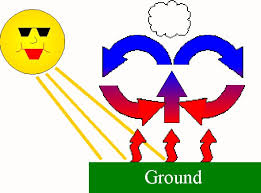
On a cold rainy day a baby is touching a cold window.  It feels so cold. Which way is the heat moving moving? 
a)
Cold is moving from the window to the hand.
b)
Heat is moving from the hand to the window.
c)
Heat doesn't move.
d)
It moves in currents
13.
Warm air rises and the cool air sinks demonstrates this type of heat transfer. 
a)
conduction
b)
convection
c)
radiation
d)
Insolation 
14.
Heat transfer occurs
a)
in many directions
b)
both from warm objects to colder ones and from cold objects to warmer ones.
c)
only from warm objects to colder ones.
d)
only from cold objects to warmer ones.
15.
Which type of image is this? 
a)
Radar
b)
Satellite
c)
Isotherm
d)
Isobar
16.

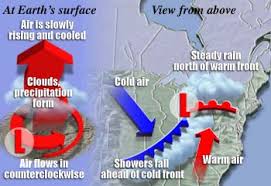
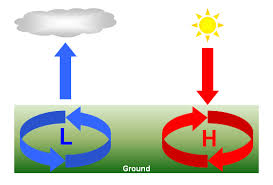
Low pressure is usually associated with what type of weather

a)

clear, fair

b)

cloudy, rainy

c)

bright blue skies

d)

sunshine

17.
Which most likely produces clear, cool weather?
a)
zero air pressure
b)
stable air pressure
c)
a low pressure system
d)
a high pressure system
18.
Which system results in rainy or stormy weather?
a)
high pressure
b)
low pressure
c)
hurricane
d)
weather system
19.
Which system results in drier, fairer weather?
a)
high pressure
b)
low pressure
c)
hurricane
d)
weather system
20.

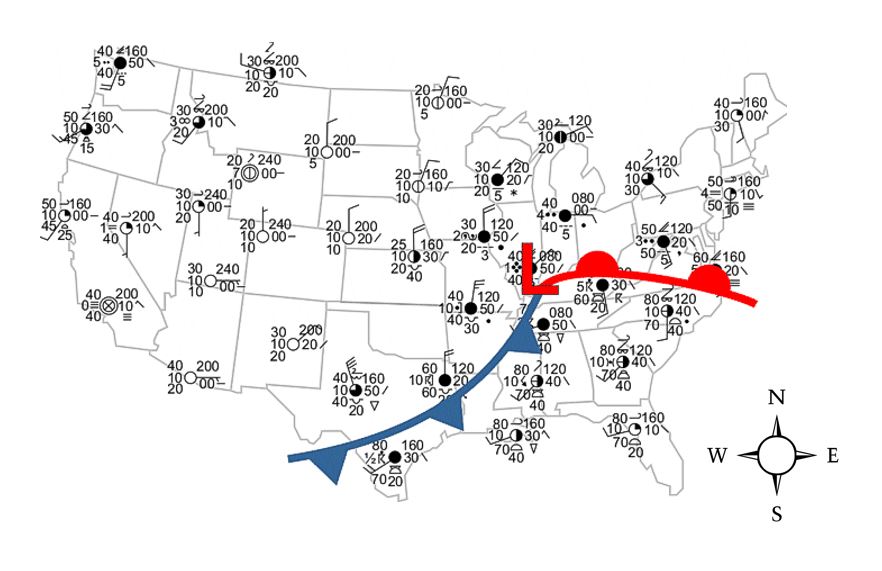
What type of front is moving through North Carolina?

a)

Warm

b)

Cold

c)

Occluded

d)

Stationary

21.

The skies in Houston are...

a)

Cloudy

b)

Clear

c)

Partly Cloudy

22.

What will be the highest temperature in southern California today?

a)

30 F

b)

60 F

c)

70 F

d)

90 F

23.

You have a flight into Atlanta today. What kind of skies can you expect?

a)

Clear

b)

Somewhat Cloudy

c)

Very Cloudy

24.

Describe the cloud cover in Denver

a)

Overcast/Very Cloudy

b)

Partly Cloudy

c)

Clear

25.

What imaginary latitude line divides our world into the northern and southern hemispheres?

a)

equator

b)

international date line

26.

As you move towards the poles, what happens to temperature?

a)

temperature becomes hotter

b)

temperature becomes colder

27.
What type of storm front is this? 
a)
warm front
b)
cold front
c)
stationary front
d)
occluded front
28.
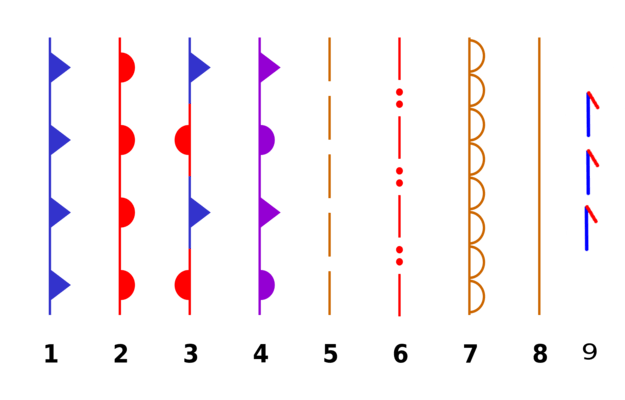
What does symbol # 3 mean?
a)
stationary front
b)
occluded front
c)
warm front
d)
cold front
29.
A front is
a)
where warm air is cooling at earth's surface
b)
a line where hot and cold air are separating
c)
a line where two different air masses meet
d)
where cold air is rising and forming rain clouds
30.
_____________ air is more dense and tends to sink
a)
cold
b)
warm
c)
moist
d)
dry
31.
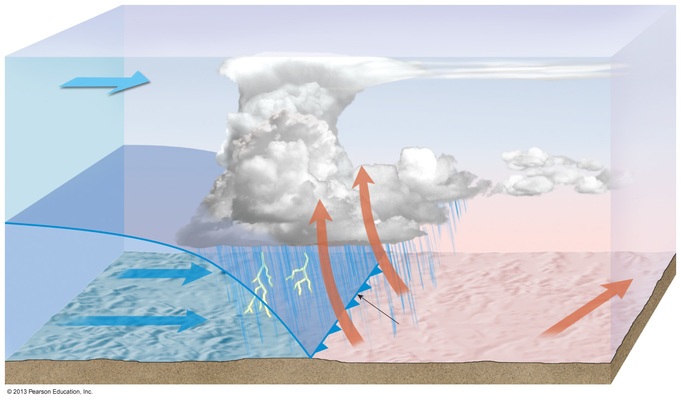
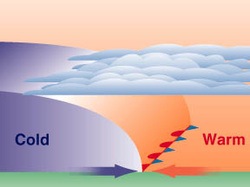
Which type of front is pictured?
a)
Cold front
b)
Warm front
c)
Occluded front
d)
Stationary front
32.
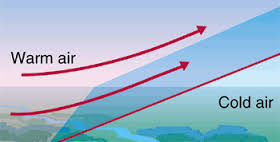
Which type of front is pictured?
a)
Cold front
b)
Warm front
c)
Occluded front
d)
Stationary front
33.
What symbol is this?
a)
warm front
b)
cold front
c)
stationary front
d)
occluded front
34.
When a cold front is approaching, what happens?
a)
warm air is pushing under cold air causing humid weather and lower temperatures
b)
warm air is pushing under cold air causing humid weather and higher temperatures
c)
warm air rises, cools, and causes rain and thunderstorms
d)
cold air is pushed over warm air causing rain and thunderstorms
35.
What direction is the warm front moving on the map? 
a)
North
b)
South
c)
East
d)
West
36.
What direction is the cold front moving on the map? 
a)
Southwest
b)
Northwest
c)
Southeast
d)
Northeast
37.
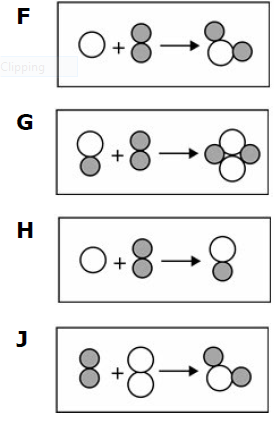
Which of the following models best demonstrates a balanced chemical equation?
a)
F
b)
G
c)
H
d)
J
38.
The reactants are on the left side of the chemical equation.
a)
True
b)
False
39.
Is burning wood a chemical or physical change?
a)
chemical
b)
physical
40.
Is glass breaking a chemical or phyiscal change?
a)
chemical
b)
physical
41.
Is hammering wood together to build a house a chemical or physical change?
a)
chemical
b)
physical
42.
Is a a rusting bicycle a chemical or physical change?
a)
chemcial
b)
physical
43.
Which is an example of a chemical reaction?
a)
paper cut into small pieces
b)
chocolate melting in a pan
c)
flour and sugar mixed in a bowl
d)
cookies baking in an oven
44.
G = green, g = yellow
The genotype for a yellow plant is...
a)
GG
b)
Gg
c)
gg
d)
all of the choices result in yellow
45.
Which of the following alleles is homozygous (purebred) recessive?
a)
Tt
b)
tt
c)
TT
d)
t
46.
Aa, DD, bB, yy are all examples of
a)
genotypes
b)
phenotypes
47.
Which of the following genotypes is homozygous dominant?
a)
A
b)
Aa
c)
AA
d)
aa
48.
Which of the following genotypes is heterozygous?
a)
Bb
b)
BB
c)
bb
d)
B
49.
What you see, or the physical appearance.
a)
Genotype
b)
Phenotype
c)
Homozygous
d)
Heterozygous
50.
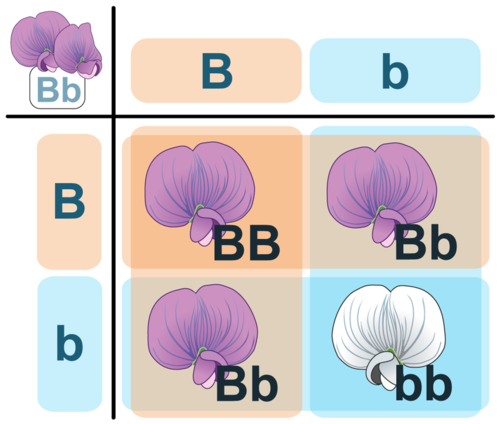
In this punnett square, which is the dominant trait?
The B stands for bud.
a)
purple flower bud
b)
white flower bud
c)
dominant
d)
recessive
51.
W=white hair
w= non-white hair
If you cross a horse with WW and a horse with ww what fraction of the offspring would be expected to have white hair?
a)
none
b)
3/4
c)
1/2
d)
all
52.

What body system takes nutrients and oxygen to and carbon dioxide and waste from the cells?

a)

circulatory system

b)

nervous system

c)

digestive system

d)

respiratory system

53.

What body system breaks down food?

a)

circulatory system

b)

nervous system

c)

digestive system

d)

respiratory system

54.

What body system controls movement of the human body?

a)

circulatory system

b)

nervous system

c)

digestive system

d)

respiratory system

55.

What body system takes oxygen into the body and gives off carbon dioxide?

a)

circulatory system

b)

nervous system

c)

digestive system

d)

respiratory system

56.

The _______ is the basic building block of the human body.

a)

organ

b)

cell

c)

tissue

d)

system

57.
This system provides a framework for the body.
a)
muscular
b)
integumentary
c)
skeletal
d)
excretory
58.
A collection of the same kinds of cells working together to do the same job.
a)
cells
b)
tissues
c)
organs
d)
system
59.
Which of the following is in the correct order from smallest to largest?
a)
tissue-organ-system-cell
b)
cell-organ-tissue-system
c)
System-tissue-cell-organ
d)
cell-tissue-organ-system
60.
How does the cardiovascular system and the respiratory system work together?
a)
The cardiovascular system transports oxygen around the body while the repiratory system gives the body oxygen
b)
The cardiovascular system makes cells while the respiratory system moves them where they are suppose to go.
c)
The cardiovascular system allows the body to have energy while the repiratory system makes cells
d)
The cardiovascular system transports nutrients around the body while the respiratory system brings oxygen into the body