
 Worksheets
Question Bank for Economics
Total questions: 171
Worksheet time: 3hrs 35mins
These is a market situation in which a single supplier makes up an entire industry for a good/service with no close substitutes.
oligopoly
monopoly
market structure
"Perfect Competition" is a type of market structure that happens when there are a lot of buyers and sellers & no single buyer or seller can affect price.
TRUE
FALSE
Supermarkets and Farmers' markets are a couple of examples of a "Perfect Competition"
TRUE
FALSE
When Supply increases, the supply curve shifts to the ______.
RIGHT
LEFT
DOWNWARD
When Demand decreases, the demand curve shifts to the ______.
RIGHT
LEFT
UPWARD
The price at which the quantity demanded by consumers equals the quantity that is supplied by the producers is ______.
Surplus
Equilibrium Price
Shortage
The Circular Flow of Economic Actvity is an economic model that pictures income as flowing continuously between businesses & consumers.
TRUE
FALSE
According to economic theory, which ofd the following situations would cause scarcity of a product?
limited resources and unlimited desires
limited resources and unlimited credit
limited resources and unlimited regulation
limited resources and unlimited choice
Which of these is an example of a natural resource that trucking companing require?
a large garage
a spare engine
a trained driver
a petroleum supply
A new company employee is an example of which kind of productive resouce?
capital resource
human resource
natural resource
entrepreneurial resource
What is a capital resource?
a good available after a production process.
a supply of money to be spent of production
a pool of labor capable of producing goods
a good used as a means of production
Economics is the study of....
Finance
Choice
Business
Purchases
Which of the following IS NOT one of the essential questions of econ?
What to produce
When to produce
How to produce
For whom to produce

What best describes this shift?
Increase in supply
Decrease in supply
Increase in demand
Decrease in demand
Land, labor, and capital are examples of what?
Scarcity of Resources
Opportunity Cost
Macroeconomics
Factors of Production
An opportunity cost of Sharon’s decision to study hard to pass her Economics test would be –
Sharon making her teacher proud
time spent chatting with her friends
receiving an A o the Economics test
Sharon raises her grade in the course

Which of the following would be an accurate conclusion that could be drawn from the image about a free enterprise system?
Multiple businesses give fewer product options.
The government limits economic freedoms and choice.
Competition leads to increased choices for consumers.
All franchises have the same property rights as others

Point X on the production possibilities curve above represents -
over utilization
equilibrium
efficiency
under utilization
Economic recovery begins-
above the trend line
at the end of a recession (trough)
at the "boom" period
below the trend line
Which option presents the business cycle in the correct order
trough, contraction, peak, recovery
trough, expansion, peak, contraction
peak, expansion, trough, recovery
peak, contraction, recovery, trough
An example of a Command Economy would be...
the government has assumed varying degrees of control over the economy in socialist countries
the government controls the economy. The state decides how to use and distribute resources. The government regulates prices and wages
economic decisions are made by individuals
Many economic decisions are made in the market by individuals. But the government also plays a role in the allocation and distribution of resources
An example of a Mixed Economy is...
combines elements of the market and command economy. Many economic decisions are made in the market by individuals. But the government also plays a role in the allocation and distribution of resources.
economic decisions are made by individuals.
a type of command economic system. The government has assumed varying degrees of control over the economy. In some, only major industries have been subjected to government management
the government controls the economy. The state decides how to use and distribute resources.
What type of economy has both command and market characteristics?
Command
Traditional
Mixed
Market
a student who just graduated from college and is waiting to start their new job is...
frictionally unemployed
structurally unemployed
technologically unemployed
cyclically unemployed
seasonally unemployed
a woman who lost her job due to a decrease in sales during a recession in the economy is...
frictionally unemployed
structurally unemployed
technologically unemployed
cyclically unemployed
seasonally unemployed
Farm helpers are unemployed when the cropping season is over.
frictional
cyclical
structural
seasonal
Which type of advantage allows one to specialize?
Absolute advantage
Comparative advantage
The U.S. Federal Reserve System was established to
serve as a source of loans for farmers
provide the nation a safer, flexible, and more stable monetary system
What is the opposite of a surplus?
Excess
Quantity
Quality
Shortage
A Monopoly is
can enter and leave the market as they want
perfect balance of power in a market
companies have issues to enter the market
one company holds all the industry
What is Economics?
The study of how people manage scarce resources
The study of money
The study of how money works
The study of the stock market
What is an owner of a share of company called?
Bondholder
Fundholder
Stockholder
Board of Director
The total value of all final goods and services produced in a country in a given year.
Gross Domestic Product
Consumer Price Index
Inflation
Unemployment
Opportunity cost refers to
the dollar amount attached to a good or service
the value of the next best alternative
the cost of not expanding production
the cost of labor when production is expanded or changed

Which is not an economic system?
Capitalism
Mutualism
Communism
Socialism

Hint: think of the soda market
Fiscal Policy is controlled by...
The Government
The Federal Reserve System
The states
The Department of Commerce
What are the four main parts of the circular flow diagram?
Product Market, Stock Market, Factor Market, Fish Market
Product Market, House Market, Factor Market, Good Market
Factor Market, Product Market, Households, Firms
Factor Market, households, Stock Market, super market

The exchange of money for goods/services to consumers is represented in which part of the circular flow diagram?
1 and 2
3 and 4
5 and 6
7 and 8

The delivery of finished products for sale in exchange for revenue is represented in which arrows?
1 and 2
3 and 4
5 and 6
7 and 8
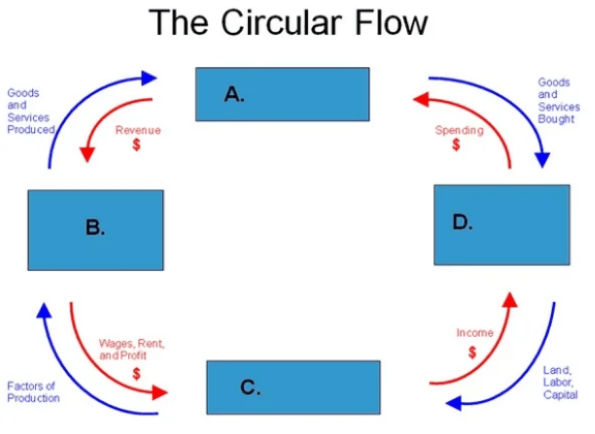
Point B represents
Product Market
Factor Market
Individuals
Businesses

Hint what to you earn from a business?
Taxes
Income
Savings
Investment
Someone buys a car in exchange for a large amount of money. They have completed an exchange in which part of the circuclar flow model?
Product Market
Factor Market
Firms
Individuals

Are you ready for the exam?
yes😥
absolutely yes!😎
A review of the jargon: Is rent control a “price ceiling” or a “price floor?”
price ceiling
price floor
A review of the jargon: Is the minimum wage a “price ceiling” or a “price floor?
price ceiling
price floor

Which river is this?
Huang He River
Nile River
Tigris River
Indus River

Which river is this?
Huang He River
Nile River
Euphrates River
Indus River

Which river is this?
Huang He River
Nile River
Tigris River
Euphrates River

Which rivers are these?
Nile and Euphrates
Tigris and Huang He
Tigris and Euphrates
Indus and Huang He

Which ancient civilization was located along this river?
Mesopotamia
India
China
Egypt

Which ancient civilization was located along this river?
Mesopotamia
Indus
China
Egypt

Which ancient civilization was located along this river?
Mesopotamia
Indus
China
Egypt

Which ancient civilization was started between these two rivers?
Mesopotamia
Indus
China
Egypt
Pharaoh was the title given to the leader of which civilization?
Mesopotamia
Indus
China
Egypt
What form of writing was used by Ancient Egyptians?
sanskrit
oracle bones
cuneiform
hieroglyphics
Which civilization first used plumbing, first to make cloth, and had the cities of Harappa and Mohenjo Daro?
Mesopotamia
Indus
China
Egypt
What was the first published set of laws?
Code of Hammurabi
Code of the Pharaoh
The Ten Commandments
Code of the Oracle Bones

What is this an example of?
sanskrit
hieroglyphics
cuneiform
oracle bones

What is this a picture of?
Egyptian Pyramid
ziggurat
cuneiform
sanskrit

What is this an example of?
Sanskrit
cuneiform
hieroglyphics
oracle bones.
What was a pharaoh know for?
Creating gold towers
Living god and ruler of Egypt,
Fighting wars against the Swedish.
Discovery of the Americas.
A belief in many gods is known as...
Polytheism
Monotheism
Plagiarism
Theocracy
Which ancient civilization was isolated by mountains and desert and was home of the Yellow and Yangzte Rivers.
China
Mesopotamia
Rome
India
Which ancient civilization was home to the major cities of Harappa and Mohenjo-daro, as well as the Indus River
China
India
Egypt
Aztecs
Mesopotamia, India, China, and Egypt all depended on which of the following.
The belief in only one god.
Earthquakes
The flooding of their local rivers.
Strong winds known as Monsoons
Cuneiform, Papyrus, and Sanskrit all deal with what?
Writing
Trade
Transportation
Economics
Which group of people were at the bottom of the social structure in ancient Egypt?
Farmers
Pharaohs
gods
Slaves
The first written code of laws was written by which ruler of ancient Mesopotamia?
Abraham
Darius
Confucius
Hammurabi
A traditional economy mainly appears in ______countries.
rich
poor
any country in the world
In a traditional economy, the goods and services are traded with other countries.
true
false
A combination of all the types of economies
subsistence economy
mixed economy
capitalist economy
traditional economy
Here, the government takes control of the whole economy.
mixed economy
traditional economy
command econmy
capitalist economy
In this type of economy, the freedom of the individual in terms of choices of products, services and prices is given importance.
subsistence economy
command economy
market economy
mixed economy
Economic system based on private ownership of industries and businesses
Free market economy
Mixed Economy
Command Economy
The role of the government is to not restrict/control the economy
Free market economy
Mixed Economy
Command Economy
The government makes all economic decisions about investment, prices, wages, and production levels.
Free market economy
Mixed Economy
Command Economy
All industries/ businesses are owned by the government
Free market economy
Mixed Economy
Command Economy
An economy that includes both government owned and privatized industries.
Free market economy
Mixed Economy
Command Economy

In my country my job is the same one that my family has done over the past 200 years.
Traditional
Command
Market
Mixed

In my country, the government makes all the economic decisions.
Traditional
Command
Market
Mixed

,In my country, the government tells me where to work.
Traditional
Command
Market
Mixed

In my country we have no need for money. By custom, some of us hunt, others farm, and we are all taken care of.
Traditional
Command
Market
Mixed

Your Teacher
No One


The country of North Korea has a dictator that makes almost all of the economic decisions. What type of economy is this?
Traditional
Market
Command
Centrally Planned
The resources used to make all goods & services are called
Natural Resources
Factors of Production
Goods & Services
Renewable Resources
A natural resource is:
Gifts of nature. What the earth makes naturally
Human workers
Man made things that help make a good or service
A person who risks their time and money to start a business
A capital resource is:
Gifts of nature
A person who risks their own time and money to start a business
Money that is left over after paying operating costs
Human-made things that help make a good or service
What is an Entrepreneur?
A person who risks their own time and money to start a business
The money a business makes from selling their goods and services
Revenue
Profit
What is an economic want?
Things people need in order to survive.
Goods/services that people would like to have.
Things people don't want anymore.
Tangible goods that people must have.
Scarcity is defined as a limited supply of resources and...
limited wants for those resources
unlimited resources
limited resources
unlimited wants for available resources
What are all societies forced to do because of scarcity?
Make production decisions
Conserve resources
Limit resource use
Charge large amount of money for available resources
What is the condition that exists when Shoprite runs out of 2% milk?
Scarcity
Shortage
Trouble
Protests by milk-loving shoppers
An action that one provides for someone else is a.... (hint: haircuts, counseling, or babysitting)
Job
Good
Service
Factor of Production
Because of scarcity, people are forced to make _________ about how to use resources.
Choices
Opportunities
Analyses
Investments
A Trade-off is
a purchase in a marketplace.
any/all alternative(s) that we sacrifice when we make a decision.
any good or service a consumer needs.
a factor of production.
What name is given to the value of the next best alternative that you give up when you make a decision? We have referred to this as the "cost of choosing."
Trade-offs
Opportunity cost
Lost opportunities
Options
Which of the following correctly identifies the four Factors of Production?
Food, Shelter, Water, Clothing
Love, Life, Happiness, Success
Land, Labor, Capital, Entrepreneurship
People, Goods, Services, Scarcity
Which of the following best describes "Land" as a factor of production?
The "gifts of nature" or natural resources not created by human effort.
the tools, equipment, and factories used in production of goods and services
people with all their efforts and abilities
individuals who start a new business or bring a product to market.
Which of the following best describes "Capital"?
The "gifts of nature" or natural resources not created by human effort.
people with all their efforts and abilities
the tools, equipment, and factories used in production of goods and services
individuals who start a new business or bring a product to market.
Which of the following best describes "labor"?
people devoting their efforts, knowledge, abilities, and skills to complete a task.
individuals who start a new business or bring a product to market.
the tools, equipment, and factories used in production of goods and services.
The "gifts of nature" or natural resources not created by human effort.
Which best describes an entrepreneur?
people with all their efforts and abilities
A "risk taker" who combines land, labor, & capital to create new jobs markets, products, and/or services
The "gifts of nature" or natural resources not created by human effort.
the tools, equipment, and factories used in production of goods and services

Economics seeks the answer to the basic question of how to deal with ______.
money
hunger
demand
scarcity
New technology advances the rate at which furniture can be assembled. Why does this change the supply?
Change in cost of production
Changes in number of producers
Changes in expectations

Graph shows which of the following?
(actually use this graph to answer the question)
a decrease in demand (shift) and a decrease in quantity supplied
a decrease in demand (shift) and a decrease in supply
a decrease in quantity demanded and a decrease in quantity supplied
a decrease in quantity demanded and a decrease in supply (shift)

Assume the image is showing the market for apples. Which of the headlines could indicate the pictured shift is occurring in the market?
Pesticides on apples linked to mouth cancer.
Storms destroy apple orchards.
An apple a day really does keep the doctor away.
New genetic strain leads to apple trees that produce twice as many apples.

Which of the following is NOT a determinant of the supply of peanut butter?
The price of peanuts
The wages of peanut butter factory workers
The income of peanut butter consumers
Existing peanut butter making technology

Which of the following will cause an increase in demand for snowboards?
More costly production methods
A decrease in the price of lift tickets at resorts in Colorado
A decrease in consumer income
A decrease in the population

What does a “surplus” (extra amount) of goods in a market imply?
Prices are too high
Prices are too low
Supply is too low
Demand is too high

Americans revive their love of SUV’s and the newly remodeled, but still “gas guzzling” Hummer. What happens to the market for gasoline?
Demand for gasoline will decrease
Demand for gasoline will increase
Demand for gasoline will stay the same

In an attempt to increase the production of oil and gasoline, Congress and the President have given the okay to drill in the Alaskan Arctic Preserve. What happens to the market for gasoline?
Supply for gasoline will decrease
Supply for gasoline will increase
Supply for gasoline will stay the same

Which of the following defines "Complementary Goods?"
Goods that can be used to replace the purchase of similar goods when prices rise
Goods that are commonly used with other goods
Goods that are independent of other markets
If only the price for a good or service changes, does the demand curve shift? Why or why not?
Yes, Price shifts the demand curve to the right because less people are being goods
Yes, Price shifts the demand curve to the left because more people are buying goods
No, Because price does not shift the curve. Price stays on the line
No, because price does not impact the points on the curve
Yes and No. The price shifts the curve sometimes, but not always

Which arrows on this diagram would represent the transaction between Joe who rents his office to Homework Inc., a company that provides tutoring services?
2,3
4,7
1,2
5,6
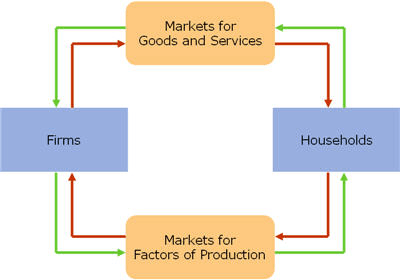
What is being represented by the "red flow line"
The flow of money
The flow of goods and services
Taxes
Productive resources
In the circular flow model, what do individuals sell to the factor market
Services
Money
Productive Resources
goods
The circular flow model of a market economy shows
how profits are made
what inputs are required for what outputs
how many firms can support the needs of how many households
the interactions between households and firms in the free market
In the circular flow model, the product market describes _____.
stores that sell goods and services to households
the government paying for public goods
households selling their labor to businesses
households receive income from businesses
Hint: think of the soda market
Which of the following industries is an example of a monopoly?
utilities/water
department stores
auto industry
commercial airlines
Firms in this kind of market produce goods that are very close substitutes.
Perfect Competition
Pure Monopoly
Monopolistic Competition
Oligopoly
Which of the following is NOT a Market Structure?
Perfect Competition
Oligopoly
Monopoly
Corporation

Using the pizza store graphic, what market structure best fits the pizza industry?
Monopoly
Oligopoly
Perfect competition
Monopolistic competition
Differentiation is _________________.
having identical products.
copying another business.
small differences that make your product unique.
having control of the market value.
Fast food restaurants are an example of _______________. (2 answers)
differentiation.
monopolistic competition.
pure / perfect competition.
monopolies.
The farmers' market is an example of _______________.
a monopoly.
a purely/perfectly competitive market.
an oligopoly.
a monopolistic competition.
Airlines are examples of _________________.
purely / perfectly competitive markets.
monopolies.
oligopolies.
monopolistic competition.

