
 Worksheets
BIO 30_Lec 5_Chemical Basis of Heredity Concepts
Total questions: 26
Worksheet time: 13mins
Name
Class
Date
1.
Chemical composition of Chromosome
a)
Lipids
b)
Proteins
c)
Nucleic Acids
d)
Carhohydrates
e)
Starch
2.
Basic Proteins
a)
Histones
b)
Protamines
c)
Non-histone chromosomal proteins
3.
Acidic Proteins
a)
Histones
b)
Protamines
c)
Non-histone chromosomal proteins
4.
Components of a Nucleotide (DNA monomer)
a)
Phosphate Group
b)
2-Deoxyribose
c)
Nitrogen base
d)
Crarbohydrate
e)
Starch
5.
Component of a nucleotide's nucleoside
a)
Phosphate Group
b)
2-Deoxyribose
c)
Nitrogen base
d)
Crarbohydrate
e)
Starch
6.
Purines
a)
Adenine
b)
Guanine
c)
Thymine
d)
Cytosine
e)
Uracil
7.
Pyrimidines
a)
Adenine
b)
Guanine
c)
Thymine
d)
Cytosine
e)
Uracil
8.
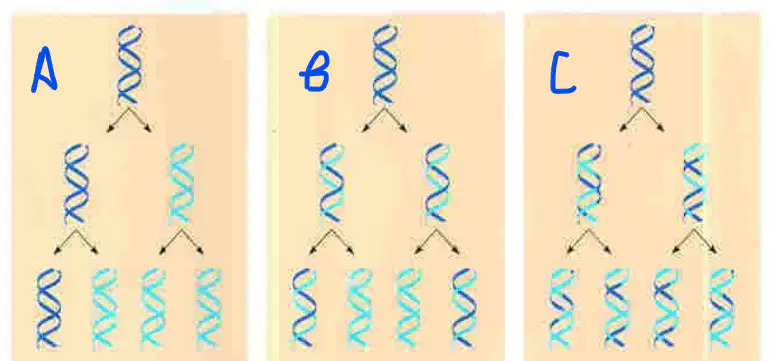
Which models are A, B, and C respectively?
(a)
9.
Site of origin for replication
a)
Ori-site
b)
Helicase
c)
Single-strand binding proteins
d)
DNA Gyrase
e)
Ligase
10.
formation of single stranded DNA templates
a)
Initiation
b)
Elongation
c)
Termination
11.
requires helix and SSBPs
a)
Initiation
b)
Elongation
c)
Termination
12.
Denatures the DNA helix to open it
a)
Ori-site
b)
Helicase
c)
Single-strand binding proteins
d)
DNA Gyrase
e)
Ligase
13.
Binds onto open template to prevent reformation of double helix
a)
Ori-site
b)
Helicase
c)
Single-strand binding proteins
d)
DNA Gyrase
e)
Ligase
14.
relaxes tension at the fork
a)
Ori-site
b)
Helicase
c)
Single-strand binding proteins
d)
DNA Gyrase
e)
Ligase
15.
Adds DNA nucleotide bases in a 5' to 3' direction
a)
DNA Polymerase I
b)
DNA Polymerase II
c)
DNA Polymerase III
d)
DNA Polymerase IV
16.
Provides RNA primers
(a)
17.
short sequences, synthesized discontinuously
(a)
18.
for excision of (RNA) primers and filling in of gaps left by the primers
a)
DNA Polymerase I
b)
DNA Polymerase II
c)
DNA Polymerase III
d)
DNA Polymerase IV
19.
joins the phosphodiester bonds in the lagging strand
a)
Ori-site
b)
Helicase
c)
Single-strand binding proteins
d)
DNA Gyrase
e)
Ligase
20.
two identical DNA molecules are produced at the end of this process
a)
Initiation
b)
Elongation
c)
Termination
21.
Constituent of a REPLISOMEduring Simultaneous synthesis of leading and lagging strands
a)
DNA polymerase III with two catalyctic cores
b)
Helicase
c)
Primase
d)
DNA Polymerase I with two catalyctic cores
22.
Constituent of a PRIMOSOME during Simultaneous synthesis of leading and lagging strands
a)
DNA polymerase III with two catalyctic cores
b)
Helicase
c)
Primase
d)
DNA Polymerase I with two catalyctic cores
23.
Mechanisms of high precision in replication
a)
Specificity of base pairing
b)
Proof reading ability of DNA polymerases
c)
Excision repair mechanism
d)
Relative constancy of DNA in all diploid tissues
e)
Doubling of DNA content at S phase
24.
repair of thymine dimer during excision repair mechanism (excision and filling)
a)
Endonuclease
b)
N Glycosidase activity
c)
Helicase
d)
Ligase
25.
hydrolyzes bond between damaged base and sugar
a)
Endonuclease
b)
N Glycosidase activity
c)
Helicase
d)
Ligase
26.
DNA binding proteins
a)
Hu
b)
H
c)
Ju
d)
J
e)
F
100 %

