
Font size
 Worksheets
Electricity Assessment
Total questions: 31
Worksheet time: 16mins
The charge on a proton is
negative, and the charge on an electron is positive.
positive, and the charge on an electron is negative.
the same as the charge on an electron.
can change according to the situation.
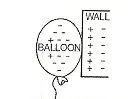
A student has rubbed a balloon on his hair. He holds it 15 centimeters away from the wall and it falls to the floor. He holds it 5 centimeters from the wall and it is attracted to the wall and “sticks” to the wall (as shown below). Which of the following best describes what has happened?
The electrons from his hair transferred to the balloon, causing it to be negatively charged. The positively induced wall attracted the balloon at a small distance.
The electrons from his hair repelled the protons, causing it to be positively charged. The neutral wall attracted the balloon at a small distance.
The protons from his hair transferred to the balloon, causing it to be positively charged. The negatively induced wall attracted the balloon at a small distance.
The protons from his hair repelled the electrons, causing it to be negatively charged. The neutral wall attracted the balloon at a small distance.
The balloon's electric force acting upon the wall
was proportional to the wall's force
decreased at a close distance
was unaffected by distance
increased at a close distance
A static discharge differs from an electric current in that a static discharge_______.
involves the movement of ions as well as electrons
results because a force i exerted on electrons
lasts only for a fraction of a second
is a constant flow of electrons
Static electricity is particularly fun in the winter when wool hats are worn more regularly. Which of the following correctly explains the static electricity occurring after wearing a wool hat?
The protons from hair are transferred to the wool cap, making the hair attracted to the air around it once the hat is removed
The electrons from hair are transferred to the wool cap, making the hair positively charged, Therefore, the hairs repel each other and move as far away from each other as possible.
The wool cap accumulates the protons and leaves the hair electrically negative.
The wool cap transfers its electrons to the hair making the hair electrically positive.

1
2
3
4
Describe the changes to the magnitude of a force when the distance between charges increases. The magnitude
is unaffected by distance
will decrease
will increase
Coulomb’s law describes the:
magnitude of the electrostatic charge between two electric charges
magnitude of the electrostatic force between two electric charges
force of electrostatic charge between two warm bodies
distance between two electrostatic charges
Suppose you acquire a positive charge from walking across a carpet. You then touch a doorknob and receive a shock. This leaves you
positively charged
negatively charged
uncharged
electrically neutral

The diagram above represents the electric field in the region of two small charged spheres, A and B. What is the sign of the net charge on A and B?
A is positive and B is positive
A is positive and B is negative
A is negative and B is negative
A is negative and B is positive

Two identically-sized metal spheres, A and B, are on insulating stands, as shown in the diagram above. Sphere A possesses an excess of 6.3 × 10¹⁰ electrons and sphere B is neutral. Which diagram best represents the charge distribution on sphere B?
1
2
3
4
What happens when a rubber rod is rubbed with a piece of fur, giving it a negative charge?
Protons are removed from the rod
Electrons are transferred to the rod
Electrons are transferred to the fur.
The fur is left neutral
Electric charge is ________________.
found only in a conductor
always conserved
found only in insulators
not always conserved

In the diagram shown above, the circles represent small balls that have electric charges. Ball 1 has a negative charge, and ball 2 is repelled by ball 1. Next, you see that ball 2 repels ball 3 and that ball 3 attracts ball 4. What is the electric charge on ball 4?
Ball 4 may have either a positive or negative charge
Ball 4 has a negative charge
Ball 4 has a positive charge
It is not possible to determine the charge on ball 4
Which sentence best describes electrical conductors?
Electrical conductors have ow mass density
Electrical conductors have high tensile strength
Electrical conductors have electric charges that move freely
Electrical conductors are poor heat conductors

The figure shown above demonstrates charging by
grounding
induction
polarization
contact
What occurs when two charges are moved closer together?
The electric field doubles
Coulomb's law takes effect
The total charge increases
The force between the charges increases
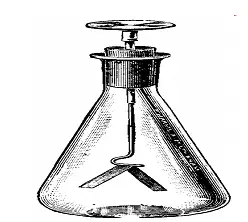
If the leaves of an electroscope spread apart, as shown in the diagram above, it indicates that ____.
the leaves of the electroscope are neutral
the leaves of the electroscope have received a charge
no charge is moving through the electroscope
there is static electricity in the electroscope
Electric current is _______________________________.
the protons moving through the wire from the outlet.
the protons moving through the wire from a battery
the electrons moving through the circuit from a power source
a and b above
In a series circuit with three bulbs, adding another bulb will
make the nearest bulb brighter
make some of the bulbs dimmer
make all the bulbs brighter
make all the bulbs dimmer
In a parallel circuit with three bulbs,
the bulbs must all be located on the same branch
there is only one path for the current to take.
current from each bulb has its own path
the overall resistance increases if a new branch is added
In an electric circuit, the voltage is supplied by the ______________, the resistance is the _____________.
battery, outlet
outlet, battery
power source, appliance
lightbulb, wire
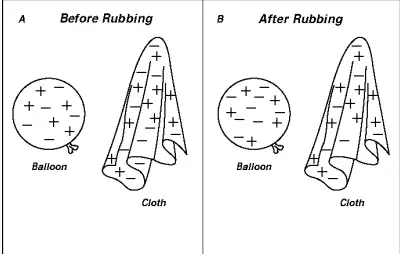
What is the overall charge of the balloon and the cloth in Diagram A?
balloon positive, cloth negative
both are neutral
balloon negative, cloth positive
both are negative
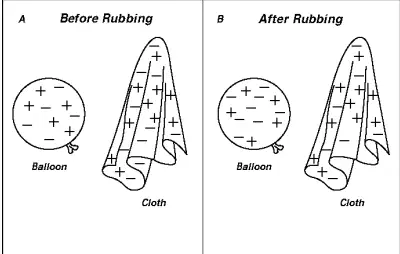
What has rubbing the balloon on the cloth done to the charges on the objects shown in diagrams A and B above?
moved electrons from the balloon to the cloth, causing the balloon to be positive and the cloth to be negative
Moved protons from the cloth to the balloon, causing the balloon to be positive and the cloth negative
Moved electrons from the cloth to the balloon, causing the balloon to be negative and the cloth to be positive
moved protons from the balloon to the cloth, causing both to be positive
In an electric circuit, the electricity flows from ______________to ___________.
high voltage areas to low voltage areas
low voltage areas to high voltage areas
batteries to wires
wires to batteries
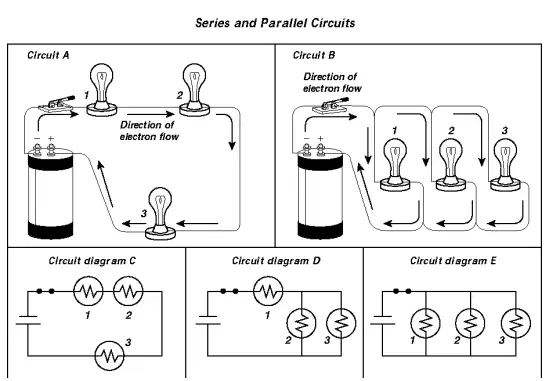
Which diagram(s) show parallel circuits?
all of them
A and B
B, D, and E
B and E
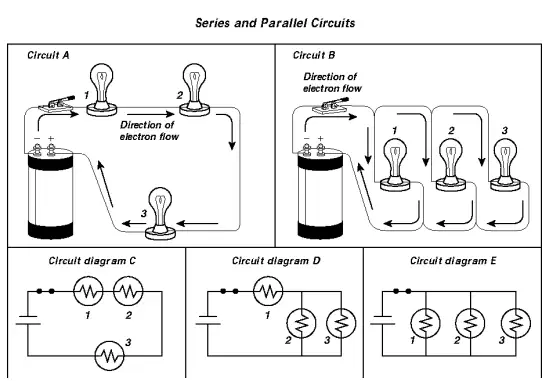
What will happen to bulb 2 and 3 in the circuit diagram D if bulb 1 burns out?
They will both stay lit
They will both go out
Bulb 2 will go out, but bulb 3 will stay lit
Bulb 3 will go out, but bulb 2 will stay lit
What is the potential difference across a 5.0 ohm resistor that carries a current of 5.0 A?
V=I* R
100 V
25 V
10.0 V
1.0 V
A flashlight bulb with a potential difference of 4.5 V across it has a resistance of 8.0 ohm. How much current is in the bulb filament? I = V/R
36 A
9.4 A
1.8 A
0.56 A
If an electric water heater uses 40 kW of power and runs for 8 hours, what is the total amount of energy used?
E = P * t
5 kilowatt-hours
32 kilowatt-hours
48 kilowatt-hours
320 kilowatt-hours
What is the cost for running a 1500 watt for 2 hours a day in a 30 day month, if the electricity cost is 0.17/kw-hr? Show your work under each portion below.
watts/1000= kilowatts kilowatts *hour=kilowatt-hours cost=kwhr *0.17
(a)

