
NEW
Font size
 Worksheets
HJH CIVICS 2023 SEMESTER BENCHMARK EXAM
Total questions: 53
Worksheet time: 2hrs 23mins
Which statement describes Thomas Paine's most important contribution to the American Revolution?
Paine's mlitary tactics caused the British to lose important battles.
Paine's pamphlets motivated colonial soldiers to continue fighting for freedom
Paine's speeches encouraged colonial leaders to embrace religious tolerance.
Paine's political arguments convinced the French to support colonial freedom.

SS.7.C.2.1
The diagram above shows the requirements for becoming a naturalized citizen.
Which statement completes the diagram?
Pay federal income tax
Have an annual income of $20,000 or more
Have resided in the United States for five years
Have a close relative (parent, spouse or child) who is a U.S. citizen
SS.7.C.2.2
Which practice is part of the obligation of a U.S. citizen to help defend the nation?
serve on a jury
register for Selective Service
vote in all national elections
keep informed about national issues
SS.7.CG.2.2
The list below identifies several activities.
-Attending a school board meeting
-Voting in a primary election
-Helping on a phone bank for a mayoral candidate
-Putting a candidate's sign in your yard
-Registering voters at a community college
What do these activities illustrate?
ways that citizens can run for political office
opportunities for citizens to participate in national elections
opportunities for citizens to influence political action committees
ways in which citizens actively participate in the political process

SS.7.C.2.2
The document above was part of a summons to perform an important civic duty.
Why is it important for citizens to meet the obligation requested in this document?
to guarantee our right to confront witnesses
to preserve constitutional limits on governmental power
to guarantee our right to be judged by a jury of our peers
to protect our right to petition for a writ of habeas corpus
Which is a constitutional means of obtaining U.S. citizenship?
paying US income tax
being born in the United States
buying real estate in the United States
agreeing to obey the laws of the United States

SS.7.C.2.1
The photograph above shows an accomplishment of Ms. Ester Tua Caballa.
What are three of the requirements she had to fulfill for this accomplishment?
reside in the United States for five years; be of "good character"; pass a U.S. history test
be of "good character"; pass a test of general knowledge; have a high school diploma
be of "good character"; enter the United States lawfully; earn more than $20,000 annually
reside in the United States for five years; enter the United States lawfully; serve in the armed forces
The founders established a representative form of government.
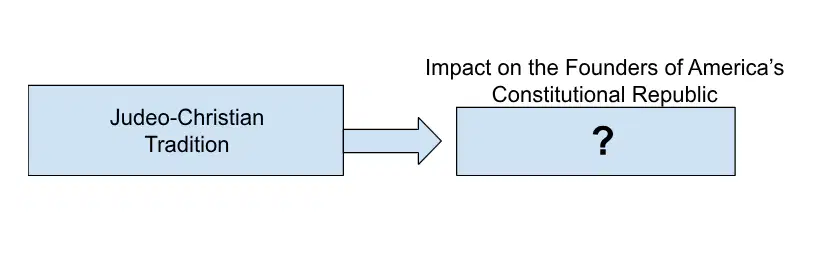
The diagram shows the impact of an important tradition.
Which phrase completes the diagram?
Voting Rights
Republicanism
Separation of powers
Ethical ideas of justice
SS.7.C.1.3
Which timeline shows English policies towards the American colonists in correct chronological order?
Townshend Act - Quartering of troops - Stamp Act - Tea Act
Quartering of troops - Townshend Act - Intolerable Acts - Tea Act
Stamp Act - Quartering of troops - Tea Act - Intolerable Acts
Stamp Act - Townshend Act - Tea Act - Quartering of troops

SS.7.C.1.3
What was the main purpose of the tar-and-feathering shown in this British caricature of the colonists?
to protest their being taxed without their consent
to protest the high cost of British manufactured goods
to protest British involvement in the French and Indian war
to protest the quartering of troops in colonists' own homes

SS.7.C.1.3
Use the diagram above to answer Questions 3 and 4.
What was the impact of the continued fighting between British troops and the Continental Army in Massachusetts and New York in 1775 and 1776?
Point 1
Point 2
Point 3
Point 4

SS.7.C.1.3
What was the impact of the passage of the Stamp Act by the British Parliament in 1765?
Point 1
Point 2
Point 3
Point 4
SS.7.C.1.4
Which colonial leader introduced the ideas of John Locke's "social contract" theory into the Declaration of Independence?
John Hancock
Thomas Paine
James Madison
Thomas Jefferson
SS.7.C.1.4
Which work publicized the concept of "natural rights," later found in the Declaration of Independence?
Magna Carta
the English Bill of Rights
the Mayflower Compact
John Locke's Two Treatises of Government
SS.7.C.1.1
According to John Locke, which agreement did individuals enter into to form their own society?
constitution
social contract
Mayflower Compact
English Bill of Rights
SS.7.C.1.1
According to John Locke, which rights were guaranteed by natural law?
trial by jury and no cruel punishments
freedom of speech and of the press
life, liberty and property
freedom of worship and the right to petition

SS.7.C.1.2
The statement above is from Magna Carta (1215).
Which right was guaranteed in this excerpt?
trial by jury
no taxation without representation
freedom of the press
freedom of religion
SS.7.C.1.1
Which thinker introduced the idea of a separation of powers for effective government?
John Locke
Baron de Montesquieu
Thomas Paine
Thomas Jefferson
Which example illustrates Montesquieu's idea of separation of powers?
Citizens of the United States choose many of their public officials in elections.
The state government of Florida has a governor, state legislature and state court system.
Individual rights to life, liberty and property are guaranteed by natural law.
People have the right to overthrow an unjust government.

SS.7.C.1.2
The diagram above indicates that the colonists based some of their political views on historic documents.
Which phrase completes the diagram?
Natural law
Separation of powers
Divine Right of Kings
Guarantee of certain individual rights

SS.7.C.1.2
The statements above are from three of the first amendments to the U.S. Constitution.
Which earlier document contained similar rights?
Magna Carta (1215)
The Mayflower Compact (1620)
The English Bill of Rights (1689)
Montesquieu's Spirit of the Laws (1784)
SS.7.C.1.3
What was the main purpose of the tar-and-feathering shown in this British caricature of the colonists?
to protest their being taxed without their consent
to protest the high cost of British manufactured goods
to protest British involvement in the French and Indian war
to protest the quartering of troops in colonists' own homes
SS.7.C.1.3
Use the diagram above to answer Questions 3 and 4.
What was the impact of the continued fighting between British troops and the Continental Army in Massachusetts and New York in 1775 and 1776?
Point 1
Point 2
Point 3
Point 4
SS.7.C.1.3
What was the impact of the passage of the Stamp Act by the British Parliament in 1765?
Point 1
Point 2
Point 3
Point 4
SS.7.C.1.4
Which colonial leader introduced the ideas of John Locke's "social contract" theory into the Declaration of Independence?
John Hancock
Thomas Paine
James Madison
Thomas Jefferson
Which complaint against King George III was stated in the Declaration of Independence?
He had quartered his troops among the colonists.
He had forced the colonists to accept the practice of slavery.
He had required the colonists to trade with French merchants.
He had failed to defend the colonists in the French and Indian war.
SS.7.C.1.4
The passage below comes from the Declaration of Independence.
"We hold these truths to be self-evident, that all men are created equal, that they are endowed by their Creator with certain unalienable Rights, that among these are Life, Liberty and the pursuit of Happiness. That to secure these rights, Governments are instituted among Men, deriving their just powers from the consent of the governed."
According to this passage, what is the principal role of government?
To promote greater social equality
To protect the natural rights of citizens
To glorify the ruler in the eyes of the Creator
To help individuals cooperate against the forces of nature
SS.7.C.1.5
How did Americans' experience under British rule influence the form of government they established under the Articles of Confederation?
The new legislature had two houses, just like the British Parliament.
The states were Sovereign, just as the colonies had been under British rule.
The new central government was not given any power to direct the military.
The new central government was not able to tax citizens as the British government had tried to do.
How did the U.S. Constitution solve a problem created by a
weakness of the Articles of Confederation?
It stopped the federal government from imposing taxes.
It gave the national government the power to raise an army.
It required unanimous consent of the states to pass amendments.
It prevented acts of piracy against American ships off the coast of Africa.

SS.7.C.3.3
Above are two opposing views expressed at the Constitutional Convention.
How was the disagreement between small states and large states resolved at the Constitutional Convention?
Each state can decide how its own representation in Congress is determined.
Representation in both our federal and state legislatures is based on population.
A Bill of Rights was added to the Constitution to protect individual rights.
States have equal representation in one house of Congress and representation based on their population size in the other.
SS.7.CG.1.8
Why did the Preamble at the Constitution begin with the phrase, "We the People?"
To indicate that the national government had limited powers.
To indicate that the states had been associated in a confederation
To indicate that federal power was separated among three branches
To indicate that the American people were the ultimate source of its authority
SS.7.CG.1.8
Which identifies one of the goals of government listed in the Preamble?
To guarantee employment to all citizens
To expand the nation's frontiers westward
To establish independence from Great Britain
To protect the rights and freedoms of all citizens

SS.7.CG.1.9
The chart shows the organization of the government of the US, based on the Constitution. Which constitutional principle is illustrated by the chart?
individual rights
due process of law
checks and balances
separation of powers
SS.7.CG.1.9
When the President nominates an individual to serve as Secretary of State, the Senate must confirm the appointment. Which constitutional principle does this illustrate?
checks and balances
separation of powers
popular sovereignty
due process of law
SS.7.CG.1.9
The list below provides 3 examples of actions by the US government:
>the President meets with the Prime Minister of the United Kingdom.
>The Supreme Court applies an existing law to a new situation.
>Congress passes a new environmental law.
Which constitutional principle do these examples illustrate?
Limited government
Separation of powers
Checks and balances
Popular sovereignty
SS.7.CG.1.9
Which example illustrates the principle of checks and balances?
The Supreme Court interprets a federal law.
The president vetoes legislation proposed by Congress.
The president confers with the members of the Cabinet.
A case between citizens from different states is tried in a federal court.

SS.7.CG.3.3
The 4 individuals described in the table are thinking of running for the office of US Senator from Florida. Which of these candidates is qualified to become a US Senator?
Joe Black
Juan Fuentes
Roberto Mendez
Marisol Sanchez
SS.7.CG.3.3
Which is NOT an example of a delegated power?
regulation of trade
power to declare war
regulation of immigration
power to create a national bank
SS.7.CG.3.3
Which is an enumerated power of Congress?
the power to tax exports
the power to declare war
the power to issue hunting licenses
the power to operate public school districts

SS.7.CG.3.3
The diagram shows details about the US Government. Which branch of government completes the diagram?
The Senate
The Cabinet
The Supreme Court
The House of Representatives
SS.7.CG.3.7
Why do most of the bills introduced in Congress never become law?
They are defeated in floor votes.
They never get out of committee.
They are vetoed by the President.
They are overruled by the US Supreme Court
SS.7.CG.2.7
Which individual could qualify as a candidate for President of the United States?
Max is 67 years old; he has lived in Ontario, Canada for all of his life; he was born in Detroit.
Martha is 45 years old; she has lived in Chicago for the last 18 years; she was born in Tampa.
Samuel is 27 years old; he has lived in New York City for the past 3 years; he was born in Israel of American parents.
Karen is 42 years old; she has lived in Boston for the last 26 years; she was born in Ireland of Irish parents.
SS.7.CG.3.3
Which constitutional power provides the basis for the President's
day-to-day control of U.S. foreign relations?
the power to appoint and receive Ambassadors
the power to appoint Justices of the Supreme Court
the power to inform Congress of the "State of the Union"
the power to summon Congress in times of national emergency
SS.7.CG.1.9
The War Powers Act of 1973 restricted the powers of the President as Commander in Chief.
Which principle of constitutional government did passage of this law illustrate?
federalism
limited government
checks and balances
separation of powers
SS.7.CG.3.3
Which power does the Constitution give to the President to check Congress?
the power to appoint heads of departments
the power to veto proposed legislation
the power to pardon offenders for federal crimes
the power to inform Congress of the "State of the Union"
SS.7.CG.3.3
During the 1976 Presidential campaign, Jimmy Carter promised to pardon draft evaders from the Vietnam War to help heal the wounds of the war. Shortly after he was elected, President Carter pardoned about 100,000 draft
dodgers. How was he able to pardon so many at once?
He was exercising his implied powers as President.
He was exercising his customary powers as President.
He was exercising his emergency powers as President.
He was exercising his expressed powers as President.

SS.7.C.3.3
The diagram above shows details about the United States government.
Which phrase completes the diagram?
Presidential powers as Commander in Chief
Presidential powers as Head of State
Presidential powers in relation to Congress
Presidential powers as Chief Executive Officer
SS.7.C.3.8
Which governmental body conducts a trial to decide if the President of the United States should be removed from office for "treason, bribery, or other high crimes and misdemeanors?"
Senate
Cabinet
Supreme Court
House of Representatives

