wayground logo

Free Printable Worksheets

Font size

S
M
L
XL
Worksheets

TRMS Evolution

Total questions: 116

Worksheet time: 3hrs 6mins

Name
Class
Date
1.

Change over time is

a)

evolution

b)

generation

c)

growth

d)

biogenesis

2.
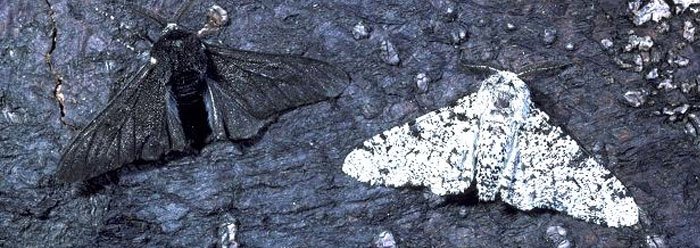
The term that best describes why the moth population changed color over time
a)
adaptation
b)
natural selection
c)
mutation
d)
predator-prey
3.
Why did the population of moths change
a)
Predators were able to easily see their prey.
b)
People hunted lighter colored moths
c)
White moths were killed by the smoke from the factories
d)
Moths mood changed to sad, causing them to become dark
4.

What caused the soot to cover the trees in Great Britain from 1780 to 1830?

a)

burning coal

b)

setting fires

c)

black wind

d)

dead moths

5.
Why did the population of peppered moths in England change from light to dark after the Industrial Revolution?
a)
Light moths were easy to see against sooty trees and were eaten
b)
Light moths were killed by soot
c)
The birds that ate the dark moths were killed by soot
d)
Dark moths were produced by industrial processes
6.
The term that best describes  "the better adapted organisms survive to pass traits along to offspring".
a)
Evolution
b)
Natural Selection
c)
Extinction
d)
Artifical Selection
7.

Which statement best describes the process of evolution?

a)

Populations can survive in different locations on earth

b)

Environmental conditions limit the number of species on Earth

c)

Populations grow when resources are abundant

d)

The traits of a species can change over time
8.
Why are advantageous traits more likely to be passed onto offspring?
a)
Because they are more likely to survive and reproduce.
b)
Because they come from dominant alleles.
c)
Because they come from recessive alleles.
d)
Because the trait is an acquired phenotype.
9.
Natural selection is when ____________ decides who survives and who doesn't
a)
nature
b)
humans
c)
animals
d)
years
10.
The trees these moths used to live on were white, but have been covered in soot from coal factories. Which moth will be more successful in this environment?
a)
Dark moth
b)
Light moth
c)
Both will be equally successful
d)
Neither will be successful
11.
Which best describes mutations?
a)
Always helpful
b)
Always harmful
c)
Can be helpful or harmful
d)
Always neutral
12.
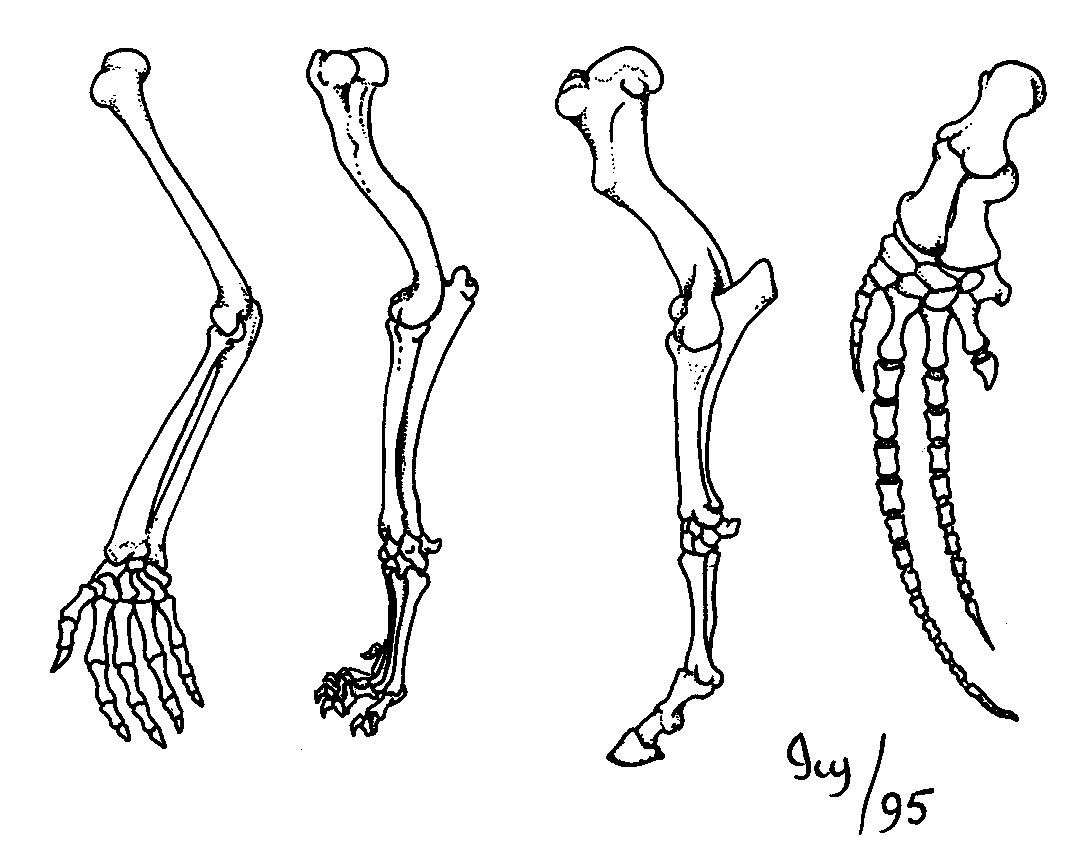
Structures with the same parts have different functions; suggests that organisms share a common ancestry
a)
vestigial structures
b)
homologous structures
c)
adaptive radiation
d)
fossil
13.
Study of embryos of various organisms to show a common ancestor because of similarities in development
a)
natural selection
b)
embryology
c)
speciation
d)
evolution
14.
The diagram shows fossils in different rock layers. Which of these statements about the age of these fossils is most likely correct?
a)
Fossil A and C are the same age
b)
Fossil B is older than fossil C
c)
Fossils A is older than fossil B
d)
Fossil D is older than fossil C
15.
What does Darwin's theory of evolution suggest?
a)
species change over time
b)
extinct species are not related to living species
c)
different species can interbreed
d)
animals that look alike are most closely related
16.
What type of structures are these?
a)
homologous
b)
vestigial 
c)
analogous
d)
fossil
17.
Which of these best represents a time period in which an organism could evolve?
a)
5 days
b)
100 years
c)
10,000 years
d)
2 decades
18.

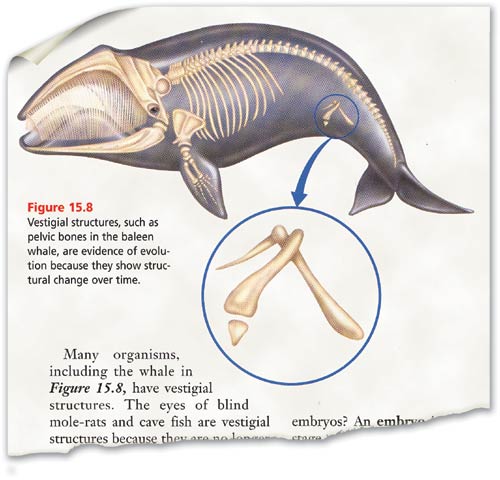
Whales are aquatic mammals that contain a pelvis (hip) bone. Even though it does not aid in its movement, the function must have been used by a common ancestor of the whale. Thus, the pelvis is referred to as a(n)

a)

vestigial structure

b)

analogous structure

c)

homologous structure

19.
A theory has significant evidence to support it.  True or False
a)
True
b)
False
20.
Genetic differences between organisms of the same species
a)
Variation
b)
Adaptation
c)
Behavior
d)
Environment
21.
The difference in the physical traits of an individual from those of other individuals in a group is called a(n)
a)
change
b)
adaption
c)
species
d)
variation
22.
The long and sharp beak of a woodpecker is an example of:
a)
Natural Selection
b)
Selective Breeding
23.
An error in DNA copying that results in a new trait
a)
Homeostasis
b)
Mutation
c)
Natural Selection
d)
Selective Breeding
24.

Natural selection results in change in a population's _____________ traits over time.

a)

inherited

b)

acquired

25.

A phenotype that improves an organism’s chance of survival in their environment is considered a(n) ____________.

a)

natural selection

b)

adaption

c)

speciation

26.

Which of the following is NOT an example of natural selection?

a)

People selectively breeding hamsters for size.

b)

Insect populations developing resistance to certain pesticides.

c)

Bacteria becoming resistant to antibiotics.

d)

Male birds of certain species inheriting colorful feathers that are more attractive to females.

27.

Eyes that can see in the dark is a(an) _______ inherited by nocturnal animals.

a)

adaptation

b)

acquired trait

c)

learned ability

28.

The forelimbs of mammals have similar anatomy because these groups descended from a recent common ancestor. Their bone structure is an example of a(n) ______________ structure.

a)

vestigial

b)

analogous

c)

homologous

29.

Many different groups of organisms have wings, even though they do not share a recent common ancestor. This is because they evolved in environments with similar selective pressures. Wings are an example of a(n) ______________ structure.

a)

vestigial

b)

analogous

c)

homologous

30.

Which does NOT cause genetic variation?

a)

crossing over in meiosis

b)

mutations

c)

traits acquired during lifetime

31.

An organism can develop new variations during its lifetime in order to survive in their environment. These acquired traits can be passed on.

a)

True

b)

False

32.

Which best describes the phrase survival of the fittest?

a)

strongest in a population are most successful

b)

fastest in a population are most successful

c)

those that can survive and reproduce are most successful

d)

those that can live the longest are most successful

33.
What does Darwin's theory of evolution suggest?
a)
species change over time
b)
extinct species are not related to living species
c)
different species can interbreed
d)
animals that look alike are most closely related
34.
What do we call similar physical structures that indicate a link to a common ancestor?
a)
absolute dating
b)
adaptations
c)
gradualism
d)
homologous structures
35.
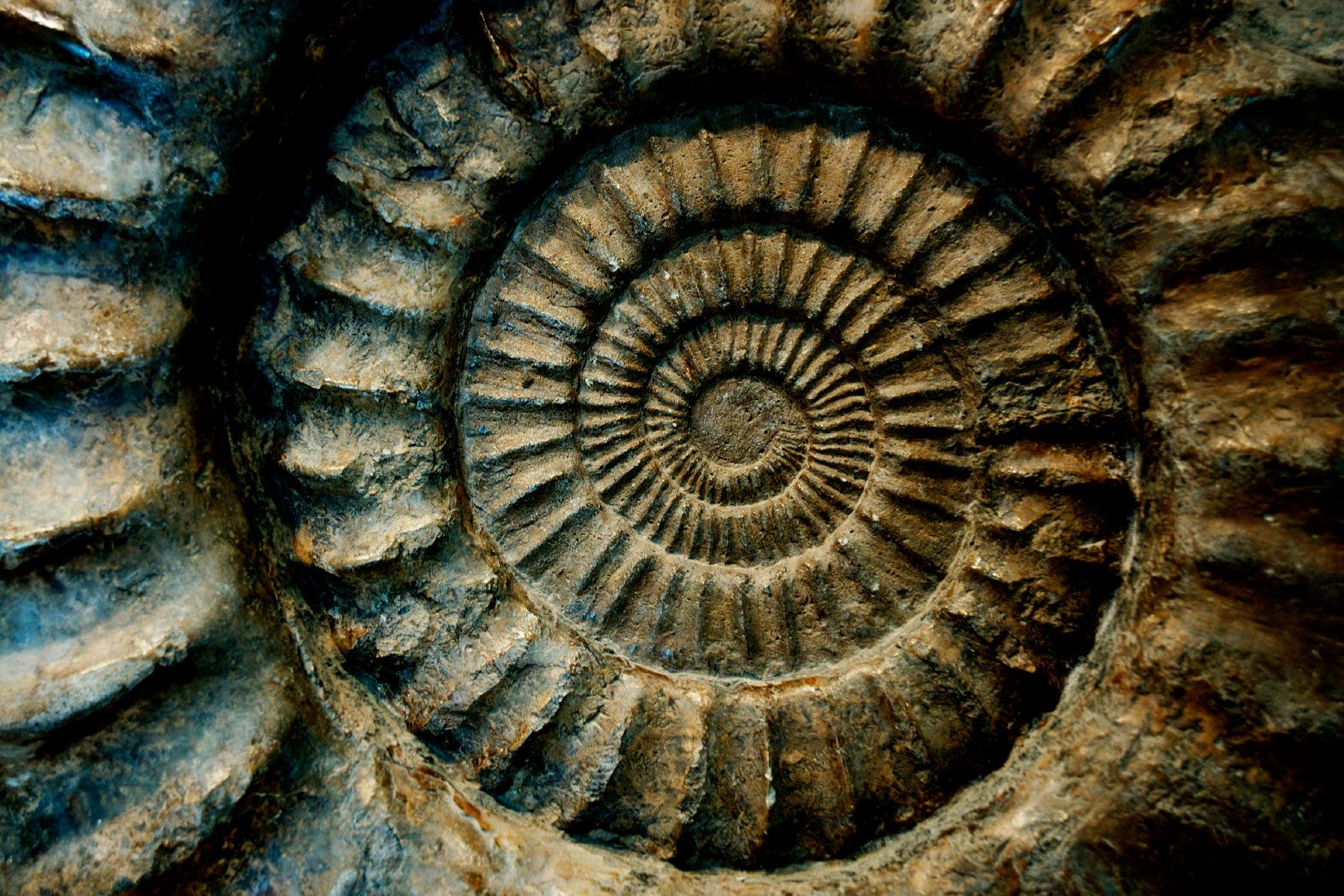
The preserved remains or physical evidence of an organism that lived in the past are called...
a)
evolutionary features
b)
fossils
c)
mutations
d)
variations
36.
What does this picture model?
a)
DNA structure of the horse
b)
Evolution of the horse
c)
Extinction of the horse
d)
Singular traite of the horse
37.
What most likely caused the finches on the Galapagos Islands to have beaks that were differnt from the finches living on the South American mainland?
a)
They were different types of food available on the island.
b)
The finches on the islands had to drink salt water.
c)
There were different types of predators living on the island.
d)
The finches on the mainland built different types of nests.
38.
Which beneficial variation would be most helpful in a desert environment?
a)
white fur
b)
claws for burrowing
c)
grean and black camouflage
d)
flippers
39.
Which would NOT be considered a fossil?
a)
bones buried deep in the earth
b)
footprints harened in  mud or rocks
c)
imprints left in rocks
d)
stories passed down from generation to generation
40.
What is it called when an organism is best adapted to its environment, it will survive and reproduce more successfully than other organisms less adapted?
a)
cloning
b)
evolution of all species
c)
natural selection
d)
selective breeding
41.

Which scientist visited the Galapagos Islands and came up with the theory of natural selection?

a)

Theodor Schwann

b)

Gregor Mendel

c)

Charles Darwin

d)

Rudolf Virchow

42.

Gigantopithecus were very large primates that lived 500,000 years ago. Since none of these mammals are still today, they are said to be....

a)

Extinct

b)

Threatened

c)

Endangered

d)

Declining

43.

Scientists have collected millions of fossils of different organisms, and have developed a timeline of life on Earth. What do we call this?

a)

Mutation

b)

Natural Selection

c)

The theory of evolution

d)

Fossil Record

44.

A physical or behavioral trait that helps an organism survive and reproduce in its environment is called a what?

a)

An adaptation

b)

A response to a stimulus

c)

A mutation

d)

Evolution

45.

When looking at two birds of the same species, you notice that one has darker feathers than the other one. You also notice that one has a beak that is just a little longer. These slight differences within members of the same species are called.....

a)

Fossils

b)

Extinction

c)

Meiosis

d)

Variations

46.

What do we call a change in a species over time?

a)

Adaptation

b)

Evolution

c)

Extinction

d)

Environmental influences

47.
This scientist came up with the idea of natural selection.
a)
Jean Baptiste Lamarck
b)
Gregor Mendel
c)
Charles Darwin
d)
Thomas Malthus
48.
Inherited trait that helps an organism survive is a(n) __________.
a)
Fossil
b)
Adaptation
c)
Ancestor
d)
Natural selection
49.
Which of the following is an example of a vestigial structure?
a)
the wings of a red-tailed hawk
b)
the hind limbs of a house cat
c)
the fins of sharks
d)
the tailbone of a human
50.

What do we call a change in a species over time?

a)

Adaptation

b)

Evolution

c)

Extinction

d)

Environmental influences

51.
Why do embryologist study embryos?
a)
to see if they are related
b)
to understand adaptations
c)
to determine the age
d)
to learn what parents are vestigial
52.
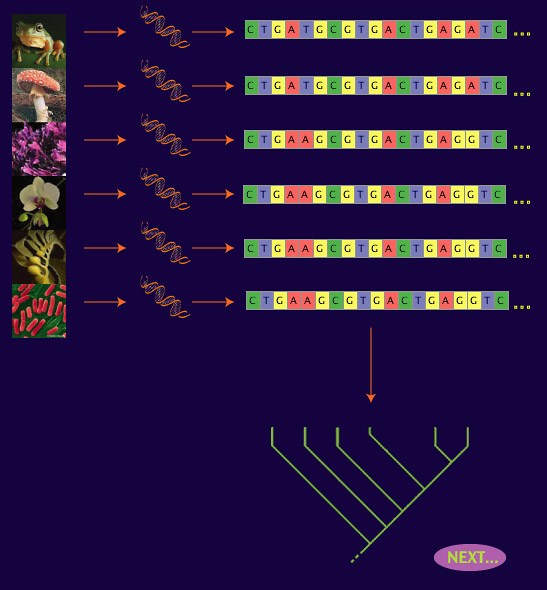
Two organisms that are closely related would have
a)
very similar DNA sequence
b)
exactly the same DNA sequences
c)
no proteins in common
d)
completely different DNA sequence
53.
Comparing human hemoglobin of chimpanzees, horses, kangaroos, and chickens, reveal that humans have the fewest amino acid differences with 
a)
Kangaroos
b)
Horses
c)
chickens
d)
chimpanzees
54.
All the individuals of a species that live in a particular area are called a
a)
variation
b)
population
c)
fossil
d)
group
55.
Which layer is oldest?
a)
A
b)
W
c)
G
d)
Z
56.
According to the law of superposition, which layer is the youngest?
a)
A
b)
B
c)
C
57.
The disappearance of a species.
a)
Evolution
b)
Extinction
c)
Migration
d)
Mutation
58.
Who hypothesized that human populations are kept in check by war, famine, and disease?
a)
Darwin
b)
Hutton
c)
Malthus
d)
Lamarck
59.
These are natural differences within a species.
a)
Evolution
b)
Genetic variation
c)
Biological diversity
d)
Populations
60.
This is an inherited trait that helps an organism survive and reproduce in its environment.
a)
Evolution
b)
Population
c)
Environment
d)
Adaptation
61.
This is an ecological relationship in which two or more organisms depend on the same limited resource.
a)
Adaptation
b)
Competition
c)
Evolution
d)
Natural selection
62.
The death of every member of a species.
a)
Competition
b)
Population
c)
Extinction
d)
Evidence
63.
This is the trace or remains of an organism that lived long ago, most commonly preserved in sedimentary rock.
a)
Competiton
b)
Extinction
c)
Evidence
d)
Fossil
64.

How do we measure the age of a fossil in years?

a)

variation

b)

absolute dating

c)

selection

d)

mutation

65.

What do you call similar structures that related species have inherited from a common ancestor?

a)

Natural Selection

b)

Analogous Structure

c)

Vestigial Structure

d)

Homologous Structure

66.

What do we call structures that no longer perform their original function?

a)

Natural Selection

b)

Analogous Structure

c)

Vestigial Structure

d)

Homologous Structure

67.

What do you call a characteristic that allows an organism to survive in an environment?

a)

variation

b)

adaptation

c)

selection

d)

overproduction

68.

Beak shape, camouflage, and webbed feet are all examples of which type of adaptation?

a)

Behavioral Adaptation

b)

Physical Adaptation

69.

Select ALL that show evidence of evolution.

a)

DNA

b)

mutations

c)

fossils

d)

skeletal structures

70.
What is the advantage of having different shaped beaks?
a)
To look different from other species.
b)
To be able to eat the food readily available in the environment.
c)
To protect itself against predators.
d)
To protect itself against prey.
71.
Genetic differences between organisms of the same species
a)
Variation
b)
Adaptation
c)
Behavior
d)
Environment
72.
Some organisms that share a common ancestor have features that have different functions, but similar structures.  These are known as
a)
vestigial structures
b)
analogous structures
c)
homologous structures
d)
fossil structures
73.
A fossil of an extinct dinosaur is found and the anatomy of the fossil shows similarities to that of a bird. What could this mean?
a)
This is purely by chance and isn't significant
b)
The extinct dinosaur and modern bird share a common ancestor
c)
All dinosaurs evolved into birds and that's why there aren't any dinosaurs alive today
d)
Dinosaurs choose to fly, and evolved into birds to escape predation and capture food
74.
Which of the following are examples of evidence for evolution?
a)
Fossils and Cellular Structure
b)
Biological Structures 
c)
Genetics/DNA
d)
All of the Above
75.
True or False?
Generations of a species that are farther apart from each other look the most different.
a)
True
b)
False
76.

Birds are eating all the green beetles. Because the brown beetles are surviving they reproduce more and make more brown beetles. This is called ___________

a)

Artificial Selection

b)

The Theory on the Origin of Species

c)

Natural Selection

d)

Mutation

77.

Darwin wrote that the organisms best suited to their environments will .....

a)

Increase in Number

b)

Go Extinct

c)

Mutate More often

78.

Which trait did Darwin pay most attention to about the finches in the galapagos islands?

a)

Their Feathers

b)

Their Horns

c)

Their Size

d)

Their Beak Shape

79.

Why could the same species of moth be two different colors?

a)

Their color was based on their DNA. Sometimes a mutation would cause the moth to be born with a different color.

b)

Their color was caused by the environment. The soot from the factories would fuse with the moth's skin.

c)

Bacteria inside the moth's stomach would sometimes give the moth stomach the ability of the moth to have "active camouflouge." This allowed the moths to change their color at will.

80.

If scientists find fossils of a type of mosquito on the bottom layer and find fossils of beetles towards the top layer, what can scientists infer?

a)

Mosquitos ate the beetles

b)

Mosquitos are older fossils than beetles

c)

Beetles are older fossils than mosquitos

d)

Both mosquitos and Beetles must have lived at the same time.

81.

When scientists compare fossils to see about old they are in a certian environment, this is called ____________

a)

Comparing

b)

Absolute Dating

c)

Relative Dating

d)

Comparative Dating

82.

Darwin's ship was called ________

a)

HMS Bugle

b)

HMS Beetle

c)

HMS Asparagus

d)

HMS Beagle

83.

When we examine this whale fossil, we can see that the whale has a pelvic bone that doesn't seem to be used by the whale. What do scientists infer?

a)

The whale had an ancestor with legs

b)

The whale must use the pelvis for an unknown reason

c)

The whale was born with an extra bone and has a disorder

d)

The whale had an ancestor with wings

84.

Why are homologous structures important to the theory of evolution?

a)

Scientists use them as evidence that many species must have had a common ancestor.

b)

Scientists use them as evidence that many species must have independently evolved and are not related to other species.

c)

Scientists use them as evidence to show that all kinds of structures in our bodies work to help us survive.

85.

Why are vestigial structures evidence for evolution?

a)

They are useful in the organism and show natural selection at work.

b)

They are not useful in the organism but they were probably useful in some ancestor of that species.

c)

They show that these organs or behaviors help an organism adapt to new environments

86.

How do scientists use embryology to support the theory of evolution?

a)

Embryos of many species have a lot of similar characteristics when they are first forming showing different creatures must have a common ancestor

b)

Embryos of many species have very little in common until they start developing for long periods of time

c)

Features like gills and tails prove that all animals are really just fish

87.

A trait or change in lifestyle that helps a plant or animal survive in its environment

a)

adaptation

b)

evolution

c)

homologous

d)

vestigial

88.

Shows how different groups of organisms have changed over time.

a)

fossil record

b)

homologous structures

c)

embryology

89.

Parts of the body that are similar to other species because they have a common ancestor

a)

fossil record

b)

homologous structures

c)

embryology

90.

Scientist that contributed the most to our understanding of evolution

a)

Darwin

b)

Lamarck

91.

The more offspring an organism has the greater the odds that a few of them will survive, reproduce and pass on those traits

a)

overproduction

b)

variation

c)

selection

d)

adaptation

92.

Organisms from the same species can vary in…

1) physical appearance

2) genetic makeup

a)

overproduction

b)

variation

c)

selection

d)

adaptation

93.

a trait that gives an organism an advantage in their particular environment

a)

overproduction

b)

adaptation

c)

selection

d)

variation

94.
Mutations are important because they bring about
a)
death of the organism in which they develop
b)
genetic variation needed for a population to evolve
c)
benefits for the individual, not for the population
d)
Hardey-Weinberg equilibrium within a population
95.
The gradual change in species over time is...
a)
Evolution
b)
Nucleotide 
c)
Adaptation
d)
Natural Selection
96.
What is another name for natural selection?
a)
survival of the smartest
b)
survival of the fastest
c)
survival of the biggest
d)
survival of the fittest
97.
This is the trace or remains of an organism that lived long ago, most commonly preserved in sedimentary rock.
a)
Competiton
b)
Extinction
c)
Evidence
d)
Fossil
98.
What would indicate that a series of fossils represent evolution?
a)
the fossils were identical
b)
the fossils were found in the same layers of rock
c)
the fossils show similarities
d)
the fossils were completely different
99.
The tree of life is a metaphor for what idea?
a)
we came from a common ancestor
b)
we need water and sunlight to survive
c)
we have multiple species
d)
we are old
100.

Adaptations are:

a)

physical or behavioral tendencies.

b)

physical or behavioral characteristics that help an organisms survive and reproduce.

c)

physical or behavioral characteristics that do not help the organism in any way.

d)

genetic mutations that have gone wrong.

101.
Another word for adapt is ____________.
a)
change
b)
create
102.
Which term refers to the process by which individuals that are better suited to the environment survive and reproduce therefore passing down their genes to their offspring? 
a)
Evolution 
b)
Variation 
c)
Adaptation
d)
Natural Selection 
103.
Darwin's expedition took how many years?
a)
3
b)
4
c)
5
d)
6
104.
Darwin's expedition was called the Voyage of the _________.
a)
Titanic
b)
Beagle
105.
What is the advantage of having different shaped beaks?
a)
To look different from other species.
b)
To be able to eat the food readily available in the environment.
c)
To protect itself against predators.
d)
To protect itself against prey.
106.
A remnant or trace of an organism from the past is called a _______.
a)
Ancestor
b)
Skeleton
c)
Fossil
d)
Imprints
107.
Why don't all living things become fossils?
a)
because some living things are too big
b)
because some are subject to catastrophism and others are not
c)

because environmental conditions have to be just right (for formation & to prevent decay)
108.
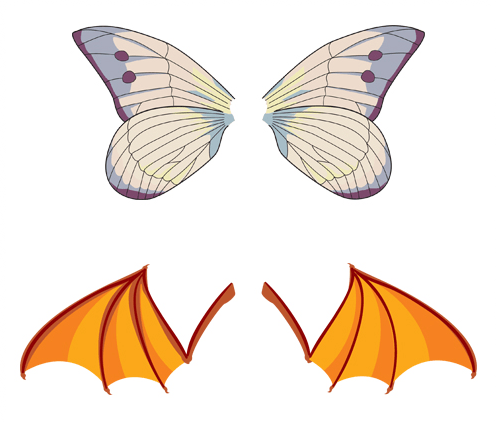
Bird wings and butterfly wings are an example of
a)
Homologous structure
b)
Analogous structure
c)
Camaflouge
d)
Mimicry
109.

A mistake or change that occurs in the DNA sequence is called a ______________________.

a)

Extinction

b)

Speciation

c)

Mutation

d)

Genetic Variation

110.
Vertebrate embryos pass through similar stages of development is evidence for
a)
use and disuse
b)
homologous structures
c)
common ancestry
d)
acquired characteristics
111.
Individuals that are well adapted to their environment will survive and produce
a)
better traits
b)
stronger genes
c)
more offspring
d)
fewer mutations
112.
Which of the following is a fossil?
a)
a plant that has recently died
b)
a group of organisms that can reproduce
c)
a structure or organ that no longer functions
d)
a trace of an organisms that existed in the past
113.
what did Charles Darwin observe in finch populations of the Galapagos Islands off the coast of South America?
a)
different species on different islands
b)
all species on one of the islands
c)
identical species on all the islands
d)
the same species as North America
114.
The disappearance of a species.
a)
Evolution
b)
Extinction
c)
Migration
d)
Mutation
115.
This image shows that 
a)
These animals have no simliarities in their structures. 
b)
two different species may have evolved from a common ancestor. 
c)
These animals are from the same species. 
d)
These animals likely evolved from different ancestors due to their differences. 
116.
There are three species of birds on an island.  Bird A has a heavy bill for eating seeds.  Bird B has a pointed bill for eating insects.  Bird C has a sharp bill for eating both insects and seeds.  If all insects on the island suddenly disappeared, which bird or birds would be the LEAST affected? 
a)
Bird A
b)
Bird B
c)
Bird C
d)
Bird A and Bird B