
 Worksheets
Section 4 - Solubility: Review Quiz (Quizizz)
Total questions: 101
Worksheet time: 1hrs 13mins
Calcium oxide, CaO, also known as lime, is an important industrial chemical. Lime can be obtained by the heating of limestone, which is mainly calcium carbonate, CaCO3. An equation representing the reaction for the production of lime is shown below.
CaCO3(s) + heat → CaO(s) + CO2(g)
State the solubility of limestone in water.
soluble
insoluble
Based on Table F, which 10.-gram sample, when thoroughly mixed with 1 liter of water at room temperature, forms a heterogeneous mixture?
ammonium chloride, NH4Cl
potassium iodide, KI
silver bromide, AgBr
sodium nitrate, NaNO3

Water, H2O, and hexane, C6H14, are commonly used as laboratory solvents because they have different physical properties and are able to dissolve different types of solutes. Some physical properties of water and hexane are listed on the table below.
Explain, in terms of the molecular polarity, why hexane is nearly insoluble in water.
Hexane is (a) and water is (b) .
Which statement describes a mixture of sand and water at room temperature?
It is heterogeneous, and its components are in the same phase.
It is heterogeneous, and its components are in different phases.
It is homogeneous, and its components are in the same phase.
It is homogeneous, and its components are in different phases.

A bottled water label lists the ions dissolved in the water. The table below lists the mass of some ions dissolved in a 500.-gram sample of the bottled water.
Based on Table F, write the formula of the ion in the bottled water table that would form the least soluble compound when combined with the sulfate ion.
Ca+2
Mg+2
Na+
HCO3-

Some compounds of silver are listed with their chemical formulas in the table below.
Identify the silver compound in the table that is most soluble in water.
silver carbonate
silver chlorate
silver chloride
silver sulfate
Based on Table F, which equation represents a saturated solution having the lowest concentration of Cl– ions?
NaCl(s) ⇌ Na+(aq) + Cl–(aq)
AgCl(s) ⇌ Ag+(aq) + Cl–(aq)
NH4Cl(s) ⇌ NH4+(aq) + Cl–(aq)
KCl(s) ⇌ K+(aq) + Cl–(aq)
According to Table F, which substance is most soluble in water?
AgCl
CaCO3
Na2CO3
SrSO4
The elements in Group 17 are called halogens. The word “halogen” is derived from Greek and means “salt former.”
Based on Table F, identify one ion that reacts with iodide ions in an aqueous solution to form an insoluble compound.
Zn+2
Pb+2
Na+
K+
Based on Table F, which compound is least soluble in water?
AlPO4
Li2SO4
Ca(OH)2
AgC2H3O2

In an investigation, aqueous solutions are prepared by completely dissolving a different amount of NaCl(s) in each of four beakers containing 100.00 grams of H2O() at room temperature. Each solution is heated and the temperature at which boiling occurred is measured. The data are recorded in the table below.
Identify the solute and the solvent used in this investigation.
(a) is the solvent. (b) is the solute.
Which substance is most soluble in water?
(NH4)3PO4
Cu(OH)2
Ag2SO4
CaCO3
Hydrazine, N2H4, is a compound that is very soluble in water and has a boiling point of 113°C at standard pressure. Unlike water, hydrazine is very reactive and is sometimes used as a fuel for small rockets. One hydrazine reaction producing gaseous products is represented by the balanced equation below.
N2H4() → N2(g) + 2H2(g) + heat
Explain, in terms of molecular polarity, why N2H4 is very soluble in water.
Hydrazine and water are both (a) .

Two organic compounds, geraniol and linalool, can be represented by the molecular formula C10H18O. Geraniol has an odor similar to the scent of roses and linalool has an odor similar to the scent of citrus fruits. Both compounds are nearly insoluble in water. The structural formulas of geraniol and linalool are shown below.
Explain, in terms of molecular polarity, why geraniol and linalool are nearly insoluble in water.
Water is (a) and geraniol is (b) .
In a laboratory investigation, a solution that contains 13.2 grams of Pb(NO3)2 reacts completely with a solution that contains 12.0 grams of NaI, producing 18.4 grams of PbI2 and an undetermined mass of a second product, NaNO3. This reaction is represented by the balanced equation below.
Pb(NO3)2 + 2NaI → PbI2 + 2NaNO3
Identify the compound produced that is insoluble in water.
Pb(NO3)2
NaI
PbI2
NaNO3
Which sample of matter is a mixture?
Br2(l)
K(s)
KBr(s)
KBr(aq)
Which ion combines with Ba2+ to form a compound that is most soluble in water?
S2−
OH−
CO32−
SO42−

The formulas and the boiling points at standard pressure for ethane, methane, methanol, and water are shown in the table below.
Explain, in terms of molecular polarity, why the solubility of methanol in water is greater than the solubility of methane in water.
(a) and (b) are polar and (c) is nonpolar.
A 1-gram sample of a compound is added to 100 grams of H2O( ) and the resulting mixture is then thoroughly stirred. Some of the compound is then separated from the mixture by filtration. Based on Table F, the compound could be
AgCl
CaCl2
NaCl
NiCl2
Two grams of potassium chloride are completely dissolved in a sample of water in a beaker. This solution is classified as
an element
a compound
a homogeneous mixture
a heterogeneous mixture
Which compound is soluble in water?
PbS
BaS
Na2S
Fe2S3

A scientist makes a solution that contains 44.0 grams of hydrogen chloride gas, HCl(g), in 200. grams of water, H2O(l), at 20.°C. This process is represented by the balanced equation below.
Explain, in terms of the distribution of particles, why the solution is a homogeneous mixture.
The particles in a solution are (a) distributed.
Cold packs are used to treat minor injuries. Some cold packs contain NH4NO3(s) and a small packet of water at room temperature before activation. To activate this type of cold pack, the small packet must be broken to mix the water and NH4NO3(s). The temperature of this mixture decreases to approximately 2°C and remains at this temperature for 10 to 15 minutes.
Identify the type of mixture formed when the NH4NO3(s) is completely dissolved in the water.
Homogeneous Mixture
Heterogeneous Mixture

Explain, in terms of molecular polarity, why hydrogen chloride is more soluble than methane in water at 20.°C and standard pressure.
Hydrogen chloride and water are (a) and methane is (b) .
The dissolving of solid lithium bromide in water is represented by the balanced equation below.
Based on Table F, identify one ion that reacts with Br− ions in an aqueous solution to form an insoluble compound.
Hg22+
Na+
NH4+
Li+
Identify one ion from Table F that can combine with Pb2+(aq) to produce an insoluble compound.
I-
NO3-
HCO3-
CH3COO-

The compound 1,2-ethanediol can be mixed with water. This mixture is added to automobile radiators as an engine coolant. The cooling system of a small van contains 6690 grams of 1,2-ethanediol. Some properties of water and 1,2-ethanediol are given in the table below.
State, in terms of molecular polarity, why 1,2-ethanediol is soluble in water.
Water is polar and ethanediol is (a) .

Scientists who study aquatic ecosystems are often interested in the concentration of dissolved oxygen in water. Oxygen, O2, has a very low solubility in water, and therefore its solubility is usually expressed in units of milligrams per 1000. grams of water at 1.0 atmosphere. The graph below shows a solubility curve of oxygen in water.
Explain, in terms of molecular polarity, why oxygen gas has low solubility in water. Your response must include both oxygen and water.
Water is (a) and oxygen is (b) .
Two alcohols that are used in our everyday lives are rubbing alcohol and ethylene glycol. Rubbing alcohol is used as an antiseptic. Ethylene glycol is the main ingredient in antifreeze, which is used in automobile cooling systems.
Explain, in terms of molecular polarity, why rubbing alcohol, 2-propanol, is soluble in water.
Water is (a) and 2-propanol is (b) .

ndigestion may be caused by excess stomach acid (hydrochloric acid). Some products used to treat indigestion contain magnesium hydroxide. The magnesium hydroxide neutralizes some of the stomach acid.
The amount of acid that can be neutralized by three different brands of antacids is shown in the data table below.
Based on Reference Table F, describe the solubility of magnesium hydroxide in water.
Magnesium hydroxide is (a) .

Based on Table G, what is the mass of KCl that must be dissolved in 200. grams of H2O at 10.°C to make a saturated solution?
15 g
30. g
60. g
120. g

Based on Table G, which sample, when added to 100. grams of water and thoroughly stirred, produces a heterogeneous mixture at 20.°C?
20. g of KCl
20. g of KI
80. g of KCl
80. g of KI
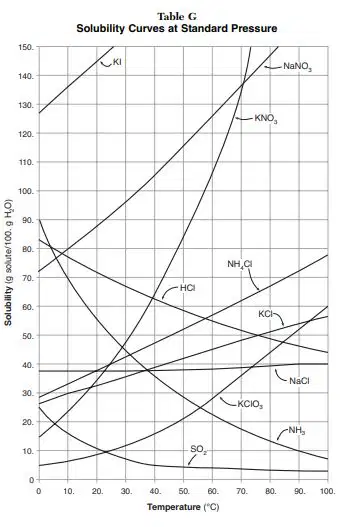
Based on Table G, which solute sample in 100.g of water at 40.°C can produce a solution equilibrium in a closed system?
10. g KClO3
25 g NaCl
45 g KCl
55 g KNO3

A sample of normal rainwater has a pH of 5.6 due to dissolved carbon dioxide gas from the atmosphere. Acid rain is formed when other gases, such as sulfur dioxide, dissolve in rainwater, which can result in lake water with a pH value of 4.6. The equation below represents the reaction of water with SO2(g).
Based on Table G, describe what happens to the solubility of SO2(g) as the temperature increases from 10.oC to 30.oC at standard pressure.
The solubility (a) .

A 100.-gram sample of liquid water is heated from 20.0oC to 50.0oC. Enough KClO3(s) is dissolved in the sample of water at 50.0oC to form a saturated solution.
Based on Table G, determine the mass of KClO3(s) that must dissolve to make a saturated solution in 100. g of H2O at 50.0oC.
(a)
At 23oC, 85.0 grams of NaNO3(s) are dissolved in 100. grams of H2O(l).
Based on Table G, determine the additional mass of NaNO3(s) that must be dissolved to saturate the solution at 23oC.
(a)
According to Table G, which substance forms an unsaturated solution when 80. grams of the substance are stirred into 100. grams of H2O at 10.°C?
KNO3
KI
NH3
NaCl

A solution is made by dissolving 70.0 grams of KNO3(s) in 100. grams of water at 50.°C and standard pressure.
Determine the number of additional grams of KNO3 that must dissolve to make this solution saturated.
(a)
Using Reference Table G, determine the minimum mass of NaCl that must be dissolved in 200. grams of water to produce a saturated solution at 90.°C.
(a)
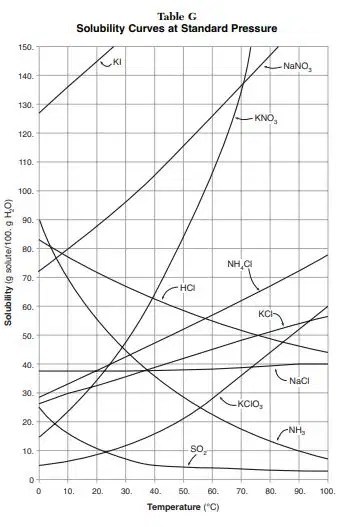
At standard pressure, what is the temperature at which a saturated solution of NH4Cl has a concentration of 60. g NH4Cl/100. g H2O?
66°C
57°C
22°C
17°C
In a laboratory investigation, ammonium chloride was dissolved in water. Laboratory procedures and corresponding observations made by a student during the investigation are shown in the table below.
State evidence from the investigation that indicates the NH4Cl(aq) solution is saturated.

Determine the mass of KNO3 that dissolves in 100. grams of water at 40.°C to produce a saturated solution.
(a)
After being thoroughly stirred at 10.°C, which mixture is heterogenous?
25.0 g of KCl and 100. g of H2O
25.0 g of KNO3 and 100. g of H2O
25.0 g of NaCl and 100. g of H2O
25.0 g of NaNO3 and 100. g of H2O
Baking soda, NaHCO3, can be commercially produced during a series of chemical reactions called the Solvay process. In this process, NH3(aq), NaCl(aq), and other chemicals are used to produce NaHCO3(s) and NH4Cl(aq).
To reduce production costs, NH3(aq) is recovered from NH4Cl(aq) through a different series of reactions. This series of reactions can be summarized by the overall reaction represented by the unbalanced equation below.
NH4Cl(aq) + CaO(s) → NH3(aq) + H2O() + CaCl2(aq)
Determine the mass of NH4Cl that must be dissolved in 100. grams of H2O to produce a saturated solution at 70.°C.
(a)

Ammonium chloride is dissolved in water to form a 0.10 M NH4Cl(aq) solution. This dissolving process is represented by the equation below.
Determine the minimum mass of NH4Cl(s) required to produce a saturated solution in 100. grams of water at 40.°C.
(a)
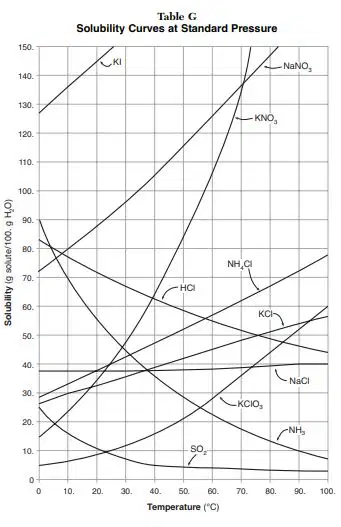
What is the mass of KNO3(s) that must dissolve in 100. grams of water to form a saturated solution at 50.°C?
(a)
At standard pressure, which substance becomes less soluble in water as temperature increases from 10.°C to 80.°C?
HCl
KCl
NaCl
NH4Cl
Which compound becomes less soluble in water as the temperature of the solution is increased?
HCl
KCl
NaCl
NH4Cl
What is the total mass of KNO3 that must be dissolved in 50. grams of H2O at 60.°C to make a saturated solution?
32 g
53 g
64 g
106 g
Determine the mass of KNO3 that dissolves in 100. grams of water at 40.°C to produce a saturated solution.
(a)
After being thoroughly stirred at 10.°C, which mixture is heterogenous?
25.0 g of KCl and 100. g of H2O
25.0 g of KNO3 and 100. g of H2O
25.0 g of NaCl and 100. g of H2O
25.0 g of NaNO3 and 100. g of H2O
Baking soda, NaHCO3, can be commercially produced during a series of chemical reactions called the Solvay process. In this process, NH3(aq), NaCl(aq), and other chemicals are used to produce NaHCO3(s) and NH4Cl(aq).
To reduce production costs, NH3(aq) is recovered from NH4Cl(aq) through a different series of reactions. This series of reactions can be summarized by the overall reaction represented by the unbalanced equation below.
NH4Cl(aq) + CaO(s) → NH3(aq) + H2O() + CaCl2(aq)
Determine the mass of NH4Cl that must be dissolved in 100. grams of H2O to produce a saturated solution at 70.°C.
(a)

Ammonium chloride is dissolved in water to form a 0.10 M NH4Cl(aq) solution. This dissolving process is represented by the equation below.
Determine the minimum mass of NH4Cl(s) required to produce a saturated solution in 100. grams of water at 40.°C.
(a)
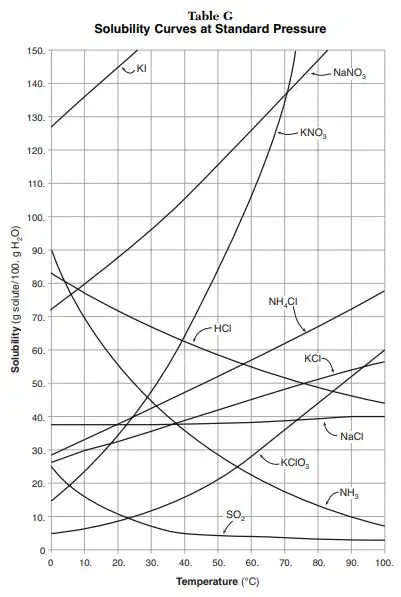
What is the mass of KNO3(s) that must dissolve in 100. grams of water to form a saturated solution at 50.°C?
(a)
At standard pressure, which substance becomes less soluble in water as temperature increases from 10.°C to 80.°C?
HCl
KCl
NaCl
NH4Cl

A scientist makes a solution that contains 44.0 grams of hydrogen chloride gas, HCl(g), in 200. grams of water, H2O(), at 20.°C. This process is represented by the balanced equation below.
HCl --> H+ + Cl-
Based on Reference Table G, identify, in terms of saturation, the type of solution made by the scientist.
(a) solution.
Which compound becomes less soluble in water as the temperature of the solution is increased?
HCl
KCl
NaCl
NH4Cl
What is the total mass of KNO3 that must be dissolved in 50. grams of H2O at 60.°C to make a saturated solution?
32 g
53 g
64 g
106 g
In a laboratory, a student makes a solution by completely dissolving 80.0 grams of KNO3(s) in 100.0 grams of hot water. The resulting solution has a temperature of 60.°C. The room temperature in the laboratory is 22°C.
Classify, in terms of saturation, the type of solution made by the student. (a) solution.
A solution is made by completely dissolving 90. grams of KNO3(s) in 100. grams of water in a beaker. The temperature of this solution is 65°C.
Determine the total mass of KNO3(s) that settles to the bottom of the beaker when the original solution is cooled to 15°C.
(a)
Which term is used to express the concentration of an aqueous solution?
parts per million
heat of fusion
pressure at 0°C
volume at 0°C
How many milliliters of 1 M HCl(aq) must be diluted with water to make exactly 500 mL of 0.1 M HCl(aq)?
10 mL
50 mL
100 mL
5000 mL
Which unit can be used to express the concentration of a PbCl2(aq) solution?
kelvins
kilojoules per gram
pascals
parts per million
One sample of tap water contains dissolved ions such as Ca2+(aq), Mg2+(aq), and CO32-(aq). A 150.-gram sample of this tap water contains 0.000 75 gram of CaCO3(aq). When these ions in the tap water are present in greater concentrations, the water is called hard water. The hard water can damage water pipes and water heaters by producing large deposits of solid calcium carbonate, known as scale. Some homeowners have a water softener to replace positive ions, such as Ca2+(aq) and Mg2+(aq), in hard water with sodium ions, Na+(aq).
Determine the parts per million of CaCO3 in the tap water sample.
(a)
What is the molarity of 2.0 liters of an aqueous solution that contains 0.50 mole of potassium iodide, KI?
1.0 M
2.0 M
0.25 M
0.50 M
What is the molarity of 0.50 liter of an aqueous solution that contains 0.20 mole of NaOH (gram-formula mass = 40. g/mol)?
0.10 M
0.20 M
2.5 M
0.40 M
A solution contains 25 grams of KNO3 dissolved in 200. grams of H2O. Which numerical setup can be used to calculate the percent by mass of KNO3 in this solution?


A solution is prepared using 0.125 g of glucose, C6H12O6, in enough water to make 250. g of total solution. The concentration of this solution, expressed in parts per million, is
5.00 × 101 ppm
5.00 × 10² ppm
5.00 × 10³ ppm
5.00 × 10⁴ ppm
What is the concentration of an aqueous solution that contains 1.5 moles of NaCl in 500. milliliters of this solution?
0.30 M
0.75 M
3.0 M
7.5 M
What is the concentration of an aqueous solution that contains 1.5 moles of NaCl in 500. milliliters of this solution?
0.30 M
0.75 M
3.0 M
7.5 M
What is the molarity of a solution that contains 0.500 mole of KNO3 dissolved in 0.500-liter of solution?
1.00 M
2.00 M
0.500 M
4.00 M
What is the concentration of AgCl in an aqueous solution that contains 1.2 X 10⁻³ gram of AgCl in 800. grams of the solution?
1.2 ppm
1.5 ppm
7.2 ppm
9.6 ppm
Which expression could represent the concentration of a solution?
3.5 g
3.5 M
3.5 mL
3.5 mol
Parts per million is used to express the
atomic mass of an element
concentration of a solution
volume of a substance
rate of heat transfer
An aqueous solution has a mass of 490 grams containing 8.5 × 10⁻³ gram of calcium ions. The concentration of calcium ions in this solution is
4.3 ppm
8.5 ppm
17 ppm
34 ppm
The concentration of a solution can be expressed in
kelvins
milliliters
joules per kilogram
moles per liter

A 2.50-liter aqueous solution contains 1.25 moles of dissolved sodium chloride. The dissolving of NaCl(s) in water is represented by the equation below.
Determine the molarity of this solution.
(a)
Compared to the freezing point and boiling point of water at 1.0 atm, a 0.5 M aqueous solution of NaCl at 1.0 atm has
a lower freezing point and a lower boiling point
a lower freezing point and a higher boiling point
a higher freezing point and a lower boiling point
a higher freezing point and a higher boiling point
Compared to a 1.0 M NaCl(aq) solution at 1.0 atm, a 2.0 M NaCl(aq) solution at 1.0 atm has
a lower boiling point and a lower freezing point
a lower boiling point and a higher freezing point
a higher boiling point and a lower freezing point
a higher boiling point and a higher freezing point
A beaker contains a dilute sodium chloride solution at 1 atmosphere. What happens to the number of solute particles in the solution and the boiling point of the solution, as more sodium chloride is dissolved?
The number of solute particles increases, and the boiling point increases.
The number of solute particles increases, and the boiling point decreases.
The number of solute particles decreases, and the boiling point increases.
The number of solute particles decreases, and the boiling point decreases.
At standard pressure, the boiling point of an unsaturated NaNO3(aq) solution increases when
the solution is diluted with water
some of the NaNO3(aq) solution is removed
the solution is stirred
more NaNO3(s) is dissolved in the solution
Which sample, when dissolved in 1.0 liter of water, produces a solution with the highest boiling point?
0.1 mole KI
0.2 mole KI
0.1 mole MgCl2
0.2 mole MgCl2
Compared to the boiling point and the freezing point of water at 1 atmosphere, a 1.0 M CaCl2(aq) solution at 1 atmosphere has a
lower boiling point and a lower freezing point
lower boiling point and a higher freezing point
higher boiling point and a lower freezing point
higher boiling point and higher freezing point
A solution consists of 0.50 mole of CaCl2 dissolved in 100. grams of H2O at 25°C. Compared to the boiling point and freezing point of 100. grams of H2O at standard pressure, the solution at standard pressure has
a lower boiling point and a lower freezing point
a lower boiling point and a higher freezing point
a higher boiling point and a lower freezing point
a higher boiling point and a higher freezing point
At standard pressure, how do the boiling point and the freezing point of NaCl(aq) compare to the boiling point and the freezing point of H2O(l)?
Both the boiling point and the freezing point of NaCl(aq) are lower.
Both the boiling point and the freezing point of NaCl(aq) are higher.
The boiling point of NaCl(aq) is lower, and the freezing point of NaCl(aq) is higher.
The boiling point of NaCl(aq) is higher, and the freezing point of NaCl(aq) is lower.

The table below gives information about four aqueous solutions at standard pressure.
Which list of solutions is arranged in order from highest boiling point to lowest boiling point?
A, B, D, C
A, C, B, D
C, D, B, A
D, B, C, A
How do the boiling point and freezing point of a solution of water and calcium chloride at standard pressure compare to the boiling point and freezing point of water at standard pressure?
Both the freezing point and boiling point of the solution are higher.
Both the freezing point and boiling point of the solution are lower.
The freezing point of the solution is higher and the boiling point of the solution is lower.
The freezing point of the solution is lower and the boiling point of the solution is higher.
Compared to the freezing point and boiling point of water at 1 atmosphere, a solution of a salt and water at 1 atmosphere has a:
lower freezing point and a lower boiling point
lower freezing point and a higher boiling point
higher freezing point and a lower boiling point
higher freezing point and a higher boiling point
Compared to the freezing point and boiling point of water at 1 atmosphere, a solution of a salt and water at 1 atmosphere has a:
lower freezing point and a lower boiling point
lower freezing point and a higher boiling point
higher freezing point and a lower boiling point
higher freezing point and a higher boiling point
Which aqueous solution of KI freezes at the lowest temperature?
1 mol of KI in 500. g of water
2 mol of KI in 500. g of water
1 mol of KI in 1000. g of water
2 mol of KI in 1000. g of water
Which phrase describes the molarity of a solution?
liters of solute per mole of solution
liters of solution per mole of solution
moles of solute per liter of solution
moles of solution per liter of solution
Which solution has the lowest freezing point?
10. g of KI dissolved in 100. g of water
20. g of KI dissolved in 200. g of water
30. g of KI dissolved in 100. g of water
40. g of KI dissolved in 200. g of water
A 3.0 M HCl(aq) solution contains a total of
3.0 grams of HCl per liter of water
3.0 grams of HCl per mole of solution
3.0 moles of HCl per liter of solution
3.0 moles of HCl per mole of water
Compared to a 2.0 M aqueous solution of NaCl at 1 atmosphere, a 3.0 M aqueous solution of NaCl at 1 atmosphere has a
lower boiling point and a higher freezing point
lower boiling point and a lower freezing point
higher boiling point and a higher freezing point
higher boiling point and a lower freezing point
Compared to a 0.1 M aqueous solution of NaCl, a 0.8 M aqueous solution of NaCl has a
higher boiling point and a higher freezing point
higher boiling point and a lower freezing point
lower boiling point and a higher freezing point
lower boiling point and a lower freezing point
Compared to pure water, an aqueous solution of calcium chloride has a
higher boiling point and higher freezing point
higher boiling point and lower freezing point
lower boiling point and higher freezing point
lower boiling point and lower freezing point
At standard pressure when NaCl is added to water, the solution will have a
higher freezing point and a lower boiling point than water
higher freezing point and a higher boiling point than water
lower freezing point and a higher boiling point than water
lower freezing point and a lower boiling point than water
What occurs when NaCl(s ) is added to water?
The boiling point of the solution increases, and the freezing point of the solution decreases.
The boiling point of the solution increases, and the freezing point of the solution increases.
The boiling point of the solution decreases, and the freezing point of the solution decreases.
The boiling point of the solution decreases, and the freezing point of the solution increases.
Which aqueous solution has the lowest freezing point?
1.0 M C6H12O6
1.0 M C2H5OH
1.0 M CH3COOH
1.0 M NaCl
What is the total number of grams of NaI(s ) needed to make 1.0 liter of a 0.010 M solution?
0.015
0.15
1.5
15
Which solution containing 1 mole of solute dissolved in 1000 grams of water has the lowest freezing point?
KOH(aq)
C2H12O6(aq)
C2H5OH(aq)
C12H22O11(aq)

