
NEW
Font size
 Worksheets
Physics Force Test Review
Total questions: 64
Worksheet time: 50mins
The sum of all forces acting on an object and direction is called the
Balanced Force
Net Force
Unbalanced Force
Contact Force
A push/pull exerted on an object is called a
Force
Momentum
Speed
Net force

Are the forces balanced or unbalanced?
Balanced
Unbalanced
A Newton is a unit of ______.
Acceleration
Inertia
Force
Velocity

Name the missing force.
Gravitational Force
Normal Force
Friction Force
Applied Force

Name the missing force.
Normal Force
Push/Pull Force
Friction Force
Tension Force

Name the missing force.
Normal Force
Friction Force
Gravitational Force
Push/Pull Force
The force that keeps objects on top of surfaces instead of letting them sink into the surface is known as:
Normal Force
Gravitational Force
Friction Force
Air resistance
A leftward force is applied to a crate to push it across the floor at a constant speed. Which is the correct force diagram?


A rightward force is applied to a dresser to accelerate it to the right across the bedroom floor.


Which one of Newton's laws is shown
3rd law
2nd law
1st law

What does this picture represent?
Newton's 1st Law
Newton's 2nd Law
Newton's 3rd Law
All of these

Which one of Newton's laws are displayed
2nd law
1st law
3rd law

Which of Newton's laws is shown
1st law
3rd law
2nd law
What force slows objects down and keeps them from moving?
Acceleration
Gravity
Friction
Net Force
(Using Fnet=ma), What net force is required to accelerate a car at a rate of 2 m/s2 if the car has a mass of 3,000 kg?
6,000 N
1,500 N
3,002 N
2,998 N
(Use Fnet=ma). What is the mass of a falling rock if it produces a force of 147 N? (Acceleration due to gravity = 9.81 m/s2)
15 kg
1,440.6 kg
156.8 kg
137.2 kg
(Use Fnet=ma). What is the acceleration of a softball if it has a mass of 0.5 kg and hits the catcher's mitt with a force of 25 N?
0.5 kg
50 kg
25.5 kg
12.5 kg

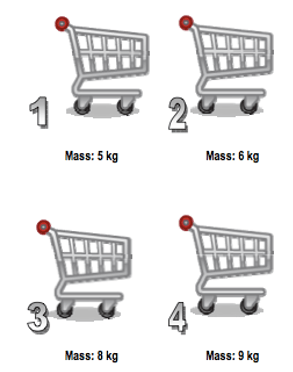
(Use Fnet=ma). Use the diagram to determine the net force, assume the object is accelerating at a rate of 2 m/s2 and determine the mass of the object.
2 kg
4 kg
6 kg
8 kg

(Use Fnet=ma). Use the diagram to determine the net force, assume the object is accelerating at a rate of 3 m/s2, and determine the object's mass?
3 kg
5 kg
60 kg
75 kg
Since Force = Mass * Acceleration, how would you manipulate the equation to solve for acceleration?
Divide both sides of the equation by Mass
Divide both sides of the equation by force
Divide both sides of the equation by acceleration
Equations cannot be manipulated
What do we call a force that has a net force of zero Newtons and the object does not change its motion?
balanced force
unbalanced force
acceleration force
net force
What do we call a force that causes an object to accelerate?
net force
moving force
acceleration force
unbalanced force

What is the magnitude and direction of the force in the free body diagram shown?
70 N right
70 N left
50 N right
50 N left

What is the magnitude and direction of the force in the free body diagram shown?
20 N, no change in motion
20 N right
20 N left
0 N , no change in motion

What is the magnitude and direction of the force in the free body diagram shown?
35 N right
17 N right
11 N right
5 N right

How would the absence of friction affect a marble traveling on a long, straight path?
The marble’s velocity would decrease.
The marble’s would accelerate.
The marble would stop immediately.
The marble would remain at constant velocity.
Determine the coefficient of friction if :FN=100N, Ff=20N
μ=5.0
μ=0.2
μ=1.2
μ=0.1
In what direction does friction act, relative to motion?
in the same direction
in the opposite direction
need more information
depends on the force
A box takes 40. N to start moving when the coefficient of static friction is 0.54. What is the weight of the box?
81 N
18 N
98 N
74 N
Normal force is
Always opposite the weight
Always parallel and down the incline
Always perpendicular to the surface
It depends on the direction of motion

Which of the following is NOT a contact force?
friction
normal force
weight
air resistance
If you have a mass of 72 kg, about how much is your weight?
700 pounds
720 Newtons
72 Newtons
7.2 pounds
A 20 kg bike accelerates at 10 m/s2. What was the force?
30 Newtons
2 Newtons
200 Newtons
10 Newtons

Force of attraction (pulling) between two objects. (Every object experiences this on earth)
gravitational
normal
applied
friction

what is the force acting in the ropes of the swing?
tension
normal reaction
friction
weight
100 N 230 N
<------ --------->
direction

When the vectors (arrows) point away what function do you use?
Dividing
Multiplying
Subtracting
Adding

Assuming this object was originally at rest, will the net force cause an acceleration, (a change in its motion)? If so, in what direction will it accelerate?
No, the net forces are balanced, therefore in equilibrium. The box remains at rest
The forces are not balanced, so the Net force is not in equilibrium, so the box will accelerate to the left.
The forces are not balanced, so the Net force is not in equilibrium, so the box will accelerate up.
The forces are not balanced, so the Net force is not in equilibrium, so the box will accelerate to the right.
The forces are not balanced, so the Net force is not in equilibrium, so the box will accelerate down.


How is this an example of Newton's Third Law?
Only the ball is applying a force to the soccer players head
Only the soccer players head is applying the force to the ball
The are both exerting an equal force on each other

When a cannon fires a cannonball we observe Newton's third law. Which is the reaction force?
The cannon moving forward
the cannon moving backwards
the cannonball moving backwards
The cannonball moving forward
A book rests on a table. The force of gravity pulls down on the book with a force of 20 newtons. What prevents the books from accelerating downward ?
The table presses back up on the book with an equal and opposite force of 20 newtons.
The table presses back up with a force greater than 20 Newtons
The tale and the book together are accelerating downwards at 9.8 m/sec2
The inertia of the book holds it up
FN=100N, Ff=20N
μ=5.0
μ=0.2
μ=1.2
μ=0.1

A 2.50 kg block is held motionless on a rough inclined plane by means of a string attached to a vertical wall as shown in the drawing. θ=15.0 and the string is pulling with 10.0 N. What amount of static friction is present?
6.34 N
10.0 N
3.70 N
0 N


Which of the following is the best expression for the Normal Force?
FN = mg cos(ϴ)
FN = mg sin(ϴ)
FN = mg sin(180-ϴ)
FN = mg cos(90-ϴ)

If there is no friction, then the accelerating force would be equal to
mg
sin(θ)mg
g
sin(θ)g

