wayground logo

Free Printable Worksheets

NEW

Font size

S
M
L
XL
Worksheets

Respiratory Test Review Questions

Total questions: 55

Worksheet time: 28mins

Name
Class
Date
1.

What happens to the volume of the chest cavity during inhalation?

a)

It remains unchanged

b)

It decreases

c)

It increases

2.
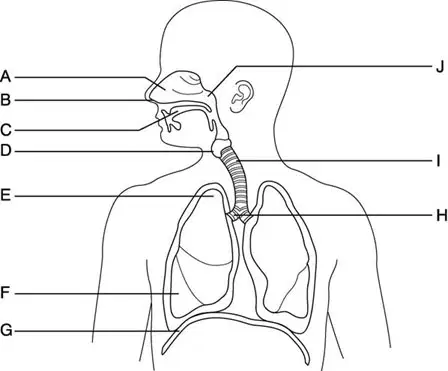
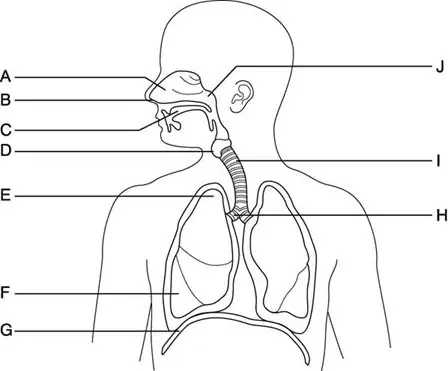
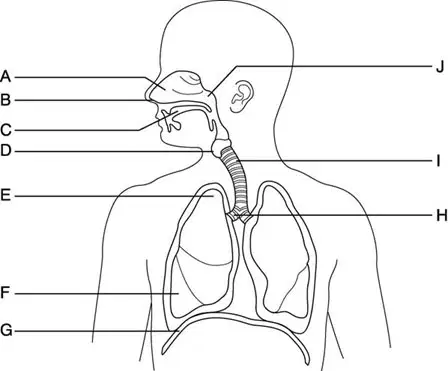
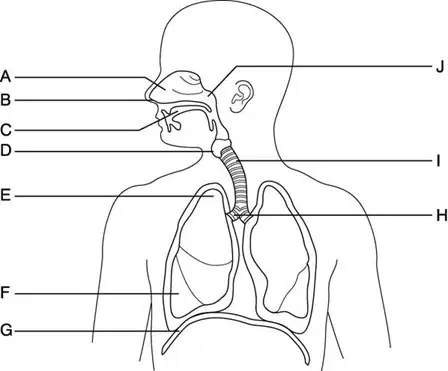
The larynx is indicated by the letter __.
a)
C
b)
D
c)
H
d)
I
e)
J
3.
The trachea is indicated by the letter__:
a)
A
b)
D
c)
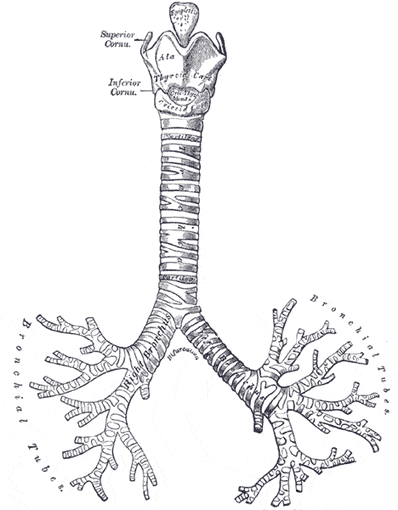
E
d)
H
e)
I
4.
The diaphragm muscle is indicated by the letter__:
a)
A
b)
D
c)
G
d)
H
e)
J
5.
The pharynx is indicated by the letter __.
a)
A
b)
D
c)
G
d)
H
e)
J
6.
The membrane that surrounds the lungs is known as:
a)
the peritoneum
b)
the pleura
c)
the pericardium
d)
the meniges
7.
The trachea is:
a)
a passageway for food and air
b)
held open by rings of cartilage
c)
a muscular tube that collapses when empty
d)
none of the choices
8.

Which of the following is a region of the pharynx?

a)

auditory pharynx

b)

nasopharynx

c)

middle pharynx

d)

upper pharynx

9.
The vocal cords are located in the:
a)
nasopharynx
b)
larynx
c)
laryngopharynx
d)
oropharynx
10.
The substance that prevents lung collapse by lowering the surface tension of the water film lining each alveolar sac is called:
a)
resorbin
b)
surfactant
c)
renin
d)
lecithin
e)
fibrosin
11.
The superior portion of the pharynx is called the:
a)
oropharynx
b)
nasopharynx
c)
laryngopharynx
d)
tracheopharynx
12.
Carbon dioxide and oxygen are exchanged across the respiratory membrane by the process known as:
a)
active transport
b)
simple diffusion
c)
pinocytosis
d)
osmosis
13.
The windpipe is the
a)
bronchi
b)
trachea
c)
larynx
d)
pharynx
e)
alveoli
14.
The total amount of exchangeable air is the:
a)
Tidal volume
b)
Vital capacity
c)
Inspiratory reserve volume
d)
Expiratory reserve volume
15.
The cartilage flap that closes the trachea during swallowing is called the __.
a)
glottis
b)
epiglottis
c)
uvula
d)
hyoid
16.
The __prevents food and drink from entering the larynx when swallowing.
a)
glottis
b)
epiglottis
c)
uvula
d)
nasopharynx
17.
The small sacs in the lungs where gas exchange occurs are the:
a)
bronchi
b)
epiglottis
c)
alveoli
d)
intercostals
18.
The nasal cavity is separated from the oral cavity by the:
a)
the nasal conchae
b)
the hard palate
c)
both the hard and the soft palate
d)
the uvula
e)
both the nasal conchae and the soft palate
19.
The main muscles involved in inhalation are:
a)
diaphragm and latissimus dorsi
b)
intercostals and pectoralis major
c)
intercostals and diaphragm
d)
rectus abdominis and pectoralis major
e)
both the nasal conchae and the soft palate
20.
Tidal volume is air:
a)
forcibly expelled after normal expiration
b)
inhaled after normal inspiration
c)
exchanged during normal breathing
d)
remaining in lungs after forced expiration
21.
Most inspired particles such as dust fail to reach the lungs because of the:
a)
ciliated mucous lining in the nose
b)
abundant blood supply to nasal mucosa
c)
porous structure of turbinate bones
d)
action of the epiglottis
22.
Respiratory control centers are located in the:
a)
upper spinal cord and medulla
b)
medulla and pons
c)
pons and cerebellum
d)
spinal cord and medulla
23.
The amount of air remaining in the lungs even after the greatest possible expiratory effort is the
a)
expiratory reserve volume
b)
residual volume
c)
dead space volume
d)
vital capacity
24.
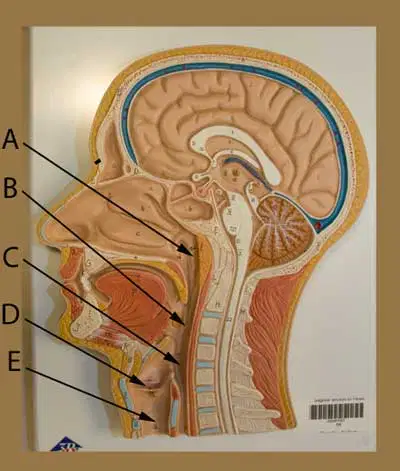
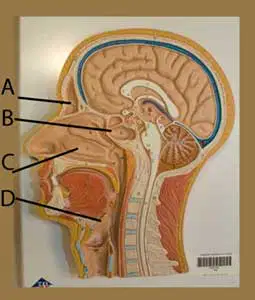
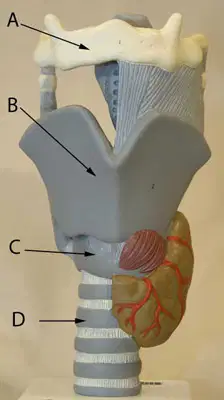
Identify the structure labeled "B."
a)
bronchus
b)
trachea
c)
pharynx
d)
larynx
25.
On expiration, air in the structure labeled "A" will enter which structure next?
a)
trachea
b)
nasal cavity
c)
pharynx
d)
larynx
26.
Structures "A," "B," and "C" are all parts of the same structure. Name this structure.
a)
trachea
b)
epiglottis
c)
pharynx
d)
larynx
27.
On inspiration, air entering structure "E" will enter which structure next?
a)
trachea
b)
lung
c)
pharynx
d)
larynx
e)
bronchi
28.
Identify the structure labeled "C."
a)
oral cavity
b)
nostril
c)
pharynx
d)
nasal cavity
29.
The structures labeled "B" and "C" are both parts of the same structure. Name this structure.
a)
trachea
b)
esophagus
c)
pharynx
d)
larynx
e)
bronchus
30.

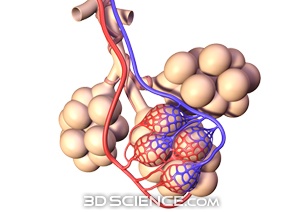
Microscopic sacs where gas exchange takes place; are called:

a)

alveoli

b)

bronchi

c)

villi

31.
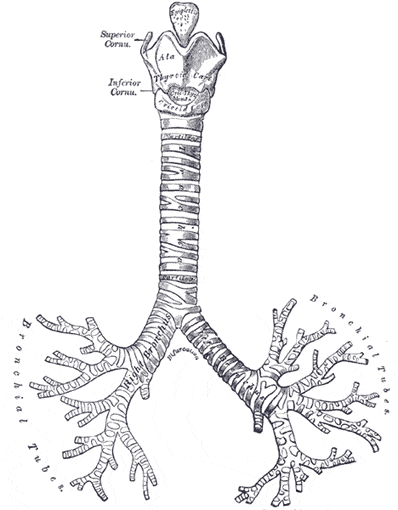
The trachea branches off into two:
a)
Alveoli
b)
Bronchi
c)
Bronchioles
32.
Another name for the throat is called the:
a)
Nasopharynx
b)
Pharynx
c)
Larynx
33.
What important activity takes place in the lungs?
a)
Food is digested
b)
Waste filtered from blood
c)
Oxygen (O2) is exchanged for Carbon Dioxide (CO2)
d)
Trachea is exchanged for the larynx
34.
What is another name for the windpipe?
a)
Lungs
b)
Trachea
c)
Larynx
d)
Esophagus
35.

Which part of the Respiratory System collects air from the environment & heats/moistens the air before entering the body?

a)

lungs

b)

nose

c)

heart

d)

mouth

36.

Which is not a job of the respiratory system?

a)

taking in oxygen

b)

taking in carbon dioxide

c)

moisten air

d)

transport glucose

37.

Which system shares the pharynx with the respiratory system?

a)

circulatory

b)

digestive

c)

excretory

d)

skeletal

38.

A small flap of tissue that covers the trachea when swallowing is called the

a)

bronchi

b)

larynx

c)

pharynx

d)

epiglottis

39.

What is labeled at E?

a)

bronchi

b)

trachea

c)

pharynx

d)

none of the above

40.
The Bronchi branch out into many different smaller tubes which take oxygen to the alveoli. What are these tiny tubes called?
a)
Trachea
b)
Larynx
c)
Pharynx
d)
Bronchioles
41.
Where are your vocal cords located?
a)
Nose
b)
Lungs
c)
Larynx
d)
Alveoli
42.
Given the following structures:
1. larynx
2. nasal cavity
3. pharynx
4. trachea
Which of the following is the correct order that air would flow during inhalation. 
a)
1,2,3,4
b)
2,3,1,4
c)
2,1,3,4
d)
4,2,3,1 
43.
The two main branches from the trachea (one to each lung)
a)
bronchi
b)
alveoli
c)
capillaries
d)
bronchioles
44.
The air sacs that are covered with capillaries where gas exchange takes place
a)
bronchi
b)
lungs
c)
oxygen
d)
alveoli
45.

Name the organ label # 6.

a)

alveoli

b)

bronchi

c)

trachea

d)

lungs

46.
What is tube that is also known as your wind pipe?
a)
esophogus
b)
bronchi
c)
trachea
d)
alveoli
47.

Name the structure labeled 8

a)

lungs

b)

trachea

c)

diaphragm

d)

alveoli

48.
The passageway that is shared by both the digestive and respiratory system is the....
a)
larynx
b)
pharynx
c)
trachea
d)
nose
49.

Specialist cells in the bronchioles have structures on them called

a)

alveoli

b)

cilia

c)

dermacytes

d)

erythrocytes

50.

Why do you need mucous membranes in the bronchioles?

a)

to help the food go down smoothly

b)

to stop the air irritating them

c)

to help air pass through

d)

to trap and remove foreign particles

51.

The exchange of oxygen and carbon dioxide in the alveoli is through a process called

a)

active transport

b)

conduction

c)

convection

d)

diffusion

52.
Tiny tubes that branch off of bronchi
a)
capillaries
b)
alveoli
c)
bronchioles
d)
pluera
53.

When air is leaving the lungs, after it passes through the bronchioles it will next enter the

a)

alveoli

b)

bronchi

c)

larynx

d)

trachea

54.

Which of the following is not a function of the sinus cavities?

a)

Lighten skull

b)

Purify air

c)

Act as a resonance chamber for speech

d)

Produce mucus

55.

Which part of the pharynx is most superior?

a)

laryngopharynx

b)

nasopharynx

c)

oropharynx

d)

alveolarpharynx