wayground logo

Free Printable Worksheets

Font size

S
M
L
XL
Worksheets

Biomolecules/Enzymes/Pro vs. Eu

Total questions: 60

Worksheet time: 34mins
Name
Class
Date
1.
Which biomolecule contains pastas and breads?
a)
Lipid
b)
Protein
c)
Nucleic Acid
d)
Carbohydrate
2.
Which biomolecule helps form body structures like muscles?
a)
Nucleic Acid
b)
Carbohydrate
c)
Protein
d)
Lipids
3.
Which biomolecule is responsible for insulation and long term energy storage?
a)
Protein
b)
Nucleic Acid
c)
Lipid
d)
Carbohydrate
4.
Which biomolecule includes sugars, cellulose and starch?
a)
Lipids
b)
Proteins
c)
Carbohydrates
d)
Nucleic Acid
5.
Which biomolecule is made of the monomer amino acids?
a)
Nucleic Acid
b)
Carbohydrate
c)
Protein
d)
Lipid
6.
Which biomolecule is your main source of energy?
a)
Nucleic Acid
b)
Protein
c)
Lipid
d)
Carbohydrate
7.
Which biomolecule contains fats, oils, and waxes?
a)
Proteins
b)
Nucleic Acid
c)
Lipids
d)
Carbohydrate
8.
The monomer of a protein is called...
a)
an amino acid
b)
a monosaccharide
c)
a fatty acid
d)
a nucleotide
9.
Enzymes are considered to be 
a)
Lipids
b)
Carbohydrate
c)
Protein
d)
Nucleic Acid
10.
What is the purpose  of an enzyme?
a)
give permission for the reaction
b)
raise activation energy
c)
speed up reactions
d)
control how many reactions occur
11.
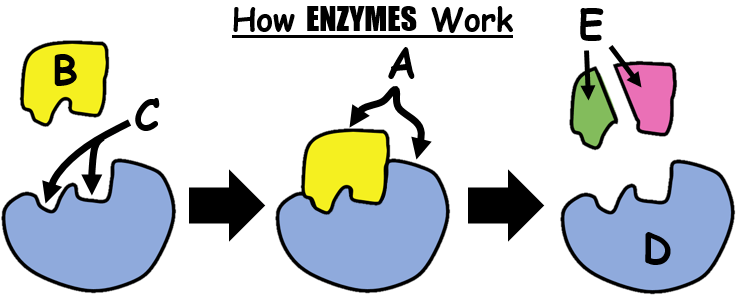
Letter D in the picture is...
a)
active site
b)
enzyme
c)
substrate
d)
products
12.
The enzyme known as ‘catalase’ is involved in the breakdown of hydrogen peroxide molecules into separate water and oxygen molecules. During this reaction, what happens to the ‘catalase’?
a)
The enzyme would become products: O2 and H20
b)
The enzyme would be fully used up and discarded.
c)
The enzyme would remain unchanged in any way.
d)
The enzyme would become a new type of enzyme.
13.
What is being represented by the letter A in the image?
a)
Substrate
b)
Enzyme
c)
Product
d)
Complex
14.
What is being represented by the letter B in the image?
a)
Active Site
b)
Enzyme
c)
Substrate
d)
Product
15.
The part of the enzyme that the substrate bonds to is called the _____.
a)
active site
b)
activation energy
c)
bond site
d)
dehydration synthesis
16.
What makes an enzyme substrate specific?
a)
Size
b)
Shape
c)
Name
d)
Location it is found in
17.
Enzymes need certain environmental conditions in order to function properly.  What happens when enzymes are heated to a high temperature?
a)
they die
b)
they denature (change shape)
c)
they change their amino acid sequence
d)
they work better
18.

What is the shape of DNA?

a)

Double Hyperbola

b)

Paraolic

c)

Double Helix

d)

Linear

19.

The monomers of nucleic acids are

a)

nucleotides

b)

amino acids

c)

glucose

d)

monosaccharides

20.

Pick 2 functions of proteins:

a)

muscle movement

b)

quick energy

c)

act as enzymes

d)

long term energy

21.

Functional proteins can act as: (pick 2)

a)

enzymes

b)

starches

c)

fatty acid

d)

hormones

22.

The two types of nucleic acids are:

a)

DNA

b)

NA

c)

RNA

d)

TNT

23.

What is the main function of DNA?

a)

store lipids

b)

store genetic information

c)

reproduction

d)

makes carbohydrates

24.

Which biomolecule is responsible for insulation and long-term energy storage?

a)
Protein
b)
Nucleic Acid
c)
Lipid
d)
Carbohydrate
25.

Enzymes help reactions take place in our body, what are they best classified as?

a)

Lipid

b)

Carbohydrate

c)

Protein

d)

Nucleic Acid

26.

_________ are utilized as a form of fast energy source. ________ provide longer term energy and storage.

a)

carbohydrates, lipids

b)

lipids, carbohydrates

c)

protein, carbohydrates

27.

A major component of the cell membrane is made of which biomolecule?

a)

Lipid

b)

Nucleic Acid

c)

Protein

d)

Carbohydrate

28.

DNA and RNA are classified as....

a)

Lipids

b)

Carbohydrates

c)

Nucleic Acids

d)

Protein

29.

What is the monomer of Proteins?

a)

Monosaccharides

b)

Amino Acids

c)

Nucleotides

d)

Glycerol/Fatty Acids

30.

What is the monomer of Nucleic Acids?

a)

Monosaccharides

b)

Amino Acids

c)

Nucleotides

d)

Glycerol/Fatty Acids

31.

Many carbohydrates tend to end in......

a)

"ose"

b)

"ase"

c)

"ing"

d)

"ain"

32.

Glucose is a sugar that provides quick energy it would best be classified as...

a)

Carbohydrate

b)

Protein

c)

Nucleic Acid

d)

Lipids

33.

Plant cell walls consist of cellulose, what is it best classified as.

a)

Carbohydrate

b)

Protein

c)

Nucleic Acid

d)

Lipids

34.

Functions can include building cell wall and being a form of quick energy....

a)

Carbohydrates

b)

Proteins

c)

Nucleic Acid

d)

Lipids

35.

Functions can include providing structure, aiding in muscle movement, and aiding reactions.....

a)

Carbohydrates

b)

Proteins

c)

Nucleic Acid

d)

Lipids

36.

Functions include containing the genetic information and providing the instructions or blueprints for traits.

a)

Carbohydrates

b)

Proteins

c)

Nucleic Acid

d)

Lipids

37.

Functions can include being long term energy, insulation, and component of the plasma membrane.

a)

Carbohydrates

b)

Proteins

c)

Nucleic Acid

d)

Lipids

38.

The following image shows a source of.....

a)

Carbohydrates

b)

Proteins

c)

Nucleic Acids

d)

Lipids

39.

The following image shows a source of.....

a)

Carbohydrates

b)

Proteins

c)

Nucleic Acids

d)

Lipids

40.

The following image shows a source of.....

a)

Carbohydrates

b)

Proteins

c)

Nucleic Acids

d)

Lipids

41.

Monomers are....

a)

the smaller building blocks for biomolecules

b)

the complex components for biomolecules

c)

the finalizing step to building biomolecules

42.

Prokaryotes have NO...

a)

Nucleus

b)

Membrane Bound Organelles

c)

They have both

d)

They have neither

43.

Eukaryotes DO have...

a)

Nucleus

b)

Membrane Bound Organelles

c)

They have both

d)

They have neither

44.

This is a...

a)

Prokaryotic Cell

b)

Eukaryotic Cell

c)

Neither

45.

This is a...

a)

Prokaryotic Cell

b)

Eukaryotic Cell

c)

Neither

46.
Plants and animal cells are examples of ___ cells 
a)
prokaryotic cells 
b)
eukaryotic cells 
47.

Bacteria is an example of a(n)

a)

prokaryotic cell.

b)

eukaryotic cell.

48.

Which type of cells have DNA?

a)

Eukaryote

b)

Prokaryote

c)

Both

49.
What is the purpose  of an enzyme?
a)
give permission for the reaction
b)
raise activation energy
c)
speed up reactions
d)
control how many reactions occur
50.
Where do substrates bind on an enzyme?
a)
voltage-gated channels
b)
surface receptor
c)
calcium channels
d)
active site
51.
What is structure A?
a)
Substrate
b)
Active site
c)
Enzyme
d)
Products
52.
What is the name for the mechanism of enzyme activity?
a)
Lock and key
b)
jigsaw puzzle
c)
hammer and nail
d)
two hands pattern
53.
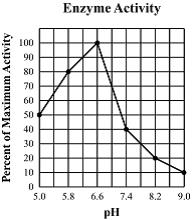
Which of the following conclusions can be drawn from this graph?
a)
The optimum pH of the enzyme is 6.6.
b)
The optimum pH of the enzyme is 5.8
c)
The enzyme’s activity increases as pH increases 5.0 to 9.0
d)
The enzyme’s activity is greater around pH of 8.0 .
54.
What makes an enzyme substrate specific?
a)
Size
b)
Shape
c)
Name
d)
Location it is found in
55.
The part of the enzyme that the substrate bonds to is called the _____.
a)
active site
b)
activation energy
c)
bond site
d)
peptide bond
56.

Can be a component (a part of) in the exoskeleton of some animals known as chitin.

a)

Carbohydrate

b)

Lipid

57.

Produced in the leaves of plants as a product of photosynthesis, also known as glucose.

a)

Carbohydrate

b)

Lipid

58.

Our bodies consume this biomolecule for readily available energy or quick energy.

a)

Carbohydrate

b)

Lipid

59.

Can be found surrounding our cells as the lipid bilayer, or the cell membrane.

a)

Carbohydrate

b)

Lipid

60.

Animals located at the north and south poles of our planet typically have a layer of this biomolecule formally known as blubber. Blubber helps keep the animal insulated or warm. This is a-

a)

Carbohydrate

b)

Lipid