Wayground logo

Free Printable Worksheets

Font size

S
M
L
XL
Worksheets

5th Grade Science Review

Total questions: 47

Worksheet time: 35mins

Name
Class
Date
1.

The 3 physical states of matter are:

a)

rock, paper, scissors

b)

solid, liquid, gas

c)

metal, glass, wood

d)

solid, liquid, glass

2.

A liquid does not have a definite____ but does have definite____.

a)

shape and volume

b)

flavor and color

c)

volume and mass

d)

mass and weight

3.

A ______ is a type of mixture in which the particles of one or more substances are dissolved.

a)

solution

b)

mixture

c)

density

d)

solubility

4.

When a substance spreads out uniformly in a liquid it means that the substance can _______.

a)

melt

b)

freeze

c)

evaporate

d)

dissolve

5.

A combination of 2 or more substances than can easily be separated is a ______.

a)

density

b)

volume

c)

mixture

d)

soluble

6.

Properties of matter that can be observed, measured, or changed without changing the matter itself are _______.

a)

obvious properties

b)

physical properties

c)

matter properties

d)

states of matter

7.

A solution is a mixture that cannot be easily separated, evenly dissolves, and does not maintain its physical properties.

a)

True

b)

False

c)

Could be

d)

I have no idea

8.

Look at the examples of physical changes. Which combination below is a physical change?

a)

breaking a pencil

b)

kool aide

c)

baking a cake with 4 different ingredients

d)

strawberry milkshake

9.

If you want to create a solution, which items would you use?

a)

water, sugar and lemon juice

b)

milk and cheerios

c)

water and sand

d)

marshmallows and chocolate chips

10.

A mixture is made up of 2 or more substances that can be

a)

eaten fast

b)

put in the microwave

c)

separated easily

d)

easily dissolved

11.

Pick the mixture

a)

cheerios, chocolate chips, and marshmallows

b)

salt, water

c)

oil, water, and blue food coloring

d)

milk and cerial

12.

Boiling point is at

a)

100°C

b)

100°F

c)

75°C

d)

75°F

13.

Melting point is at

a)

35°C

b)

0°C

c)

75°F

d)

0°F

14.

Freezing point is at

a)

0°F

b)

100°C

c)

35°F

d)

0°C

15.

Look at the items listed and their physical properties.

Which item can be cardboard?

a)

1

b)

2

c)

3

d)

4

16.

Look at the items listed and their physical properties. Which item can be glass?

a)

1

b)

2

c)

3

d)

4

17.

The process of changing from gas to liquid is called

a)

ice

b)

evaporation

c)

condensation

d)

matter

18.

When heat is added to a liquid, the liquid

a)

water will evaporate

b)

you make hot tea

c)

the liquid will freeze

d)

the liquid will melt

19.

You fill 3 graduated cylinders with 50ml of water in each and place them in 3 different places- fridge, desk, and by sunny window. Which one will have the water evaporate quicker?

a)

fridge

b)

window

c)

desk

d)

they all evaporate at the same time

20.

You're going to the beach and want to separate different mixtures. Which will you be able to separate using your strainer.

a)

the salt from the water

b)

the different grains of sand

c)

sand and water

d)

sugar and coffee

21.
When sediments stick together its called . . . 
a)
cementation
b)
compaction
c)
deposition
d)
erosion
22.
How many steps in the process make sedimentary rock?
a)
3
b)
5
c)
6
d)
4
23.
Erosion is one of the processes involved in the formation of sedimentary rock. Which of these best describes the process of erosion?
a)
Rocks are broken into smaller pieces that remain in the same location.
b)
Pressure compacts layers of sediment and turns them into rock.
c)
Pieces of rock or soil are carried from one place to another.
d)
Sediment grains fall to the bottom of a lake to form sedimentary layers.
24.
You are working in the lab using glassware. Your partner drops a glass beaker and it shatters. A piece of glass gets in his eyes. What should he have been wearing?
a)
A. Gloves
b)
B. Sun glasses
c)
C. Safety Goggles
d)
 D. A lab aporn
25.
You are working in the lab using glassware. Your partner drops a glass beaker and it shatters. A piece of glass gets in his eyes. What should he have been wearing?
a)
A. Gloves
b)
B. Sun glasses
c)
C. Safety Goggles
d)
 D. A lab aporn
26.
A ball is moving in a certain direction.  What would happen to the ball if a greater force was applied on the ball along its direction of motion?
a)
The speed of the ball would decrease.
b)
The speed of the ball would increase.
c)
The ball will stop instantly.
d)
The ball will change direction.
27.
A ball is rolled on four different types of materials.  Which material will cause the least amount of friction between it and the ball?
a)
Tile Floor
b)
Carpet
c)
Grass
d)
Cement Sidewalk 
28.

Non-renewable flammable material (coal, oil, natural gas) made from the remains of plants and animals buried in Earth's crust that is burned to produce heat and power

a)

Sedimentary Rock

b)

Fossil Fuels

c)

Igneous Rock

d)

Metamorphic Rock

29.

The Waste and remains of plants and animals

a)

Sediment

b)

Organic Matter

c)

Process

d)

Coal

30.

Coal, oil, natural gas formed over millions of years from deposition of organic matter.

a)

Sedimentary Rock

b)

Fossil Fuels

c)

Natural Resources

d)

Renewable Resources

31.

A solid fossil fuel that is formed from the concentrated remains of plants over a very long period of time.

a)

Oil

b)

Coal

c)

Natural Gas

32.

Fossil fuels formed from the remains of tiny, ancient marine organisms.

a)

Oil

b)

Coal

c)

Natural Gas

d)

Both Oil and Natural Gas

33.
Some students made a model to show one of the first steps in the formation of sedimentary rock.  The students pour 2 cm of light-colored sand into a clear plastic box.  Then they add 1 cm of gravel.  Finally, they pour 2 cm of dark-colored sand on top of the gravel.  Which characteristic of sedimentary rock does this model best show?
a)
Sedimentary rock is made of layers.
b)
Sedimentary rock is cemented bits of rock.
c)
Sedimentary rock is often limestone.
d)
Sedimentary rock is common in Texas.
34.
All of these are related to the formation of oil or natural gas EXCEPT
a)
Decomposed Animals
b)
Decayed Plants
c)
Sedimentary Rocks
d)
Active Volcanoes
35.
Coal often forms where once there was swamps.  What characteristic of swamps is important to the formation of coal?
a)
High Temperature
b)
Abundant Plant Life
c)
Frequent Rains
d)
Reptile Predators
36.
If I have two different sizes of inclines and I use the same marble on the same surface to roll the marble and measure the distance it moves, is this a good investigation or bad investigation?
a)
good
b)
bad
37.

Which statement best states the relationship between mass and gravitational attraction between two objects?

a)

The less mass an object has, the greater its gravitational force.

b)

The more mass an object has, the greater its gravitational force.

c)

The masses of objects do not affect gravitational force

d)

All objects have the same gravitational force.

38.

The_________is the sharp tip of the mountain. A mountain can have one ___________or multiple __________.

a)

summit

b)

peak

c)

crest

d)

mountain

e)

slope

39.

What is the process of moving sediments from location to another?

a)

Deposition

b)

Erosion

c)

Weathering

d)

Compaction

40.
The process of breaking up Earth's surface into sediment is called...
a)
sediment
b)
erosion
c)
weathering
d)
deposition 
41.
Which of these is an example of erosion
a)
Light Shinning onto a mountain
b)
Rain breaking down rock 
c)
Wind blowing away sediment
d)
All of the above
42.
Over long periods of time, deposition may change the Earth’s surface by _____.
a)
forming new land features.
b)
breaking down large rocks into smaller ones.
c)
washing away beaches.
d)
moving topsoil.
43.
The process that breaks down rocks and other materials on Earth's surface is called
a)
Weathering
b)
Erosion
c)
Deposition
d)
Decomposition
44.

Rock that are made of layers of compressed and cemented sediments are called...

a)

regular sedimentary rock

b)

chemical sedimentary rock

c)

clastic sedimentary rock

d)

school house rock

45.
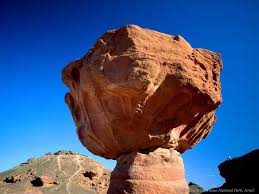
What is this landform?
a)
mountain
b)
canyon
c)
coast
d)
cliff
46.

A type of rock that forms when existing rock is weathered, eroded, and deposited in layers on land or underwater.

a)

Sedimentary Rock

b)

Igneous Rock

c)

Metamorphic Rock

d)

Soft Rock

47.
Use the diagram and relative dating to determine what is the oldest layer. 
a)
The bottom layer will contain the oldest fossils
b)
The top layer will contain the oldest fossils
c)
It is impossible to tell which layer contains the oldest fossils with out absolute dating
d)
Layer A and C contain fossils from the same period